
Fri Sep 20 17:53:40 UTC 2024: ## NPS Vatsalya: A New Scheme for Children’s Retirement, But Is It the Best Choice?
**New Delhi, India:** The Indian government’s latest pension scheme, NPS Vatsalya, aims to help parents plan for their children’s retirement. Launched in September 2023, this scheme allows parents to invest in their children’s names up to the age of 18. Once the child turns 18, the account transitions to a regular NPS account.
While the scheme is designed to encourage long-term savings for retirement, some financial experts are questioning its practicality and suitability for meeting children’s immediate needs.
**The Pros and Cons of NPS Vatsalya:**
**Pros:**
* **Early Start:** The scheme offers a head start on retirement planning, allowing parents to contribute even small amounts from a young age.
* **Potential for High Returns:** NPS Vatsalya allows for up to 75% equity allocation, potentially generating higher returns over the long term.
* **Tax Benefits:** Contributions to NPS are eligible for tax deductions under Section 80C.
**Cons:**
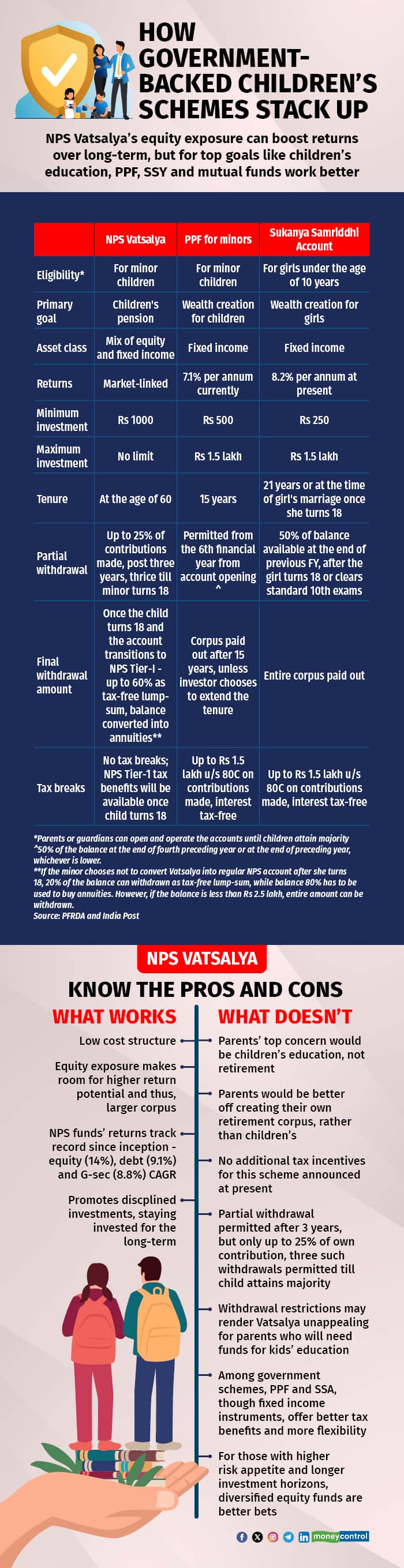
* **Limited Access:** Partial withdrawal of up to 25% of contributions is allowed after a three-year lock-in period, but not the entire account balance, potentially limiting its use for education expenses.
* **Prioritization:** Parents may already be struggling to save for their own retirement and prioritize their children’s education, making it difficult to dedicate funds to a long-term retirement scheme.
* **Alternatives:** Popular schemes like PPF and Sukanya Samriddhi, while offering lower potential returns, offer higher certainty and flexibility for education expenses.
**Experts Weigh In:**
Financial experts highlight the importance of prioritizing education savings over retirement planning for children in the short-term. They suggest using PPF, Sukanya Samriddhi, or diversified mutual funds to build an education corpus.
**Conclusion:**
NPS Vatsalya provides a new avenue for long-term retirement planning for children, but it may not be the best choice for meeting immediate educational needs. Parents need to carefully weigh their financial priorities and consider alternative options for ensuring their children’s future.
 First Piper