
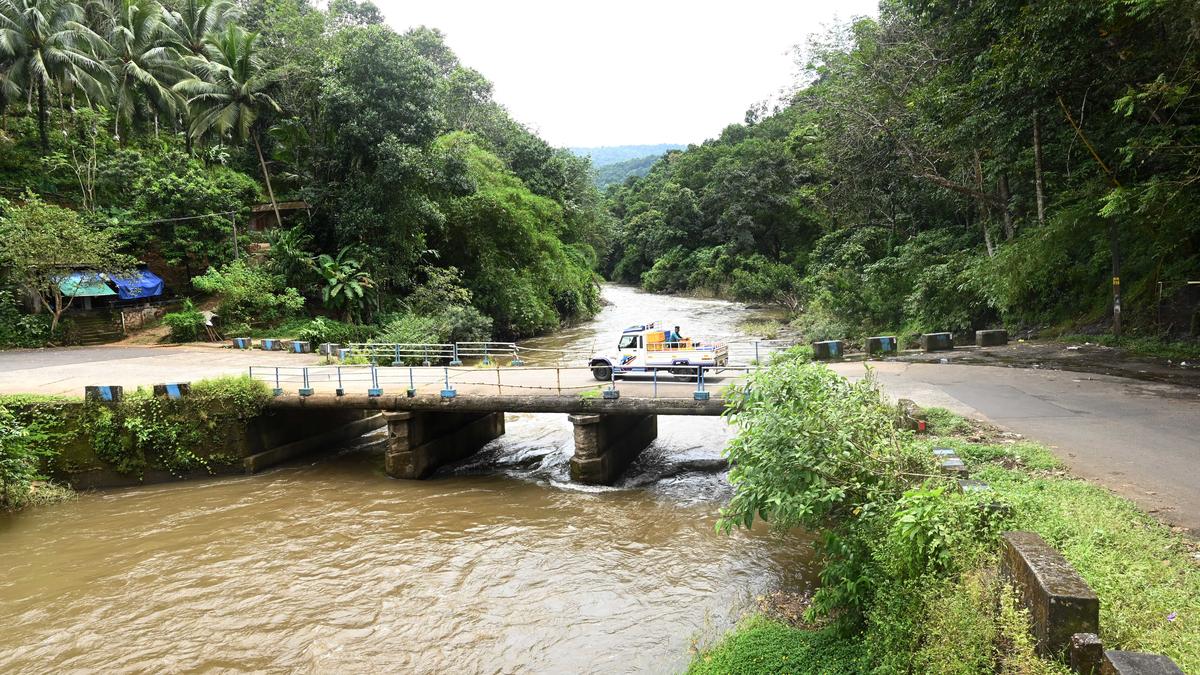
Thu Oct 24 19:17:48 UTC 2024: Updated – October 25, 2024 12:52 am ISTThe Mookenpetty causeway over the Azhutha river, which is a gateway to the enclosures of Angel Valley and Pampa Valley from Erumely. | Photo Credit: VISHNU PRATHAP
The rutted causeway with its battered handrails marks the boundary between two worlds.
On the far side, a patchwork of rubber and cocoa plantations spreads across fertile hills, nestled between the Pampa and Azhutha rivers. The rugged wilderness of the Periyar Tiger Reserve (PTR) rises in stark contrast on the other side. Though the bustling base stations of Pampa and Erumely, gateways to the Ayyappa temple at Sabarimala in Pathanamthitta district, lie about 20 kilometres away on either side, they feel like distant lands from this isolated enclave.
“Welcome to Pampa Valley and Angel Valley,” reads a sign perched by the roadside, less than 100 metre above the rocky streambed. But it’s more than just a welcome. It is the beginning of a story that reveals the trials and resilience of a community long pushed to the fringes by marauding wildlife and restrictive forest laws.
Sabarimala devotees bathing in the Pampa river near the old causeway at Kanamala, where the Pampa meets the Azhutha river. This spot is located close to the Pampa Valley and Angel Valley settlements. | Photo Credit: VISHNU PRATHAP
The sign appeared in December 2022, a response to growing regional tensions. Frustrated locals had dismantled a Forest department sign after a State government satellite survey identified the area as forestland. The tipping point came when a social media clip, allegedly from the Erumely panchayat secretary, claimed that submitting forms to exclude their lands from the forest buffer zone was futile.
Feeling abandoned by the system, the locals’ anger boiled over. One of the key figures in this struggle was P.J. Sebastian, a 64-year-old man popularly called Theyyachan, one of the 63 protesters charged in a police case for damaging public property.
“It’s not just me; there are 62 others. Our case is still pending with the Judicial First Class Magistrate Court, Kanjirappally, and there was a hearing just last week,” he explains.
This legal battle is just the latest in a long series of struggles for these settlers. From the reassignment of their lands between Idukki and Kottayam districts to fighting for title deeds, and inclusion in the PTR buffer zone, these high-range settlers have long been at odds with the State, trying to defend their rights. But perhaps the most critical moment came in 2022 when the satellite survey declared their settlements as forestland.P.J. Sebastian | Photo Credit: VISHNU PRATHAP
Though the government advised settlers to submit forms to an expert panel for exemption from buffer zone regulations, the locals were sceptical. They weren’t even inside the buffer zone to begin with!
The villages of Angel Valley and Pampa Valley in Erumely panchayat in Kottayam district have been the focal points of a raging protest in Central Travancore against the buffer zone markings around protected forests. It was in June 2022 that the Supreme Court directed the setting up of these buffer zones. The government’s recommendation for excluding these from the PTR buffer zone is under the consideration of the National Wildlife Board.
Angel Valley and Pampa Valley settlements trace their roots back to the “Grow More Food” campaign of 1947-48, launched to combat post-war food scarcity. The land was initially granted to World War II veterans, and today their descendants inhabit the area.
Originally, tapioca and rice dominated the farming landscape, but the plantation boom of the 1970s coupled with the growing threat of wild animals ushered in a shift to rubber cultivation. Now, rubber trees cover most of the farmland, with cocoa and other crops interspersed among them. The settlers, predominantly Catholic Christians, live in a community where the church holds significant influence over daily life.
The St. Marys Church at Angel Valley. The church premises here has been a major venue of anti-buffer zone protests by local people. | Photo Credit: VISHNU PRATHAP
Although settlement began in 1947-48, title deeds (patta) were only granted in 2016 after years of protests. The United Democratic Front government issued them, but the Left Democratic Front government froze the process before reissuing most of the deeds. Around 40 families are still waiting to receive theirs.
Theyyachan, once an elected representative when Pampa Valley was part of the Kumily panchayat in Idukki, estimates that the two settlements now house about 5,000 people in 1,200 families. “Many families have already moved to urban centres, and the younger generation is seeking opportunities abroad. They don’t want to be stuck here amidst all these troubles,” he says.
His younger son recently left for Ireland on a student visa, while his daughters have married and settled far from the hills in Thodupuzha and Koothattukulam, both located over two hours away. However, there is now a glimmer of hope. The settlers have been assured that the Union government has granted in principle approval to exempt their land from the PTR buffer zone.
In a hurriedly convened meeting ahead of the October 9 meeting of the National Board of Wildlife, the State board recommended excluding/de-notifying the human-inhabited areas of the Pampa Valley/Angel Valley settlement, which is spread over 5.02723 sq km, from the Periyar Tiger Reserve while “retaining three small forest enclaves namely Udumparamala (0.41 sq km), Ezhukumon (0.306 sq km) and near Azhuthamunni (0.002 sq km) within the Pampa Valley settlement with the Kerala Forest department.
The national board, which considered the proposal, has decided to review the issue at its next meeting, likely in three months. In the meantime, a team will be assigned for spot verification and to prepare a detailed report, say State forest officials.But the locals appear confused. While Mariyamma Sunny, representing the Pampa Valley ward in Erumely panchayat, is hopeful this will allow the 1,200 families to reclaim the land they’ve lived on for decades, Mathew Joseph, ward member of Angel Valley, remains cautious.
Mathew Nirappel, vicar of the St. Thomas Syro-Malabar Church at Kanamala along the Erumely-Sabarimala Road which lies close to the two settlements, has been at the forefront of protests and doesn’t hold back when addressing the settlers’ concerns.
“We still haven’t received an explanation as to why the Forest department delayed the proposal to de-notify our villages, even a year after the State Wildlife Board’s decided in January 2023 to recommend denotification. If it weren’t for relentless follow-ups and political pressure, we wouldn’t have reached the National Wildlife Board. Meanwhile, the Forest department kept trying to derail the process by sending a hard copy of the proposal instead of uploading it online and forwarding it as a mere proposal instead of a formal recommendation. We had to step in each time to keep things moving,” he says.
The settlers believe that the Forest department views their land, which straddles two rivers, as a natural boundary of the PTR. “Otherwise, how do you explain ignoring a parliamentary committee’s recommendations from 1964 or including land that’s been settled since 1948 under the Forest Conservation Act?” the vicar asks pointedly.
The Forest department, however, maintains that the delineation of the PTR and its surrounding zones is part of the National Tiger Conservation Plan. “Angel Valley and Pampa Valley are two enclosures that surround the PTR but they are human habitations. This has been communicated to the NBW, and we expect a positive decision on the de-notification soon,” says P.P. Pramod, Field Director of the PTR.
The official reassures the settlers that their role in forest protection will continue. “The settlers, as members of our Eco Development Committees, have played a key role in ensuring the safety of Sabarimala pilgrims along the traditional trekking path through the PTR. They’ve helped prevent forest fires and kept the pilgrims safe from wild animals. Their partnership will continue even after the de-notification,” he adds.
But these reassurances appear to fall short. “We have churches, a CBSE school, a health centre, and anganwadis here, not to mention establishments run by the Malanad Development Society. And yet, they still marked this place as forest. So how can we trust them anymore?” Mathachan, a middle-aged man who is the convenor of the parish committee at St. Mary’s Church at Angel Valley, is unconvinced.
Though located nearly 150 km away from the twin settlements in Periyar Tiger Reserve, the residents of Urulanthanni, Thattekad and Kuttampuzha wards of the Kuttampuzha panchayat in Ernakulam district endure a similar plight.
The three divisions are also trapped inside the Thattekad Bird Sanctuary, which has been named after Salim Ali, the legendary ornithologist. Though classified as revenue land, the Thattekad, Urulanthanni and Kuttampuzha divisions of the village panchayat located near the Kuttampuzha river, an extension of the river Periyar, are geographically located inside the bird sanctuary. The otherwise tranquil area had been witnessing intense public protests demanding steps for the exclusion of the divisions from the geographical boundaries of the sanctuary.
“The people are finding it difficult to live in these divisions as their everyday life is limited by a host of regulations. The residents are forced to seek permission from the State Forest department and other agencies on almost every occasion including for constructing a house or cutting a tree in their holdings,” says Joshy Pottackal, who represents the Thattekad division in the local body.
“Human-wildlife conflicts have almost become a daily affair. People live in constant fear of attacks by wild elephants. A wild gaur killed two people here last year. The grama sabhas of the three divisions had passed resolutions asking the State authorities to exclude the divisions from the sanctuary, which was later endorsed by the panchayat committee and submitted to the State Forest department for follow-up,” he says.Sajimon Francis, former district president of the Kerala Independent Farmers Association, lambasts the successive governments for “their failure to address the concerns of the residents and for dragging the issue for so long.”
“The everyday life of nearly 12,000 people of the three wards has been paralysed by the strict environment and wildlife laws though they live in revenue land. Many have stopped farming following high instances of human-wildlife conflicts. Crop raids by monkeys and squirrels have forced many residents to end coconut farming. Yet, no measures were taken to control the population of the crop-raiders,” he laments.
“Several tribespeople,” says Joshy, “have moved out of their settlements with wild animal attacks and crop loss becoming a regular affair. Farming is no longer a viable occupation in these divisions. Even schools and hospitals located here have been included in the sanctuary,” he says.
The special meeting of the State Board for Wildlife had also recommended to the National Board for Wildlife to exclude/de-notify the human-inhabited area, which is spread over 8.9725 sq. km from Thattekad Bird Sanctuary and to carve out 10.1694 sq. km from the Munnar Forest Division to be added to the sanctuary.
The residents of both Angel Valley and Pampa Valley and the three divisions of Kuttampuzha are pinning their hopes on the decision of the national board to get out of the legal hassles and lead a normal life free of trouble.
Published – October 25, 2024 12:47 am ISTCopyright© 2024, THG PUBLISHING PVT LTD. or its affiliated companies. All rights reserved.
Terms & conditions | Institutional Subscriber
Comments have to be in English, and in full sentences. They cannot be abusive or personal. Please abide by our community guidelines for posting your comments.
We have migrated to a new commenting platform. If you are already a registered user of The Hindu and logged in, you may continue to engage with our articles. If you do not have an account please register and login to post comments. Users can access their older comments by logging into their accounts on Vuukle.
 First Piper