
Mon Oct 07 16:50:00 UTC 2024: ## Drought Grips Iowa and the Quad Cities: Burn Ban Issued as Dry Conditions Worsen
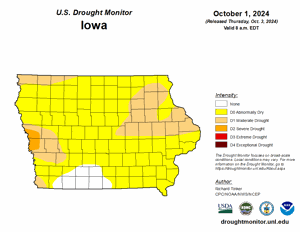
**Davenport, IA -** The Quad Cities region and much of Iowa are facing abnormally dry conditions following a period of low rainfall, according to the U.S. Drought Monitor. This has led to a ban on open burning in Scott County, issued by the Emergency Management Agency on Monday.
The lack of rain over the Midwest has left Iowa and Illinois unusually dry, with pockets of moderate drought throughout both states. While both states were free of dry conditions at the end of July, only 0.42 inches of rain fell in the Quad Cities in September, compared to the usual 3.32 inches. This trend continues into October, with minimal precipitation expected this week.
The dry conditions have prompted the issuance of burn bans in 45 of Iowa’s 99 counties. Violation of a burn ban is a simple misdemeanor. However, exceptions are made for supervised, controlled burns with permits, outdoor fireplaces, barbecue grills, and approved trash burning.
Across the country, 2024 has become the hottest year on record, exacerbating existing drought conditions. The correlation between rising temperatures and the frequency and severity of droughts is well-documented, with higher temperatures leading to increased evaporation and reduced soil moisture.
The economic and social impacts of droughts are significant. Agriculture, a vital sector in Iowa, is particularly vulnerable, with crops failing and livestock struggling. This impacts farmer livelihoods and leads to higher food prices. Socially, droughts can lead to water rationing and restrictions, straining communities.
While drought conditions nationwide are relatively mild compared to recent years, some areas are experiencing extremely dry conditions. New Mexico, Texas, and Arizona are particularly affected, with El Paso County, Texas, experiencing the most severe drought conditions in the U.S. this year. Montana and Idaho are also facing extremely dry conditions, with over 90% of residents in Missoula and Flathead Counties in Montana, and Kootenai County, Idaho, experiencing at least moderate drought.
Iowa ranks as the second driest state, with nearly a third of its residents facing severe droughts or worse.
The combination of hot temperatures and drought conditions creates a perfect storm for wildfires, adding to the challenges faced by communities across the country.
 First Piper