
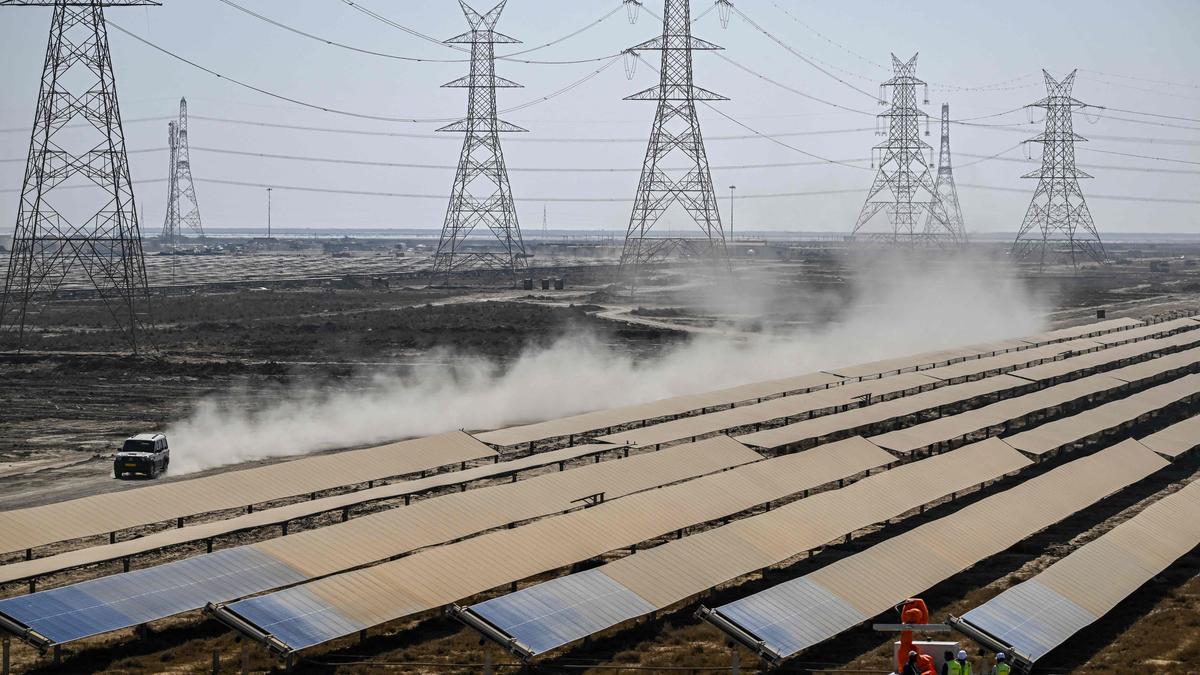
Mon Mar 17 00:00:00 UTC 2025: ## Air Pollution and Climate Change to Dampen India’s Solar Power Potential: Study
**Ahmedabad, March 17, 2025** – A new study by researchers at IIT Delhi reveals that air pollution and climate change will significantly reduce the efficiency of solar panels in India by mid-century. Published in *Environmental Research Letters*, the research highlights a critical challenge to India’s ambitious renewable energy goals.
India, the world’s fifth-largest solar power producer, aims to generate 50% of its electricity from non-fossil fuel sources by 2030, with a target of 500 GW of renewable energy capacity, including 100 GW from solar. However, the study warns that these plans may be hampered by declining solar radiation quality due to rising air pollution and temperature increases from climate change.
The IIT Delhi study, which utilized data from 1985 to 2014 to predict changes from 2041 to 2050, considered two scenarios: one with moderate climate change mitigation and air quality control efforts, and another with strong air pollution control but weak climate action. The results indicate that under the latter scenario, solar panel efficiency will drop by 2.3% by mid-century, leading to an annual loss of at least 840 gigawatt-hours of electricity. The loss is projected to be even greater under the scenario with weaker air pollution control.
Lead author Sushovan Ghosh, now a researcher at the Barcelona Supercomputing Centre, emphasizes that the study is the first of its kind to examine climate change’s impact on solar cell efficiency in India. The research highlights the combined effects of air pollution, which blocks solar radiation, and rising temperatures, which reduce solar cell efficiency. While some regions, such as parts of Northeast India and Kerala, may see increased solar potential due to reduced cloud cover, the overall impact of pollution and warming is negative.
Professor T.V. Ramachandra of the Indian Institute of Science, Bengaluru, noted that the study underscores the need for innovation in photovoltaic cell design to mitigate the negative effects. Ghosh stresses the urgency of curbing climate change and improving air quality through measures such as reducing greenhouse gas emissions, promoting electric vehicles and public transport, and increasing tree planting initiatives. He concludes that effective implementation of existing policies is crucial to achieving India’s renewable energy targets.
 First Piper