
Tue Feb 18 22:07:00 UTC 2025: ## James Webb Telescope Reveals Unprecedented Detail of Milky Way’s Black Hole
**Washington, Feb 19, 2025** – NASA’s James Webb Space Telescope has provided the clearest view yet of the supermassive black hole at the center of our Milky Way galaxy, Sagittarius A* (Sgr A*). For the first time, extended observations have revealed a dynamic environment, far from the previously assumed steady state.
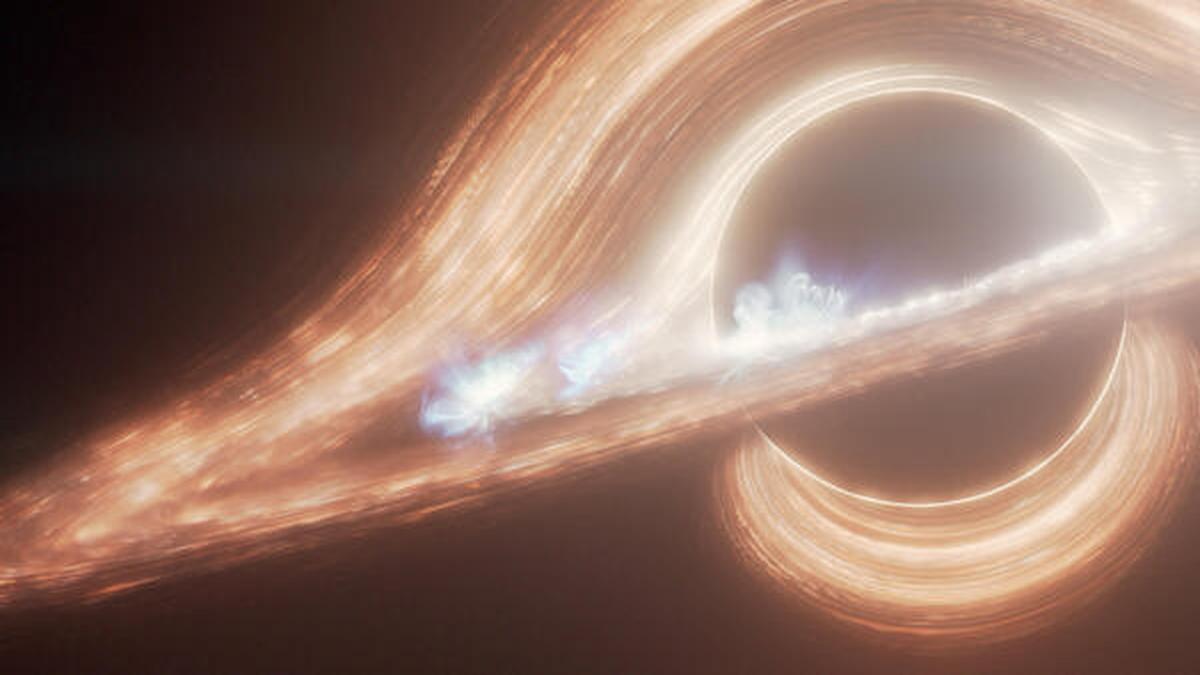
The telescope’s Near-Infrared Camera (NIRCam) captured nearly 48 hours of data over a year, showing a constantly flickering accretion disk of hot gas swirling around Sgr A*. This flickering, emanating from material near the event horizon, is punctuated by one to three large flares per day, along with smaller bursts. These flares, while similar in mechanism to solar flares, are vastly more energetic.
According to astrophysicists Farhad Yusef-Zadeh (Northwestern University) and Howard Bushouse (Space Telescope Science Institute), the turbulence within the accretion disk causes gas blobs to collide and compress, sometimes intensified by strong magnetic fields. Approximately 90% of the disk’s material falls into the black hole, while the remainder is ejected back into space. The material fueling the accretion disk appears to originate from stellar winds of nearby stars, rather than a shredded star.
These observations represent a significant leap forward. Previous ground-based and Hubble Space Telescope observations were limited to short periods, providing only fragmented views of Sgr A*’s activity. Webb’s extended observations and superior sensitivity have unveiled a level of detail previously impossible to achieve. The findings offer crucial insights into how black holes interact with their surroundings and further our understanding of these enigmatic cosmic objects. The study was published in the Astrophysical Journal Letters.
 First Piper