
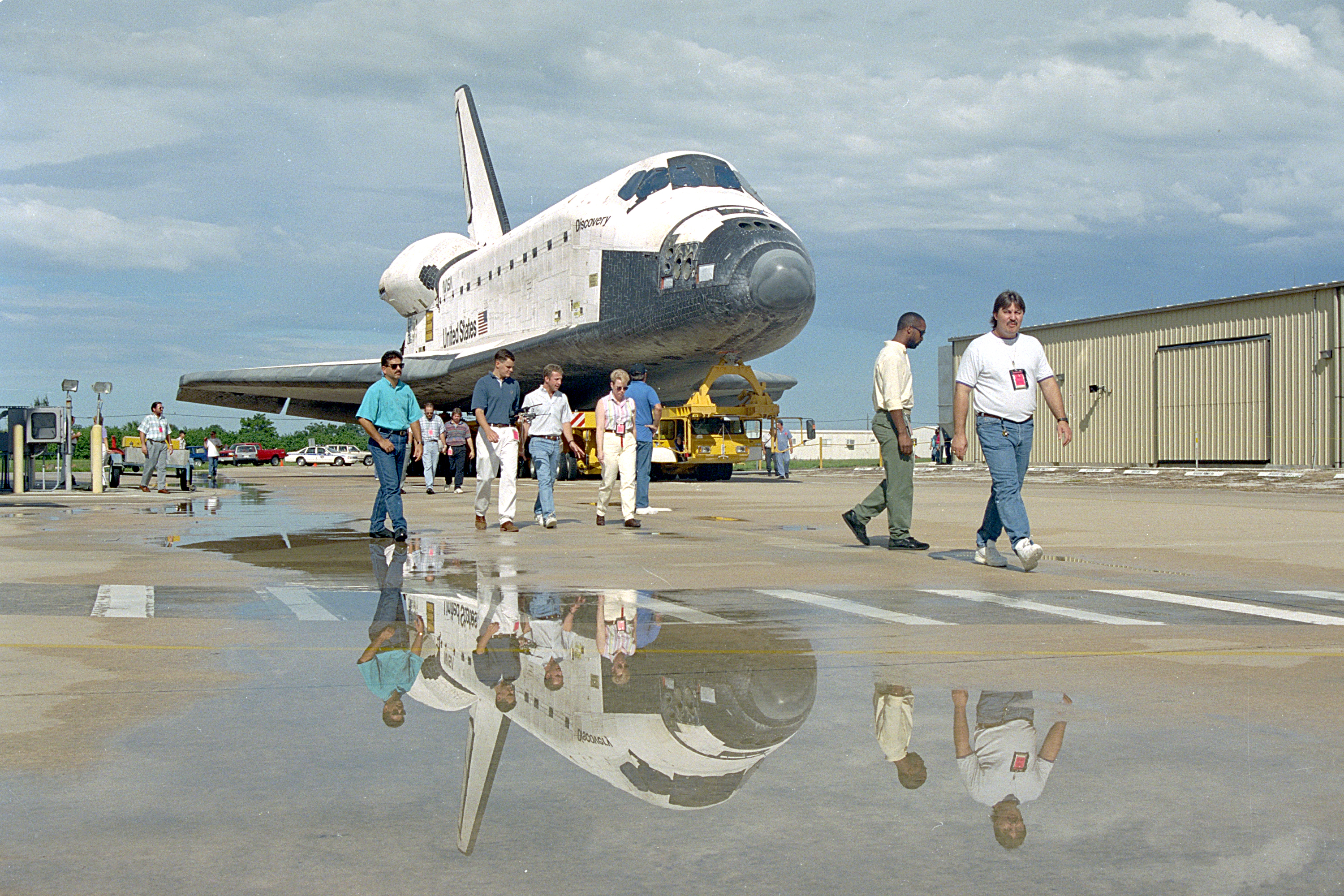
Tue Sep 10 17:01:35 UTC 2024: ## Space Shuttle Discovery Completes Successful 11-Day Mission, Including First Laser-Based Atmospheric Study
**Kennedy Space Center, FL – September 21, 1994** – Space Shuttle Discovery returned to Earth yesterday, concluding its 19th mission, STS-64, after an extended 11-day journey. The six-person crew, led by Commander Richard “Dick” Richards, successfully deployed and retrieved a science satellite, conducted the first-ever laser-based study of Earth’s atmosphere, and tested a revolutionary new astronaut rescue device.
The mission, originally planned for 10 days, was extended by one day to allow for more data collection on various payloads. The crew’s journey was further extended by inclement weather, forcing them to spend an additional day in orbit and eventually diverting their landing to Edwards Air Force Base in California.
**Key highlights of the STS-64 mission:**
* **LITE Experiment:** The LIDAR (light detection and ranging) In-space Technology Experiment (LITE) was the first to utilize a laser to study Earth’s atmosphere, cloud cover, and airborne dust from space. The experiment gathered data for over 53 hours, providing valuable information for scientists around the world.
* **SPIFEX Experiment:** The Shuttle Plume Impingement Flight Experiment (SPIFEX) characterized the behavior of the shuttle’s Reaction Control System (RCS) thrusters, providing valuable data for future shuttle and station missions.
* **SPARTAN-201 Satellite:** The Shuttle Pointed Autonomous Research Tool for Astronomy-201 (SPARTAN-201) satellite was deployed and retrieved during the mission, conducting observations of the solar wind and the Sun’s corona.
* **SAFER Test:** The Simplified Aid for EVA (Extravehicular Activity) Rescue (SAFER) device was successfully tested during a 6-hour 51-minute spacewalk, demonstrating its effectiveness for rescuing astronauts who become untethered during spacewalks. Astronauts currently use SAFER as a standard safety device during spacewalks from the International Space Station.
The STS-64 mission showcased the versatility and capabilities of the space shuttle program, demonstrating its role in scientific research, technological development, and advancement in space exploration. The successful mission lays the groundwork for future space endeavors, paving the way for further discoveries and innovations in the years to come.
 First Piper