
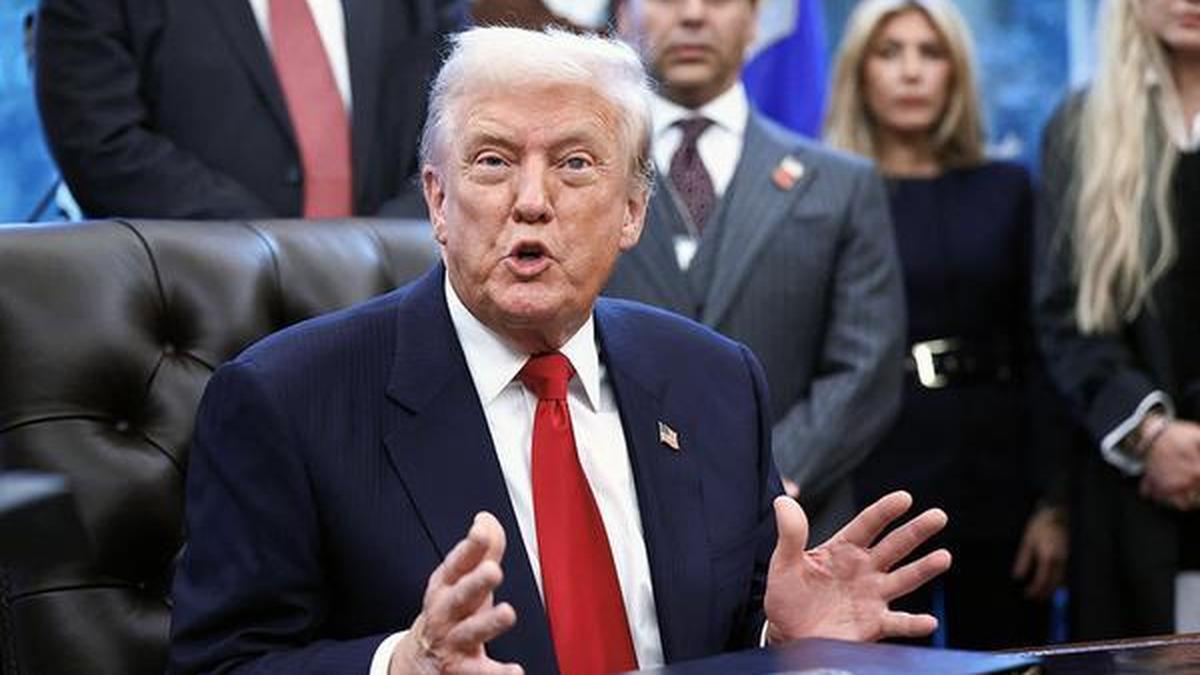
Thu Jan 08 07:38:51 UTC 2026: # Trump Administration Puts Double Pressure on India Over Energy Policy
The Story:
On January 8, 2026, India is facing significant pressure from the U.S. under President Donald Trump due to two major policy decisions: the potential imposition of up to 500% tariffs on countries buying Russian oil, and the U.S.’s withdrawal from the India-led International Solar Alliance (ISA). These announcements precede the arrival of new U.S. Ambassador-designate Sergio Gor in Delhi, who has stated that ending India’s import of Russian oil is a “top priority.” Meanwhile, in Paris, Polish Foreign Minister Radoslow Sikorski expressed satisfaction with India’s reduced Russian oil imports, a statement that External Affairs Minister S. Jaishankar did not contradict.
Key Points:
* President Trump is backing a Bill that could impose up to 500% tariffs on countries, including India, buying Russian oil.
* The U.S. is withdrawing from the International Solar Alliance (ISA), a group founded by India and France.
* U.S. Ambassador-designate Sergio Gor is set to arrive in Delhi on January 12, 2026, with a primary goal of ending India’s Russian oil imports.
* Senator Lindsey Graham stated that President Trump has “greenlit” the Russia Sanctions Bill, which could be voted on in Congress next week.
* Reliance Industries has reportedly halted Russian oil imports to its Jamnagar refinery, indicating a potential shift in India’s energy policy.
* India had previously “zeroed out” oil imports from Iran and Venezuela under similar pressure from a previous Trump administration in 2018.
Critical Analysis:
The timing of these moves, just before Ambassador Gor’s arrival, suggests a coordinated strategy to maximize U.S. leverage over India’s energy policy. The withdrawal from the ISA, while seemingly contradictory to global renewable energy efforts, can be interpreted as a pressure tactic, indicating the US is willing to sacrifice multilateral cooperation to achieve its geopolitical goals concerning Russia. The Polish Foreign Minister’s statement and Jaishankar’s lack of contradiction suggest tacit European support for reducing Russian oil revenue, further isolating India’s position.
Key Takeaways:
* The U.S. is aggressively pushing India to cease Russian oil imports, employing both economic and diplomatic pressure.
* The U.S. is willing to undermine international climate agreements to achieve its foreign policy objectives related to Russia.
* India faces a challenging balancing act between maintaining relations with the U.S., managing its energy security, and navigating its relationship with Russia.
* Reliance’s decision to halt Russian oil imports signifies a possible shift in the Indian private sector’s approach in anticipation of stricter sanctions.
* The situation mirrors the 2018 scenario, suggesting a pattern of U.S. pressure on India to align with its foreign policy.
Impact Analysis:
This situation has significant long-term implications for India’s foreign policy, energy security, and economic stability. The potential loss of access to cheap Russian oil could drive up energy costs and impact India’s economic growth. The withdrawal from the ISA could damage India’s leadership role in global renewable energy initiatives. India’s relations with Russia may be strained. India will likely need to diversify its energy sources and strengthen its strategic partnerships with other countries to mitigate the impact of these U.S. policies. This event underscores the vulnerability of nations heavily reliant on specific sources, particularly in a world where energy policy is increasingly intertwined with geopolitics.
 First Piper