
Fri Jun 20 12:56:37 UTC 2025: **Summary:**
Indian Vice-President Jagdeep Dhankhar strongly criticized the Supreme Court’s verdict during the Emergency period (1975-1977), calling it the “darkest in judicial history.” He accused the court of legitimizing dictatorship by overturning High Court rulings that upheld fundamental rights. He also questioned the then-President’s decision to declare the Emergency based solely on the Prime Minister’s advice. Dhankhar reiterated that the government observes June 25th as “Samvidhan Hatya Diwas” (Constitution Murder Day).
**News Article:**
**Dhankhar Slams Supreme Court’s Emergency Verdict as ‘Darkest in Judicial History’**
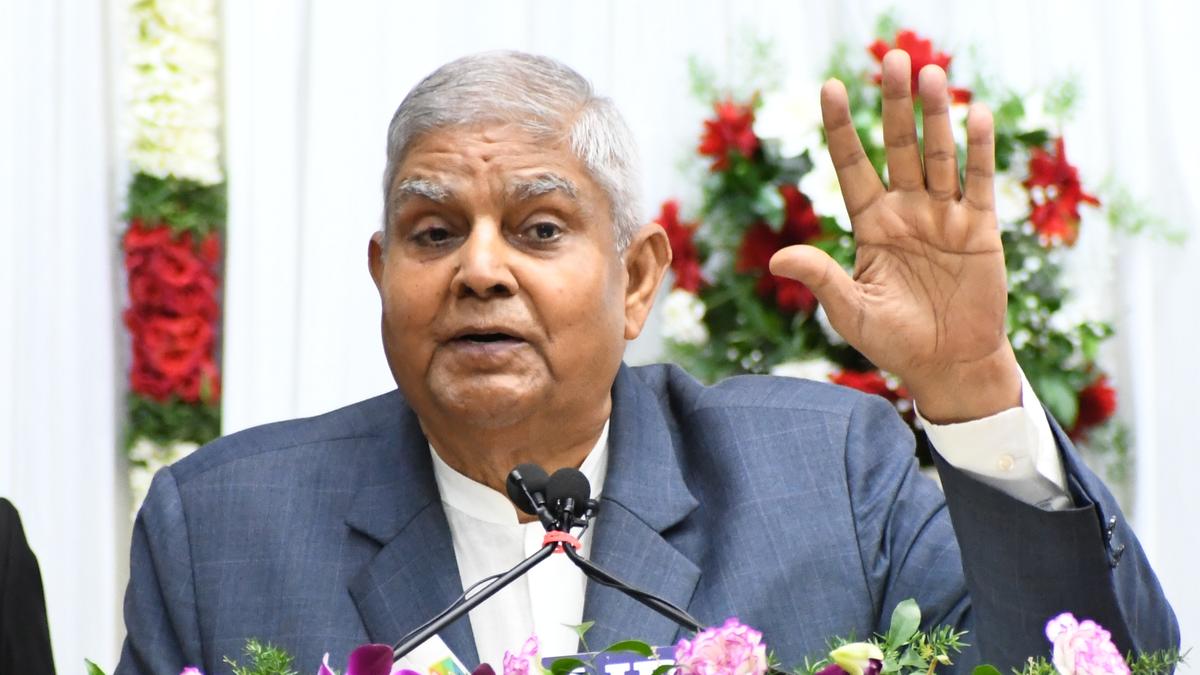
**New Delhi, June 20, 2025** – Vice-President Jagdeep Dhankhar delivered a scathing critique of the Supreme Court’s ruling during the Emergency period (1975-1977), branding it the “darkest in the history of any judicial institution in the world that believes in the rule of law.” His remarks came during an address to a group of Rajya Sabha interns.
Dhankhar accused the Supreme Court of effectively legitimizing dictatorship and authoritarianism by overturning the rulings of nine High Courts that had defended fundamental rights despite the Emergency. “The judgment of the Supreme Court legitimised dictatorship, authoritarianism and despotism in this land,” he stated.
The Vice-President also questioned the actions of then-President Fakhruddin Ali Ahmed, stating that the President could not legally act on the advice of only the Prime Minister Indira Gandhi, and should have listened to the council of ministers instead. He pointed out that over 100,000 citizens were imprisoned during the Emergency, a period he described as one where “the fundamental essence of democracy capsized.”
Dhankhar highlighted the government’s decision to observe June 25th annually as “Samvidhan Hatya Diwas” (Constitution Murder Day) to commemorate the imposition of the Emergency. The Emergency, which lasted from June 25, 1975, to March 21, 1977, remains a controversial chapter in Indian history, and Dhankhar’s remarks have reignited the debate surrounding the role of the judiciary and executive during that period.
 First Piper