
Tue May 20 08:30:00 UTC 2025: **Summary:**
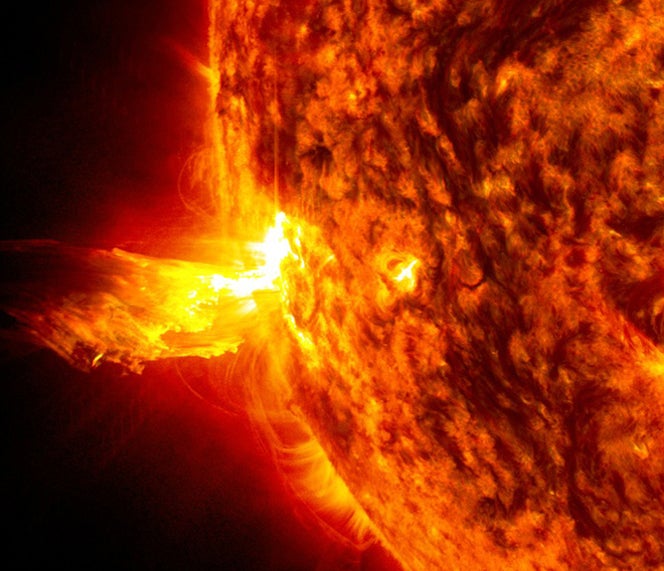
An active region on the Sun is rotating to face Earth, increasing the likelihood of solar storms, auroras, and potential radio blackouts. This region recently produced the most powerful solar flare of 2025, causing radio disruptions in the Middle East. As the Sun is currently in its solar maximum, ongoing eruptions could impact communications, power grids, navigation, and spacecraft. The approaching sunspot, AR4087, may also lead to enhanced auroras.
**News Article:**
**Solar Storms Loom as Sun’s Active Region Turns Towards Earth**
**London, UK** – Astronomers are warning of heightened space weather risks in the coming days and weeks as an extremely active region on the Sun rotates into direct view of Earth. The impending solar activity is expected to generate spectacular auroras but also poses a threat of radio blackouts and potential disruptions to critical infrastructure.
The Sun is currently at its solar maximum, the peak of its 11-year cycle, and this active region has already unleashed the most powerful solar flare of 2025. The X2.7 class flare triggered a temporary radio blackout across parts of the Middle East, disrupting high-frequency signals for approximately 10 minutes, according to the National Oceanic and Atmospheric Administration (NOAA).
NASA cautions that continued solar flares and eruptions from this active zone could have a far-reaching impact on “radio communications, electric power grids, navigation signals, and pose risks to spacecraft and astronauts.”
Furthermore, the incoming sunspot AR4087 is raising concerns about the possibility of supercharged auroras, visible as the Northern or Southern Lights. “This is getting intense,” exclaimed space photographer Vincent Ledvina, noting the active region is aligning more directly with Earth.
Authorities are monitoring the situation closely, and preparations are being made for potential disruptions caused by the incoming solar activity. The public is encouraged to stay informed through updates from weather and space agencies.
 First Piper