
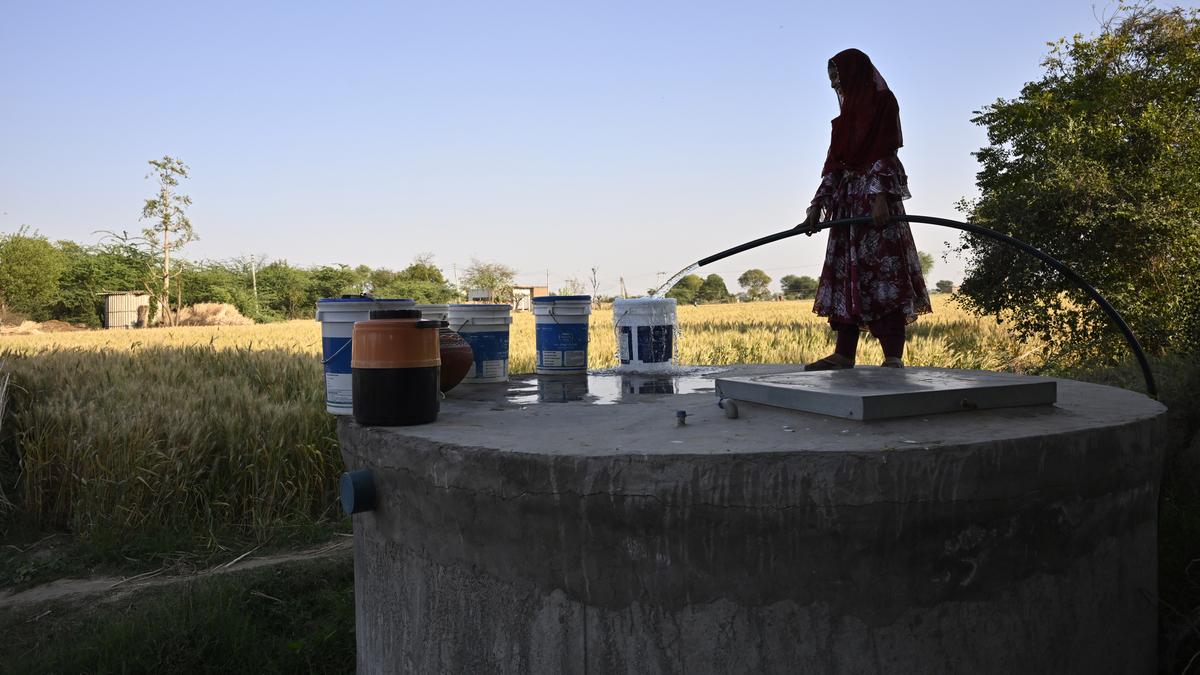
Thu Apr 03 18:11:02 UTC 2025: ## Haryana Faces Severe Groundwater Crisis: Salty Water, High Contaminant Levels Force Villagers to Build Underground Tanks
**Nuh, Haryana, April 4, 2025** – A severe groundwater crisis is gripping Haryana, with Nuh district among the hardest hit. Decades of over-extraction and pollution have rendered much of the groundwater undrinkable, forcing residents to resort to expensive and unsustainable solutions.
The crisis is highlighted by the experiences of villagers in Ghaghas, where dwindling groundwater supplies and increasing salinity have prompted residents to construct private underground water tanks (kundas), some with government assistance. Ikbal Khan, a villager living below the poverty line, spent ₹60,000 on a 20,000-liter tank, supplementing his meager income with government aid. Even with these tanks, villagers rely on rainwater for irrigation, drastically reducing crop yields. The situation is mirrored across the district, with approximately 200 kundas built in Ghaghas alone.
The problem extends far beyond Nuh. A 2024 Central Ground Water Board (CGWB) report reveals excessive fluoride and arsenic levels in Haryana’s groundwater, exceeding permissible limits in 208 out of 879 samples tested. High uranium levels were found in 16 of Haryana’s 22 districts, leading to health concerns including fluorosis and kidney damage. High salinity is also widespread, affecting irrigation capabilities.
The situation has prompted political action. Haryana MLA Arjun Chautala raised the alarm in the state assembly, highlighting the CGWB report’s alarming findings. While the government claims to have established water testing labs in every district and provided tap water connections to households, villagers like those in Madhi and across Jhajjar and Hisar districts report unreliable piped water supplies, forcing continued reliance on expensive private water tankers. Even with piped water, many prefer the taste of the groundwater, even if it is of questionable safety.
Experts and activists attribute the crisis to excessive fertilizer and pesticide use, improper waste disposal, and over-extraction of groundwater. They criticize the government’s focus on short-term solutions like pipeline water supply, advocating instead for long-term strategies like groundwater recharge, crop diversification, and interstate cooperation on water resource management. The lack of sustainable solutions leaves Haryana’s rural communities facing a looming water insecurity crisis.
 First Piper