
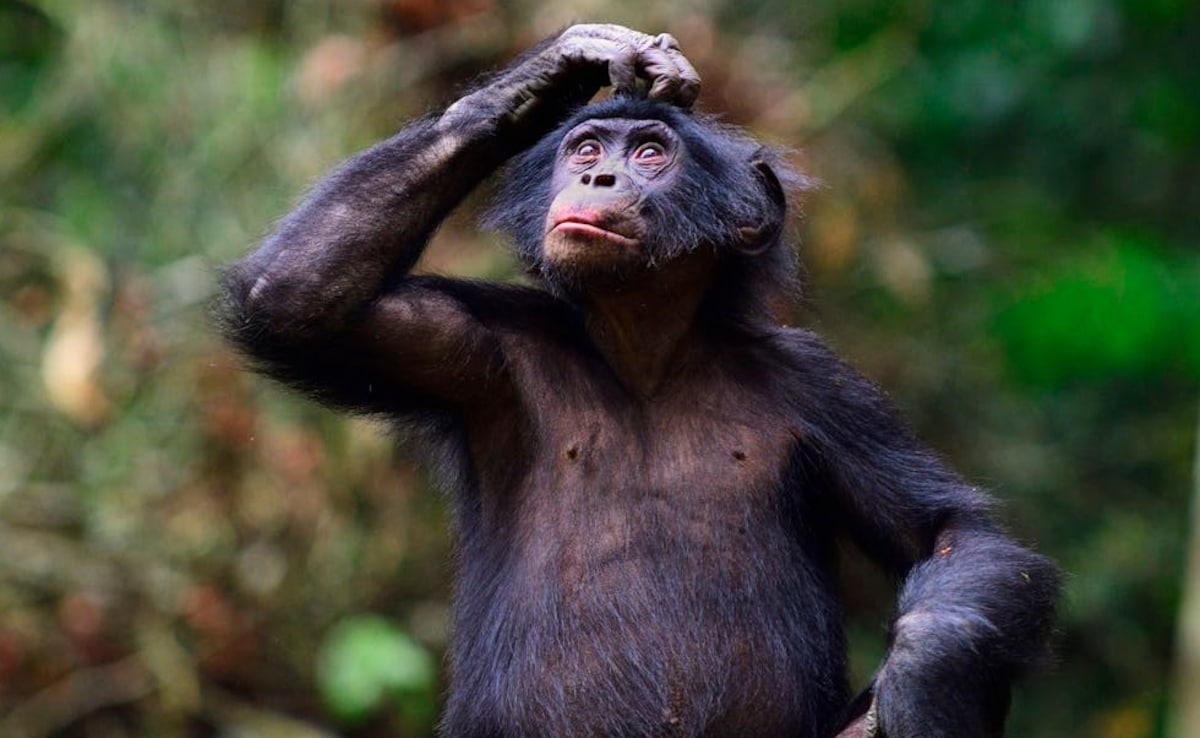
Fri Apr 04 11:11:35 UTC 2025: ## Bonobos Speak in “Sentences”: Study Reveals Compositional Language in Apes
**Zurich, Switzerland** – A groundbreaking new study published in *Science* reveals that bonobos, our closest living relatives alongside chimpanzees, possess a sophisticated form of communication strikingly similar to human language. Researchers from the University of Zurich, studying bonobos in the Kokolopori Community Reserve in the Democratic Republic of Congo, have found evidence of extensive compositionality in bonobo vocalizations—the ability to combine individual calls to create new meanings.
This challenges the long-held belief that complex compositional language is uniquely human. Previous research suggested animal communication consisted primarily of isolated calls with only rare instances of combining calls to convey more complex meanings.
The researchers developed a novel method to decipher the meaning of bonobo calls, meticulously documenting over 300 contextual parameters surrounding each vocalization. This included observing the bonobos’ behavior and the surrounding environment to avoid human bias. This painstaking work resulted in a “bonobo dictionary,” a comprehensive list of individual calls and their corresponding meanings.
Crucially, the study went beyond cataloging individual calls. The researchers developed a method to analyze whether bonobos combine calls compositionally, meaning the combined meaning is derived from the individual calls’ meanings. They identified four call combinations meeting the criteria for compositionality, with three exhibiting complex, non-trivial structures mirroring the sophisticated syntax found in human language. One example combines a “peep” call (“I would like to…”) with a whistle (“Let’s stay together”) to convey a message akin to “Let’s relax” in tense social situations.
Lead researcher Mélissa Berthet, a biologist specializing in animal behavior at the University of Zurich, emphasizes the significance of these findings for understanding the evolution of language. The presence of compositional communication in bonobos suggests this ability may have been present in our last common ancestor, at least 7 million years ago. This implies that the capacity for complex, compositional language is not uniquely human, but rather a far older evolutionary trait than previously assumed. The research was funded by the Swiss National Science Foundation and Harvard University.
 First Piper