
Tue Mar 11 00:00:00 UTC 2025: ## Cosmic Speed Secrets Unlocked: Scientists Solve Mystery of Electron Acceleration in Space
**Washington, D.C. – March 11, 2025** – Scientists have made a breakthrough in understanding how electrons reach incredibly high speeds in space. A new study published in *Nature Communications* reveals that collisionless shock waves, common throughout the universe, act as powerful particle accelerators, propelling electrons to near light-speed.
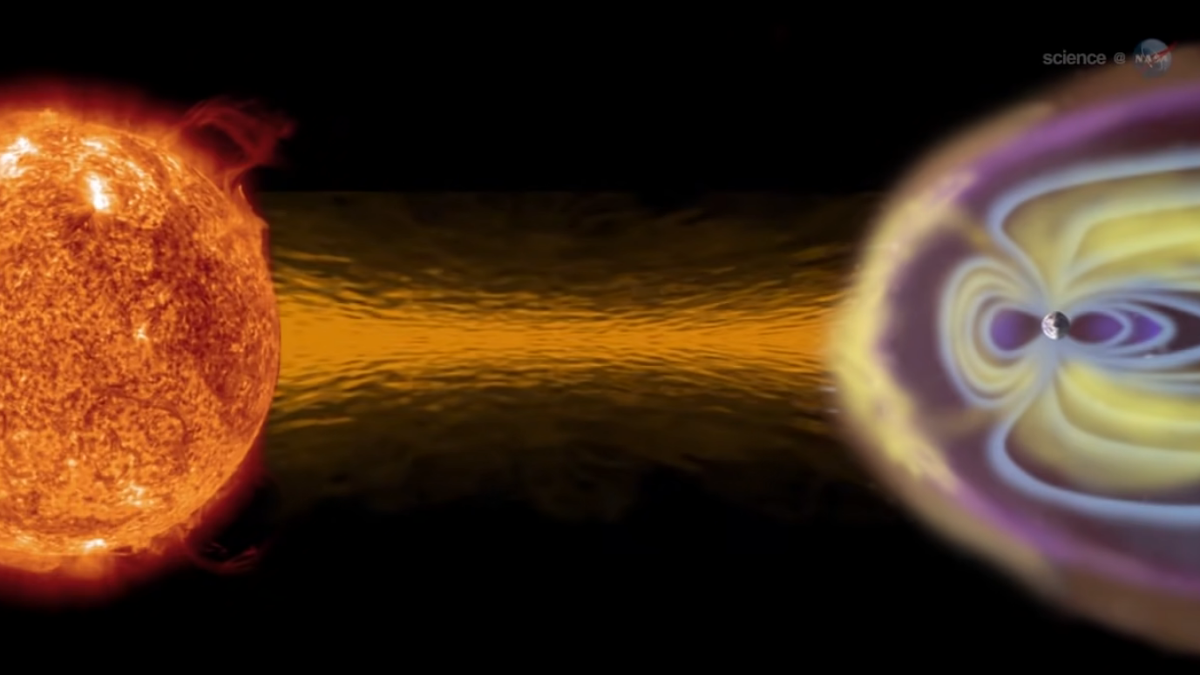
Researchers from Johns Hopkins University and Northumbria University used data from three NASA missions – MMS, THEMIS, and ARTEMIS – to observe the interaction of the solar wind with Earth’s magnetosphere. Their analysis focused on the “bow shock,” where the solar wind slows and transfers energy, creating a shock wave. Within this region, called the foreshock, they discovered electrons accelerating to over 86% the speed of light.
This finding solves a long-standing puzzle in astrophysics known as the “electron injection problem.” Existing theories of diffusive shock acceleration require electrons to already be moving at 50% the speed of light before further acceleration can occur. The new research demonstrates a mechanism that provides this initial boost through a complex interplay of plasma waves and interactions within the bow shock and foreshock.
The study’s authors propose a refined model explaining electron acceleration in collisionless shock environments. This model has implications beyond our solar system, suggesting that similar processes could be responsible for generating cosmic rays, high-energy particles traveling through space. The researchers hypothesize that supernova shocks and even interactions between planets and stellar winds could contribute to this phenomenon.
Further research is needed to fully validate this theory, particularly in stellar astrophysics and particle acceleration. However, this discovery significantly advances our understanding of particle acceleration in space and the energetic processes shaping the universe.
 First Piper