
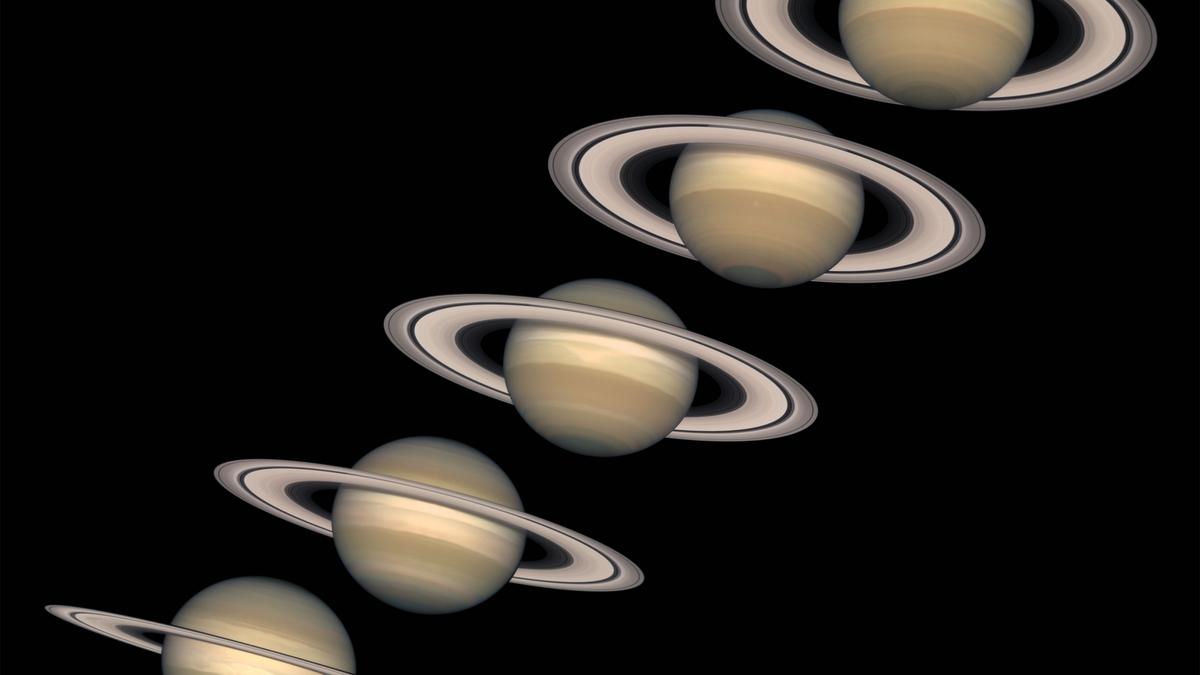
Wed Feb 19 00:00:00 UTC 2025: ## Saturn’s Rings: New Study Challenges Long-Held Beliefs About Their Age
**Ahmedabad, India (February 19, 2025)** – A new study published in *Nature Geoscience* challenges the prevailing theory about the age of Saturn’s rings. For decades, scientists believed the rings were relatively young, approximately 100 million years old, due to their surprising cleanliness—a lack of expected dust accumulation. However, researchers from the Institute of Science Tokyo and the Paris Institute of Planetary Physics propose a different explanation.
Using computer models, the researchers demonstrated that dust colliding with the icy ring particles evaporates and disperses into smaller fragments. These fragments are then either ejected from the rings, pulled into Saturn’s atmosphere, or fall onto the planet itself. This self-cleaning mechanism, the study suggests, explains the rings’ pristine appearance regardless of their age. The rings, therefore, could be as old as the solar system itself.
This finding has significant implications beyond the rings themselves. The age of Saturn’s rings is directly linked to the evolution of its moons, particularly Enceladus, a geologically active moon with a subsurface ocean that is of significant interest in the search for extraterrestrial life. The interaction between Enceladus’ icy plumes and the rings is crucial in understanding this evolution. The new research could also shed light on the diversity of ring systems among the solar system’s gas giants.
The study’s co-author, Ryuki Hyodo, suggests that a future mission to Saturn’s rings could provide further insights. The ongoing NASA Clipper mission to Jupiter’s moon Europa, another icy body with a subsurface ocean, further highlights the scientific community’s interest in these celestial features. The research published in December 2024 presents a significant shift in the ongoing discussion surrounding the formation and age of Saturn’s iconic rings.
 First Piper