
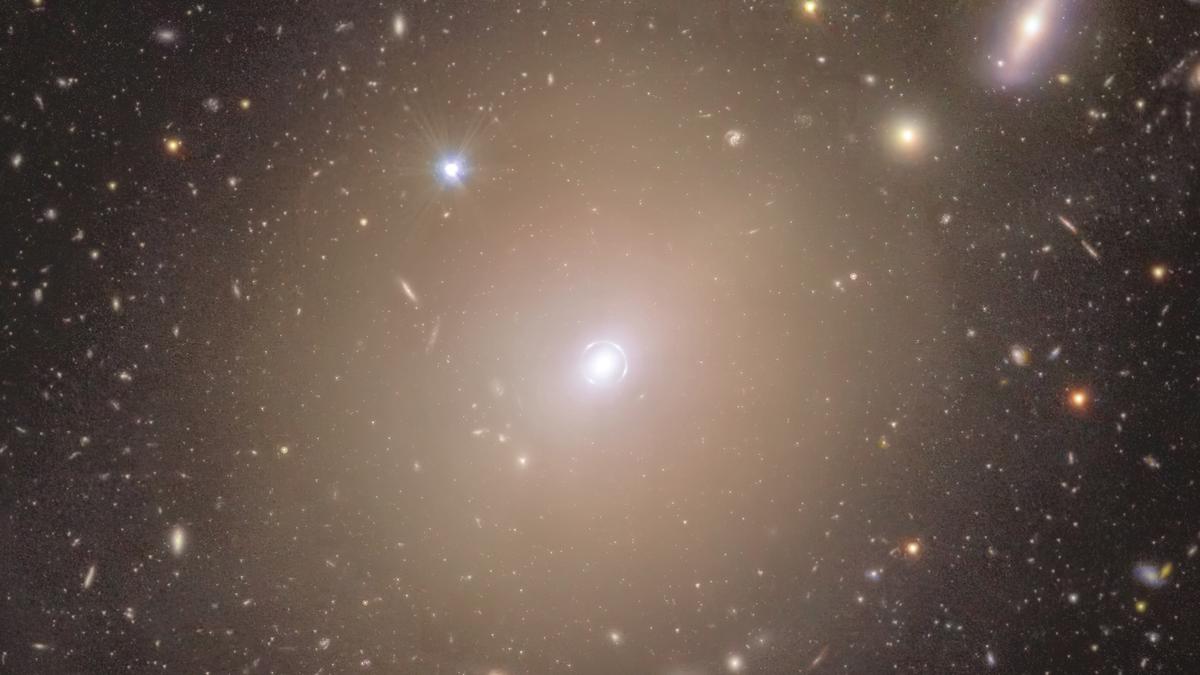
Tue Feb 18 10:40:00 UTC 2025: ## Euclid Space Telescope Discovers Rare “Einstein Ring” Galaxy
**London, February 18, 2025** – The European Space Agency’s (ESA) Euclid space telescope has made a remarkable discovery just months after its launch: a rare “Einstein ring” galaxy, a cosmic phenomenon predicted by Albert Einstein over a century ago. The ring, dubbed “Altieri’s ring” after its discoverer, is located in the galaxy NGC 6505, a relatively close 590 million light-years from Earth.
Einstein’s theory of general relativity posits that massive objects warp spacetime, bending light from objects behind them. In the case of an Einstein ring, this bending creates a near-perfect circular image of a distant galaxy around the foreground lensing galaxy. The newly discovered ring is formed by the distorted light of a galaxy 4.5 billion light-years away.
The discovery, initially spotted in a test image in September 2023, was confirmed using subsequent focused images and data from other telescopes, including the Keck Cosmic Web Imager and the Canada-France-Hawaii Telescope. The research, published in *Astronomy & Astrophysics*, confirms the lensed nature of the images and provides valuable data on the mass and distance of both galaxies.
While Altieri’s ring is exciting, scientists note its exceptional proximity and brightness make it unlikely that Euclid will find a similar ring nearby. Despite this, the discovery highlights Euclid’s capabilities. The telescope’s primary mission is to map billions of galaxies to better understand dark matter and dark energy, and it is expected to discover 100,000 gravitational lenses during its operational lifetime. The study of Einstein rings like Altieri’s offers unique opportunities to test Einstein’s theory and learn more about the universe’s expansion and the elusive dark matter.
 First Piper