
Thu Jan 23 00:00:00 UTC 2025: ## Distant Black Hole’s ‘Fast Food’ Feast May Explain Supermassive Growth
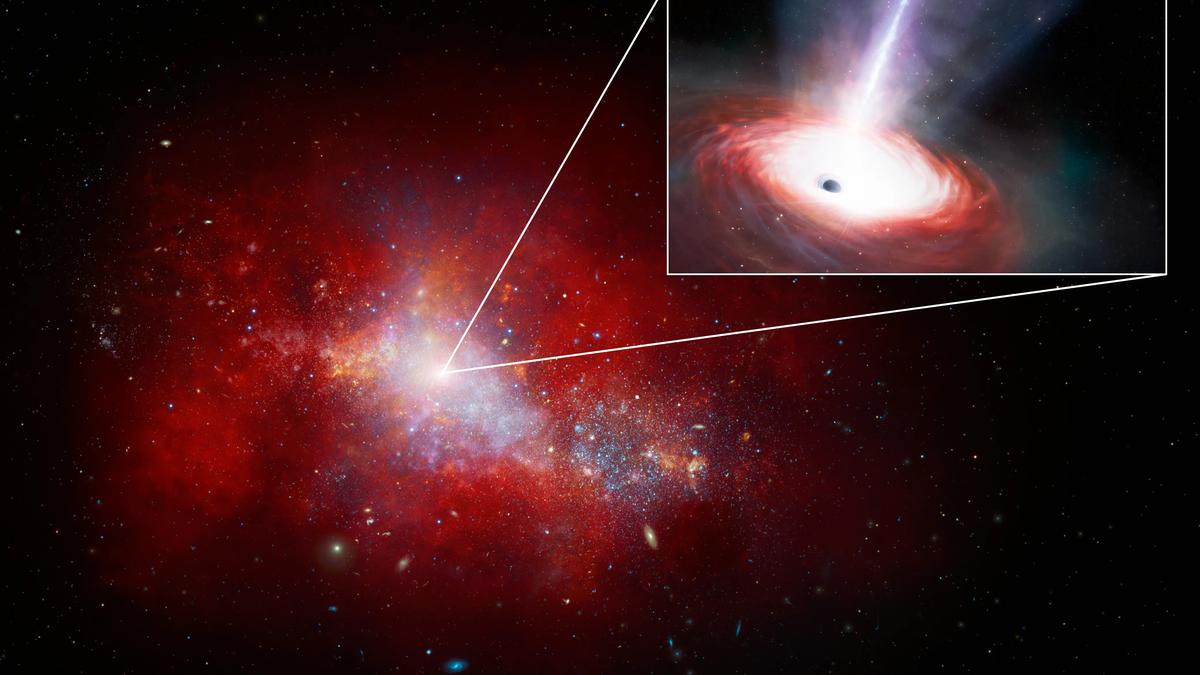
**Udupi, India (January 23, 2025)** – An international team of astronomers has discovered a rapidly growing black hole, designated LID-568, that may revolutionize our understanding of supermassive black hole formation. Using data from NASA’s James Webb Space Telescope (JWST) and the Chandra X-ray Observatory, the team, led by Hyewon Suh of the International Gemini Observatory, found the black hole located in a dwarf galaxy 1.5 billion years after the Big Bang.
LID-568 is unusual because it is accreting matter at a rate 40 times higher than the previously established theoretical limit (the Eddington limit). This “super-Eddington” accretion suggests that black holes might gain a significant portion of their mass through short, intense periods of feeding, rather than a sustained, long-term process. This discovery is especially significant as it challenges existing models explaining the existence of supermassive black holes in the early universe, which were previously thought to require millions of years of continuous accretion.
The black hole’s extreme brightness in X-rays, detected by Chandra, and its subsequent identification by JWST’s infrared capabilities, provided vital data for the study, published in *Nature Astronomy*. The research shows the galaxy hosting LID-568 is also exhibiting minimal star formation, likely due to powerful outflows driven by the black hole’s voracious appetite.
The discovery of LID-568 offers a compelling alternative explanation for the rapid growth of supermassive black holes in the early universe. Future observations will focus on identifying similar black holes and further investigating the mechanisms allowing such super-Eddington accretion. The findings could significantly alter our understanding of black hole evolution and the formation of galaxies in the early universe.
 First Piper