
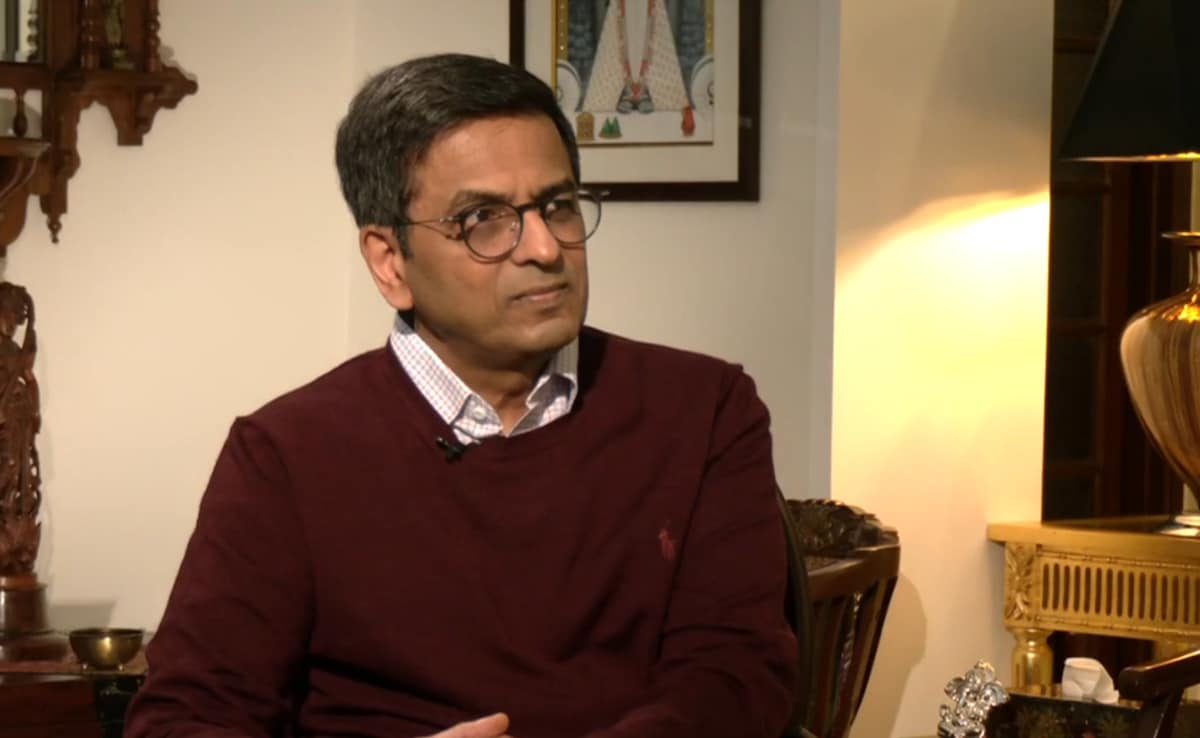
Thu Jan 09 05:10:52 UTC 2025: **Former Chief Justice of India Chandrachud Reflects on Career in Wide-Ranging Interview**
NEW DELHI – In a wide-ranging interview with NDTV, former Chief Justice of India DY Chandrachud reflected on his nearly three-decade-long legal career, offering insights into landmark judgments, the challenges of the Supreme Court, and the evolution of Indian jurisprudence.
Justice Chandrachud, who retired in November 2024 as the longest-serving Chief Justice in over a decade, discussed his pivotal role in shaping legal precedents on issues such as electoral bonds, Article 370, and same-sex marriage. He also addressed criticism leveled against the Supreme Court and judges, including comments regarding his own judicial decisions.
The interview touched on his early life, revealing that law was not his first career choice. He initially pursued economics before ultimately embracing a legal path, receiving support and friendship from his father, former Chief Justice YV Chandrachud. He recounted his early experiences, including receiving a modest fee of ₹75-₹90 for his first case after graduating from Harvard Law School, highlighting the disconnect between academic achievement and immediate professional realities.
Justice Chandrachud explained the complexities of high-profile cases like the electoral bonds ruling, emphasizing the need to balance awareness of the broader political ramifications with the strict application of legal principles. He stressed the solitary nature of judging and the profound responsibility of the Supreme Court to shape both present and future jurisprudence.
He addressed the criticism that the Supreme Court is “supreme but not infallible,” stating that the court’s finality, not its inherent correctness, dictates its authority. This, he explained, necessitates revisiting and potentially overruling past judgments, even those by his father. He cited the overruling of several past decisions, including those impacting property rights and the right to privacy, as examples of adapting jurisprudence to societal changes.
Justice Chandrachud also addressed criticism of his judicial style, clarifying that certain comments attributed to him were from circulated drafts, not the final judgment. He defended the use of strong language in overturning judgments like the ADM Jabalpur case, arguing that the gravity of such decisions warrants strong statements.
The former Chief Justice also commented on the increased scrutiny of judges via social media, noting the challenges of navigating a digital age with shortened attention spans and often irrational criticism. He acknowledged the enormous workload of the Supreme Court, emphasizing that the perceived “judicial evasion” is often due to the sheer volume of cases and the need to prioritize between constitutional issues and individual cases. He highlighted that the Supreme Court disposed of over 59,000 cases in 2024 despite an increase in Constitution bench hearings, a record since Independence.
Concluding the interview, Justice Chandrachud emphasized his commitment to his conscience and the hope that his decisions have positively impacted society. He expressed his contentment with his contributions, acknowledging that the ultimate judgment on his legacy will reside in the future.
 First Piper