
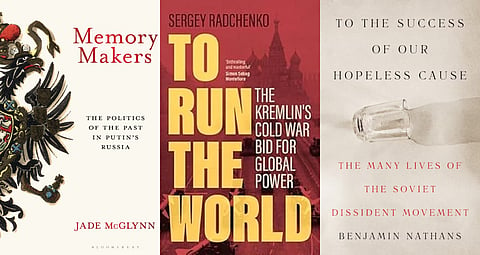
Sat Oct 26 05:07:52 UTC 2024: The article discusses the complexities of understanding Russia, referencing Winston Churchill’s description of it as “a riddle wrapped in a mystery inside an enigma.” It emphasizes the importance of studying Russia from its own perspective to avoid biases. Key points include:
1. **Cultural Complexity**: Russia’s vast size, ethnic diversity, and historical transitions from monarchy to socialism complicate its identity and global interactions.
2. **Historical Grievances**: Russia has an inferiority complex stemming from its late emergence as a world power and a desire for recognition of its global contributions.
3. **Cold War Legacy**: The analysis of Russia’s past remains relevant post-USSR, especially in understanding its current revanchist actions.
4. **Notable Literature**: The article highlights three recent books—Sergey Radchenko’s “To Run the World,” Jade McGlynn’s “Memory Makers,” and Benjamin Nathans’ “To the Success of Our Hopeless Cause”—that provide diverse insights into Russia’s political history, propaganda strategies, and dissident movements.
5. **Radchenko’s Findings**: Radchenko’s work discusses Russia’s pursuit of legitimacy and power, suggesting that its ambitions extend beyond the collapse of the USSR, yet admits limitations in fully explaining the chaotic nature of Russian governance.
6. **Propaganda Analysis**: McGlynn’s book examines how the Russian state uses media and cultural events to reshape historical narratives in the public consciousness, particularly under Putin.
7. **Dissident Movements**: Nathans’ account highlights the efforts of Soviet dissidents to challenge the government while navigating the oppressive political landscape, ultimately contributing to the regime’s collapse.
8. **Current Context**: The analysis notes the deterioration of relations between Russia and the West since 2007, resulting in a new Cold War.
9. **Importance of Understanding**: The conclusion underscores the need for mutual understanding of national interests to foster coexistence, acknowledging the shared complexities of different nations’ pasts.
Overall, the article advocates for a deeper understanding of Russia through its historical and cultural lenses, while considering how perceptions and narratives change over time.
 First Piper