
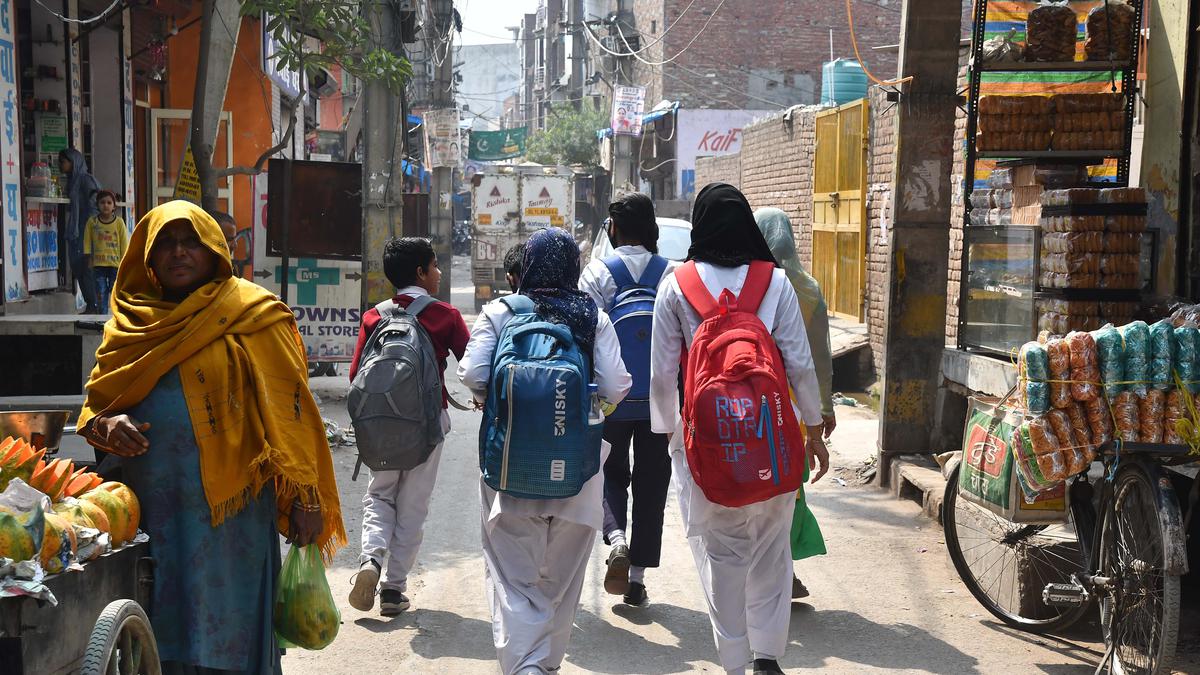
Thu Oct 24 00:15:00 UTC 2024: Updated – October 24, 2024 10:01 am IST – NEW DELHIRepresentational image of children heading to school in New Delhi | Photo Credit: Shiv Kumar Pushpakar
Two years after the scheme was launched, the State Government of Delhi has adopted the PM-SHRI (Prime Minister’s Schools for Rising India) scheme.
Delhi Government education officials signed a Memorandum of Understanding with the Ministry of Education on October 22 to implement the scheme.Spread over five years at a cost of ₹27,360 crore, the scheme proposes to convert more than 14,500 schools into “exemplar” institutions, with the Centre contributing 60% of the funding for upgradation while States will contribute the remainder. In the north east the Centre will provide 90% of funding.
The PM-SHRI scheme, which aligns with the National Education Policy (2020), falls under the Samagra Shiksha scheme, out of which major funding needs of government schools are met. Apart from PM-SHRI, these funds cover teachers’ salaries, uniforms and books, reimbursements for economically weaker section (EWS) students, and aid to EWS in private schools.
Senior MoE officials confirmed that Samagra Shiksha funds for Delhi will be released shortly.Earlier in September, Delhi’s Secretary (Education) Ashok Kumar had written to the Centre expressing interest in signing the PM-SHRI MoU. Mr. Kumar had also requested the release of third and fourth instalments of Samagra Shiksha funds for FY 2023-24 and the first instalment for FY 2024-25. The pending funds amount to ₹330 crore.
Punjab and Delhi came on board in August and October, respectively. Officials in the MoE confirmed that Tamil Nadu and Kerala are expected to sign the MoU soon.
Days after Punjab came on board to implement the PM-SHRI scheme, it also received the central share of the first instalment of Samagra Shiksha funds for 2024-25, amounting to ₹177 crore.Tamil Nadu Chief Minister MK Stalin had written a letter to Prime Minister Narendra Modi citing delay in release of funds. While Tamil Nadu follows a two-language policy, NEP recommends the implementation of a three-language policy, which Mr. Stalin has rejected. Education Minister Dharmendra Pradhan emphasised that Tamil Nadu should come on board to implement the National Education Policy.
Kerala had earlier decided not to sign the PM-SHRI scheme, citing political opposition to the NEP. It later agreed to implement the PM-SHRI scheme but is yet to sign the MoU.
West Bengal has opposed adding the prefix PM-SHRI to the names of their schools because the states bear 40% of the cost. State Government officials in September had said that West Bengal was awaiting close to ₹1,000 crore in pending Samagra Shiksha funds.
Published – October 24, 2024 05:45 am IST
Copyright© 2024, THG PUBLISHING PVT LTD. or its affiliated companies. All rights reserved.Terms & conditions | Institutional SubscriberComments have to be in English, and in full sentences. They cannot be abusive or personal. Please abide by our community guidelines for posting your comments.
We have migrated to a new commenting platform. If you are already a registered user of The Hindu and logged in, you may continue to engage with our articles. If you do not have an account please register and login to post comments. Users can access their older comments by logging into their accounts on Vuukle.
 First Piper