
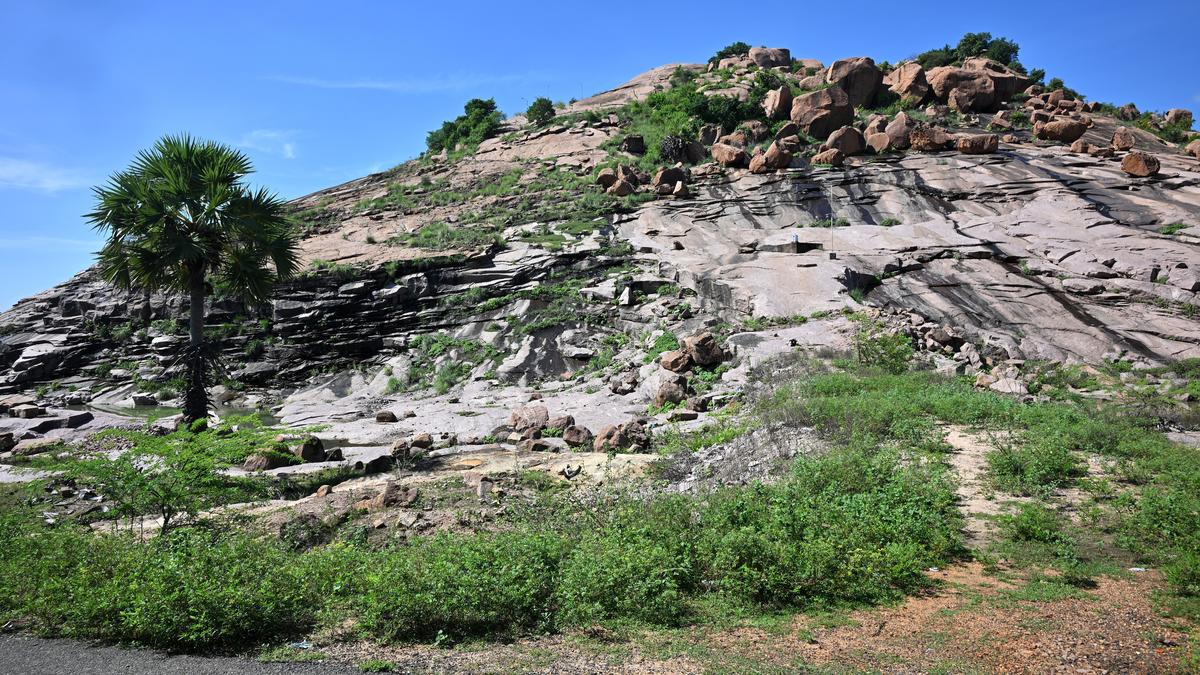
Tue Oct 22 17:34:27 UTC 2024: Published – October 22, 2024 11:04 pm ISTAccidental sighting: The Aruvimalai at Palgudi in the Kottampatti block of Madurai district. | Photo Credit: R. ASHOK
The 12 Jain beds chiselled under the ledge atop the hillock. | Photo Credit: R. ASHOK
About 40 km from Madurai, a road branches off the Madurai-Tiruchi National Highway, towards Kachirayanpatti. For about 2 km, the single-lane road curves around paddy fields and a meandering stream before reaching Palgudi in the Kottampatti block. This village rests under the shadow of Aruvimalai, a hillock known for its 13th Century Shiva temple. But within the folds of this craggy hillock and under an overhanging ledge are chiselled 12 Jain beds that are almost 2,000 years old.P. Devi Arivu Selvam, a temple architecture and sculpture researcher, says that though the locals were aware of this site, the sighting made by budding archaeologists can be termed accidental. “In Madurai, most of the Jain beds have been located in the caves of hillocks and many of these caves or crevices are almost visible from the foothills. Seeing this ledge on the Aruvimalai, we decided to explore it,” she says.
Documentation of these numerous sites sprinkled around Madurai began during the British period and the Department of Archaeology continued the exercise. Though the 13th Century Shiva Temple atop Aruvimalai has been documented, the Jain beds had not been discovered for long. One reason cited by conservationists is the strenuous climb that one has to undertake to reach the site situated on a sharp incline. But this site has been documented, under the aegis of Madurai Nature Cultural Foundation (MNCF), an NGO, that documents the heritage and bio-diversity of the district.
Tamildasan of MNCF says that Jain sites usually have inscriptions and bas relief sculptures of Tirthankaras, but this site has only revealed the Jain beds. “The presence of inscriptions on the hillock cannot be ruled out, and for this, we need to undertake more field visits,” he says.Ms. Devi points out that sometimes the inscriptions may have faded with time, but in some cases the inscriptions are written in ledges that may now be covered with wild creepers. She points to a site at Sekkiapatti, near Aruvimalai, where a single Jain bed has been discovered. “We were unable to explore the cave owing to the presence of bats, and their excreta had almost covered the inner walls. Maybe, in this hill, too, there are other nooks and crannies that remain hidden,” she adds.
Right through the ages, the southern part of India had welcomed savants of various religions. This religious coexistence may have propelled the Digamabara Jains to travel south. The rulers gave these ascetics not only protection but also largesse. With this munificence and donations made by traders, the Jains might have utilised the services of the local residents to chisel out the beds and write inscriptions. In the other hillocks in this belt, the Jain beds are located mostly in natural caves. But conservationists speculate that Aruvimalai could be one place where the rocks were hewn by craftsmen to form a shelter under which the beds could be carved out. The reasons for this conjecture are the sharp incisions seen on the overhanging ledge and slabs of roughly hewn stones lying around it.
For these saints, the caves on the hills were far from the madding crowd. They were a place to meditate and spots from where they could assemble and propagate their teaching to the locals. Ms. Devi feels that there could have been another reason for the Jains to choose these sites. Most of these sites were located near villages where frequent rituals associated with animal sacrifice to appease the village deities took place. With non-violence being the cornerstone of Jainism, they may have chosen these places to propagate their tenets. Above the Jain beds at Aruvimalai stand two huge rocks at an angle almost touching each other. The area underneath the shade of the two rocks resembles an open arena that can seat almost 100 people. The locals call this spot ‘pallikudam’. Researchers say this might have been a place where the Jain monks would have expounded on their philosophy.Now that senior archaeologist and Jain expert C. Santhalingam has also confirmed that the beds are of Jain monks, the MNCF wants the Tamil Nadu State Department of Archaeology to announce this as a protected site.
Kathierasan, the priest of the Shiva temple, says he has heard the village elders talk about saints who had lived in the hill after renouncing the worldly pleasures. “For us, this hill is sacred. We not only worship at the Shiva temple but also offer flowers at the Jain beds,” he adds. Maybe, because of the sanctity that the villagers have attributed to this site, no graffiti or broken liquor bottles mar this legacy.
But there is a fear among archaeologists. “This site sits in a fragile zone. One km away, major quarrying work is being undertaken. Even at the foothills of Aruvimalai, there are scars of quarrying having taken place,” says Mr. Tamildasan.If the Tamil Nadu State Department of Archaeology declares it a protected spot, the site can be protected from quarrying and the district’s tourism potential could be leveraged. Now tourists are being taken to the Jain beds at Keezhakuyilkudi and Yanamalai, but many other places such as Keelavalavu, Thiruvathavur, Varichiyur, and Karungalakkudi do not find a place on the tourist circuit, says Mr. Tamildasan. He points out that should Aruvimalai be declared a Jain site, Madurai district will have 17 such explored sites.
Many of these sites also house rock art that can trace its history much earlier than the Jain beds. “If the authorities put up a signboard at such places on the existence of Jain beds and also rock art, Madurai can surely find a bigger space on India’s tourism map,” Mr. Tamildasan says.
Published – October 22, 2024 11:04 pm ISTCopyright© 2024, THG PUBLISHING PVT LTD. or its affiliated companies. All rights reserved.
Terms & conditions | Institutional SubscriberComments have to be in English, and in full sentences. They cannot be abusive or personal. Please abide by our community guidelines for posting your comments.
We have migrated to a new commenting platform. If you are already a registered user of The Hindu and logged in, you may continue to engage with our articles. If you do not have an account please register and login to post comments. Users can access their older comments by logging into their accounts on Vuukle.
 First Piper