
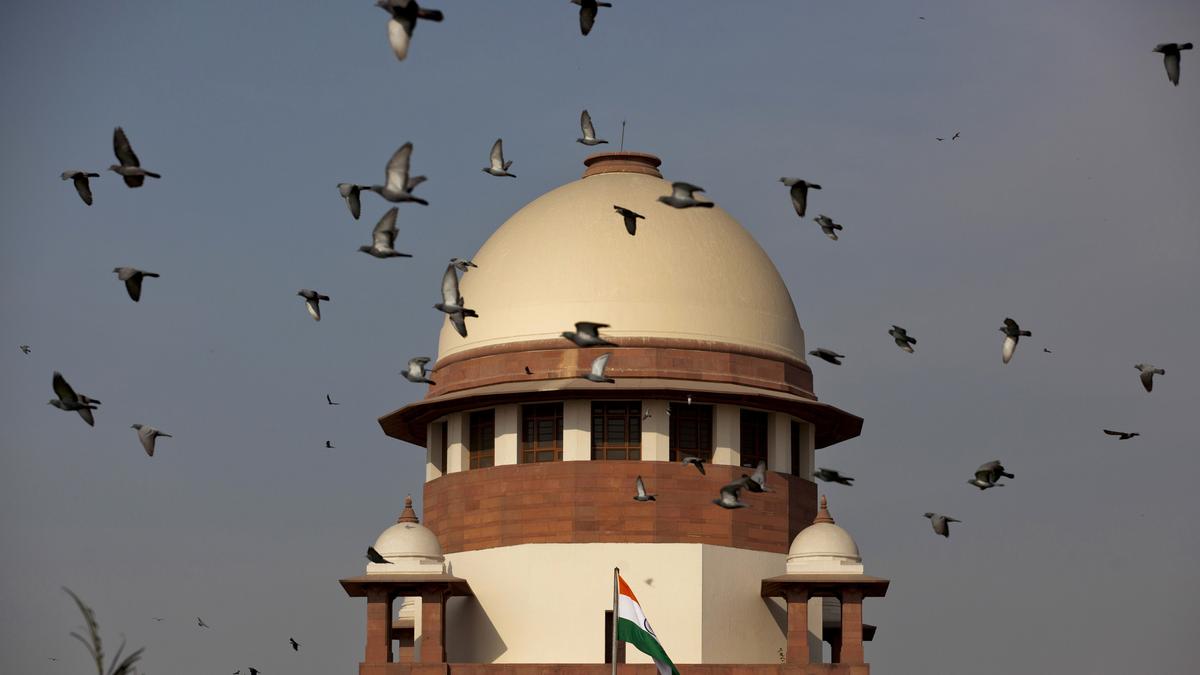
Mon Oct 21 16:49:31 UTC 2024: Published – October 21, 2024 10:19 pm IST – New DelhiThe Chief Justice pointed out that Article 30 enabled minorities to establish and administer their institutions which were not entirely confined to teaching of their religion. | Photo Credit: AP
The Supreme Court on Monday (October 21, 2024) made a point that laws which regulate institutions run by religious or linguistic minorities, for that very reason alone, cannot be accused of breaching secularism.
The oral observation by Chief Justice of India D.Y. Chandrachud, heading a three-judge Bench, was hearing a challenge to a decision of the Allahabad High Court to strike down the Uttar Pradesh Board of Madrasa Education Act, 2004.
The 2004 Act regulated madrasas in the State. The High Court concluded that the law violated the principles of secularism. It had ordered the transfer of their students, especially those in recognised madrasas, to regular schools. Petitioners claimed in the top court that the verdict had affected the lives of nearly 17 lakh students spread across 16,000 madrasas in Uttar Pradesh.“A law per se regulating an institution belonging to a particular community does not ipso facto [by the fact itself] offend the principle of secularism,” Chief Justice Chandrachud observed.
The CJI referred to another Act in the same context, The Hindu Religious Endowments and Charitable Institutions Act, which provided for the “proper administration of religious institutions… and is there in all States from Maharashtra to Tamil Nadu”.
The Chief Justice said a State had a right to legislate to improve the excellence of a government-aided minority-run institution.
“It is within a State’s vital interest. These are young children who come to madrasas. They need a broad-based education… They should learn the essentials of subjects required to lead a proper life, so they become worthy citizens,” the CJI observed.
Senior advocate Menaka Guruswamy said the 2004 Act was a regulatory statute of the State of Uttar Pradesh. “The High Court conflated regulations with religious instructions and concluded the law violated secularism,” Ms. Guruswamy submitted.
The Chief Justice pointed out that Article 30 enabled minorities to establish and administer their institutions which were not entirely confined to teaching of their religion.“A Zoroastrian or Buddhist institution can teach medicine or engineering. There is no compulsion that a Buddhist institution should teach only Buddhism,” the CJI remarked.
Petitioners argued that the High Court had found that madrasas violated Article 28 of the Constitution, which prohibited “religious instruction” in educational institutions fully funded by the State.
They argued that academics in madrasas was a “mixture of science, mathematics, etc with certain portions of religious education and not religious instruction”.
The Bench however questioned whether a certificate from a madrasa would be valid for a student to go outside its system for a postgraduation course. Ms. Guruswamy said the solicitations to give madrasas university status began in 2002, but there has been no headway.
The court would resume the hearing on October 22.
Published – October 21, 2024 10:19 pm ISTlaws / judiciary (system of justice) / crime, law and justice / justice and rights / constitution
Copyright© 2024, THG PUBLISHING PVT LTD. or its affiliated companies. All rights reserved.
Terms & conditions | Institutional SubscriberComments have to be in English, and in full sentences. They cannot be abusive or personal. Please abide by our community guidelines for posting your comments.
We have migrated to a new commenting platform. If you are already a registered user of The Hindu and logged in, you may continue to engage with our articles. If you do not have an account please register and login to post comments. Users can access their older comments by logging into their accounts on Vuukle.
 First Piper