
Mon Sep 09 15:15:13 UTC 2024: ## AI Helps Astronomers Hunt for Alien Signals
**Oxford, UK** – A recent conference at the University of Oxford brought together leading astronomers and planetary scientists to discuss the use of artificial intelligence (AI) in the search for extraterrestrial intelligence (SETI). The Breakthrough Discuss conference, now entering its mainstream astrophysics, highlighted how AI is revolutionizing the search for signs of advanced civilizations in the cosmos.
Traditionally, SETI researchers faced limitations in deciding where and what to look for when searching for signals. However, advancements in AI and observational capabilities have enabled scientists to sift through massive datasets at unprecedented speeds.
“We are surveying almost a million nearby stars identified by the Gaia mission,” said Vishal Gajjar, SETI investigator and project scientist for Breakthrough Listen.
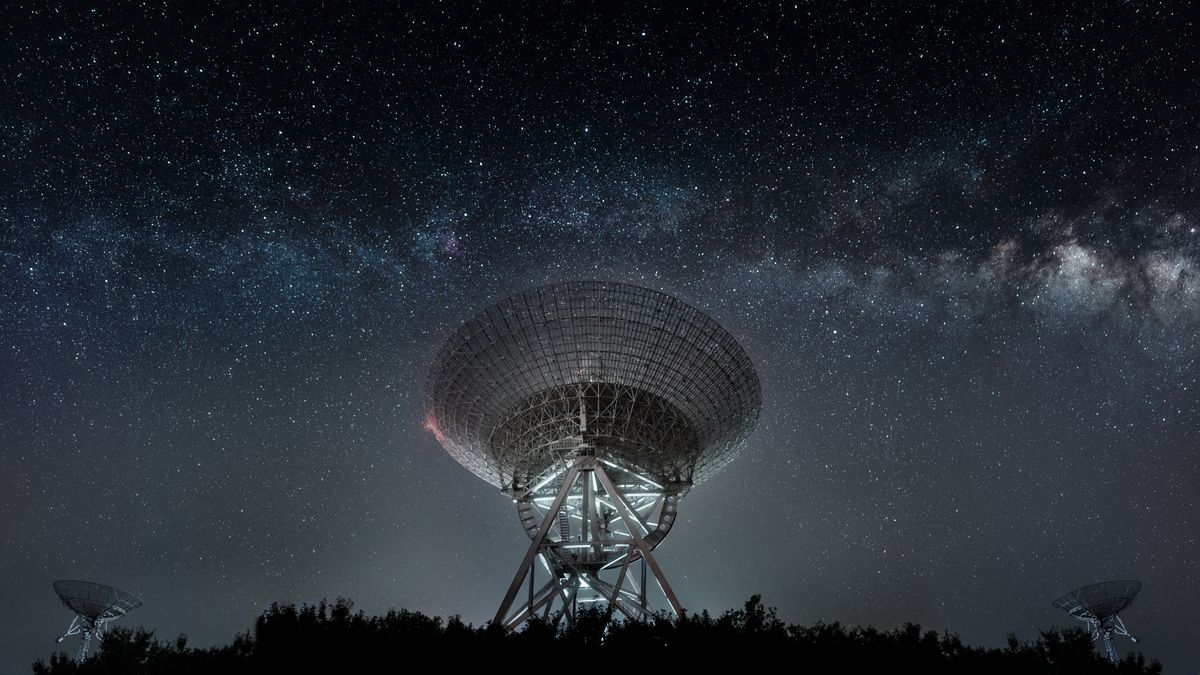
Researchers are using powerful telescopes, like the Green Bank Telescope and the MeerKAT Array, to search for technosignatures, potential indicators of advanced technology, not only from stars but also from empty space, including potential alien spacecraft or probes.
However, with such vast amounts of data, separating human-generated signals from potential extraterrestrial ones presents a significant challenge. AI models, trained on existing data, have been effective in eliminating false positives, reducing the noise and allowing researchers to focus on anomalous signals.
“With AI we have been able to remove 99.8% of our own signals,” said Gajjar.
While the search for technosignatures is still in its early stages, the potential for groundbreaking discoveries is enormous. The next generation of observatories, like the Vera C. Rubin Observatory and the Square Kilometer Array, will generate even larger datasets, posing computational challenges but also offering unprecedented opportunities.
“There will be computational challengers for astronomers seeking to identify new potential targets in large data sets created by current and future observatories, however, the possibilities for scientific discoveries are enormous,” said Michelle Lochner, an astrophysicist who develops anomaly detection algorithms.
The advancements in AI and the influx of new data are fueling renewed excitement in the field of SETI. Researchers are optimistic that the combination of AI, large datasets, and human expertise could lead to one of the most significant discoveries in human history: the confirmation of intelligent life beyond Earth.
 First Piper