
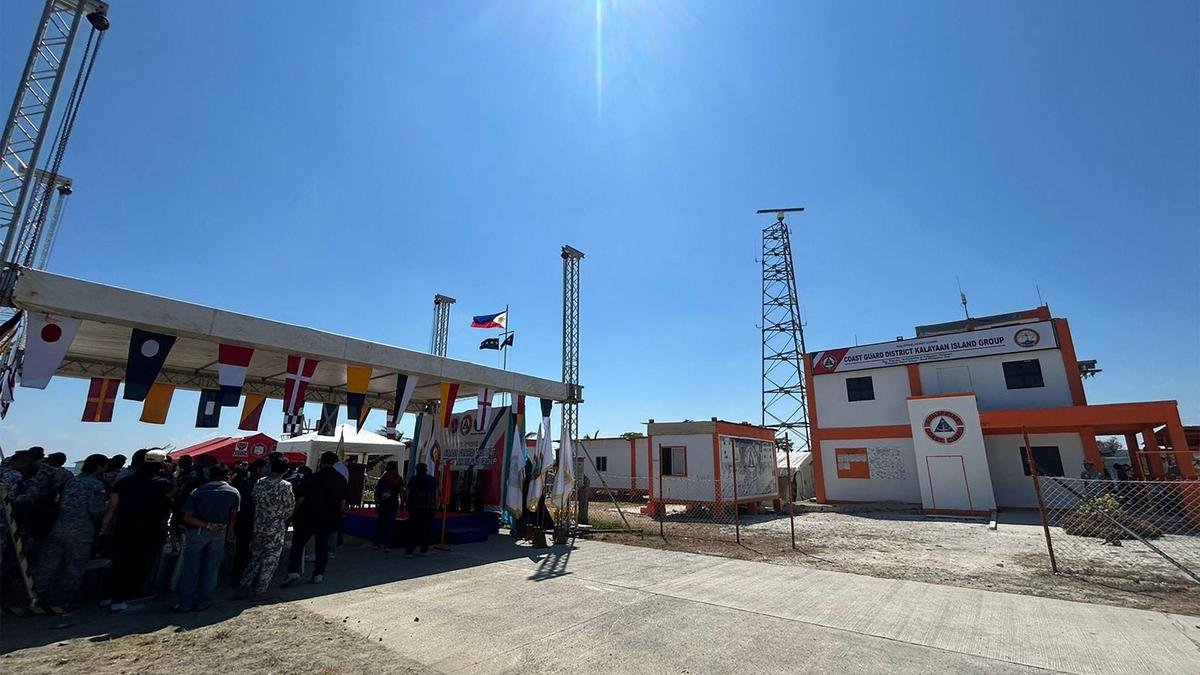
Thu Apr 09 07:21:44 UTC 2026: ### Headline: Philippines Establishes Coast Guard Command Center in Disputed South China Sea
The Story:
On April 9, 2026, the Philippine Coast Guard (PCG) inaugurated its first dedicated command center on Thitu Island in the Spratly island chain. This move underscores the Philippines’ efforts to assert its presence in the disputed South China Sea, a region marked by ongoing territorial disputes and frequent confrontations with Chinese vessels. The new headquarters will oversee a 68,000 square kilometer area previously managed from Palawan.
Key Points:
- The Philippine Coast Guard (PCG) unveiled its first command center on Thitu Island on April 9, 2026.
- Thitu Island is located in the Spratly island chain, a region within the disputed South China Sea.
- The command center will oversee an area of approximately 68,000 square kilometers (26,000 square miles).
- The command center was formerly overseen from Palawan.
- The South China Sea has been the site of repeated confrontations with Chinese vessels.
Key Takeaways:
- The establishment of the command center signifies the Philippines’ determination to enhance its maritime security and monitoring capabilities in the South China Sea.
- This action is likely to further escalate tensions between the Philippines and China, given the ongoing territorial disputes in the region.
- The move highlights the strategic importance of the South China Sea and the increasing militarization of the area by claimant states.
Impact Analysis:
- Geopolitical Significance: The establishment of the PCG command center has significant geopolitical implications. It reinforces the Philippines’ claim to the Spratly Islands and signals a stronger commitment to protecting its maritime interests in the face of Chinese assertiveness.
- Regional Security: The long-term impact on regional security is uncertain but potentially destabilizing. China is likely to view this development as a provocation, which could lead to increased naval presence and potentially more aggressive actions in the South China Sea. This could, in turn, prompt the Philippines to seek closer security cooperation with allies like the United States, further complicating the regional power dynamics.
- International Law: The move could be seen as a test of international law and the United Nations Convention on the Law of the Sea (UNCLOS). The Philippines has previously relied on UNCLOS to challenge China’s claims in the South China Sea, and this action may be interpreted as a continuation of that strategy. However, the practical impact on China’s behavior remains to be seen.
 First Piper