
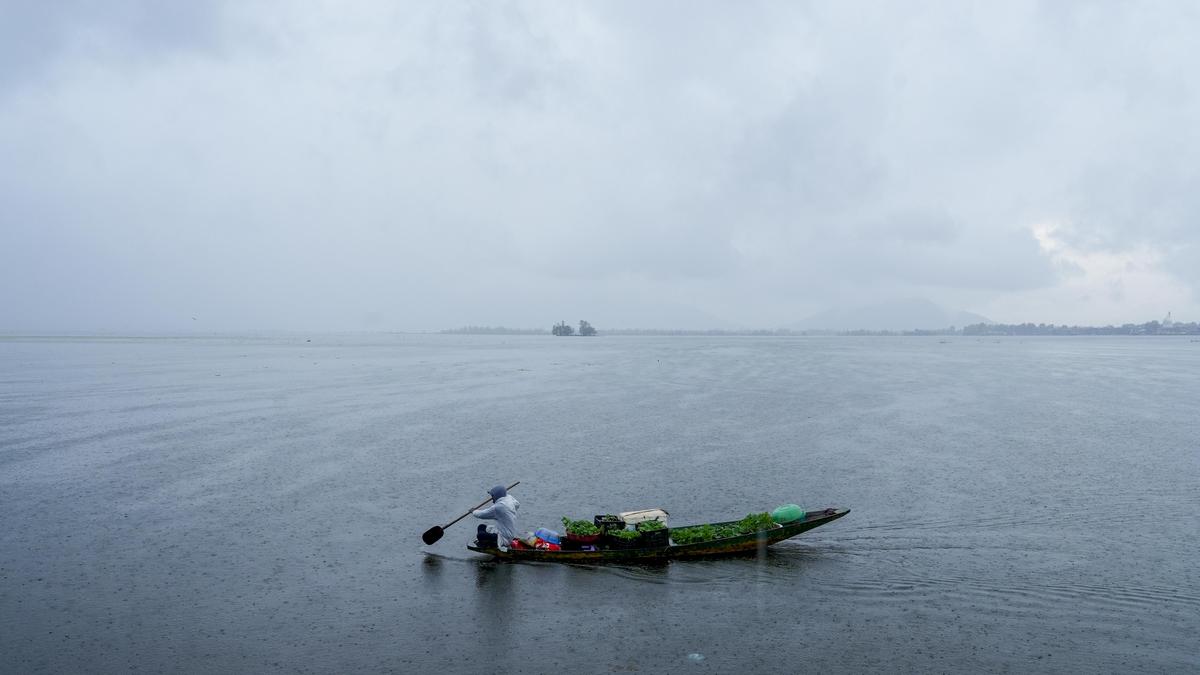
Tue Apr 07 06:33:23 UTC 2026: # J&K Lakes Vanishing at Alarming Rate, Threatening Ecosystem and Increasing Flood Risk
The Story:
A report by the Comptroller and Auditor General of India reveals a critical environmental crisis in Jammu and Kashmir (J&K). A staggering 74%, or 518, of the region’s lakes have either disappeared or shrunk, leading to ecosystem degradation and heightened climate insecurity. The report, covering the period up to March 2022, indicates that 315 lakes have vanished entirely, and the water area of another 203 lakes has significantly decreased. The shrinkage is cited as a contributing factor to the devastating floods of September 2014, as lakes serve as natural flood control reservoirs.
The report criticizes the J&K government’s lack of comprehensive conservation and management programs, particularly the failure of several administrative departments and the Forest Department to address anthropogenic pressures around the lakes. Only six lakes currently have dedicated conservation programs. The lack of a detailed survey of all 697 lakes by the J&K Ecology, Environment & Remote Sensing Department further exacerbates the problem, hindering the development of effective conservation plans.
Key Points:
- 518 lakes (74%) in J&K have either disappeared or shrunk.
- 315 lakes (45% of the total 697) have disappeared entirely.
- Water area of 203 lakes (29%) has decreased by 1,314.19 hectares.
- 63 lakes are at potential greater risk of extinction with water area reduced by “more than or equal to 50%”.
- The J&K government has conservation programs for only six lakes: Dal, Wular, Hokersar, Manasbal, Surinsar and Mansar lakes.
- The CAG report suggests the shrinkage of lake area contributed to the September 2014 floods.
- The J&K Ecology, Environment & Remote Sensing Department failed to carry out a detailed survey of 697 lakes.
Key Takeaways:
- The disappearance and shrinkage of lakes in J&K represent a severe environmental crisis with far-reaching consequences.
- Lack of effective conservation and management programs by the J&K government is a major contributing factor.
- Anthropogenic pressures, including construction and land use changes, are accelerating the degradation of lake ecosystems.
- The loss of lakes increases the risk of flooding and exacerbates climate insecurity in the region.
- Comprehensive surveys and data collection are crucial for developing informed and effective conservation strategies.
Impact Analysis:
The alarming rate of lake loss in J&K has significant long-term implications for the region’s environment, economy, and population. The degradation of lake ecosystems will negatively impact biodiversity, water resources, and livelihoods dependent on these resources, such as fishing and tourism. Increased flood risk poses a threat to infrastructure, agriculture, and human lives. Addressing this crisis requires urgent and coordinated action by the J&K government, involving comprehensive conservation programs, strict enforcement of environmental regulations, and sustainable land management practices. Failure to act decisively will result in irreversible damage to the region’s natural heritage and increased vulnerability to climate change impacts.
 First Piper