
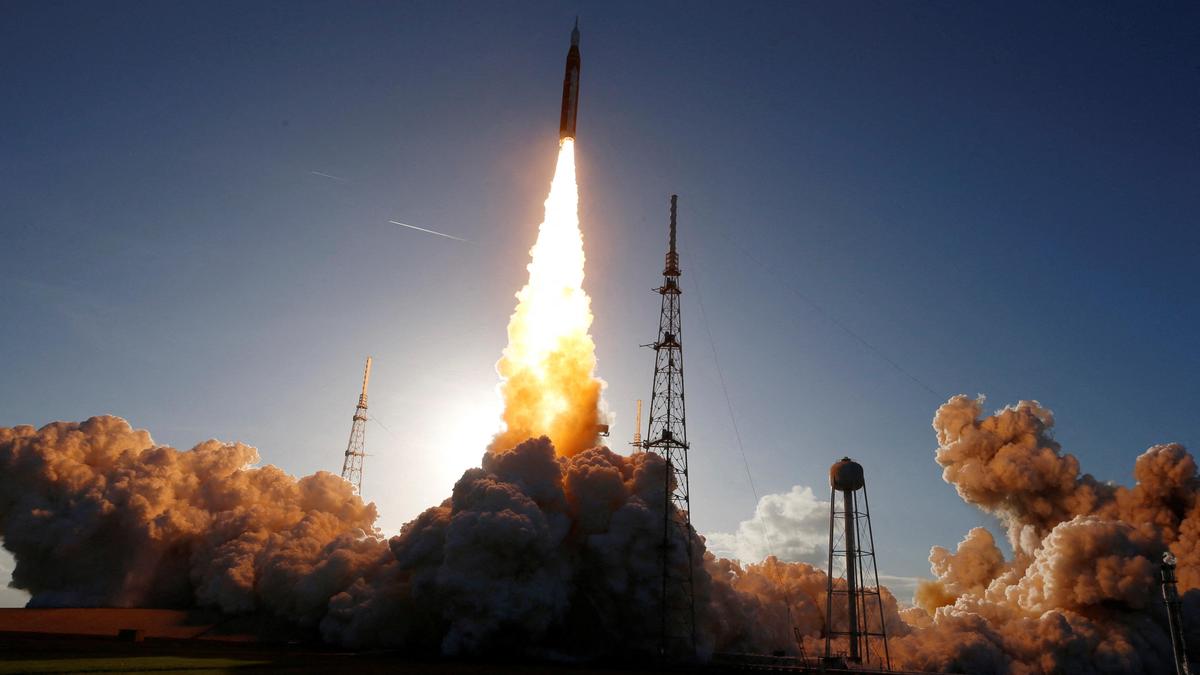
Thu Apr 02 01:30:26 UTC 2026: ### Artemis II Launches, Ushering in a New Era of Lunar Exploration
The Story:
On April 1, 2026, NASA’s Artemis II mission successfully launched from the Kennedy Space Center in Cape Canaveral, Florida, marking humanity’s first crewed lunar mission in over 50 years. The mission, utilizing the Space Launch System (SLS) rocket and the Orion crew capsule, carries four astronauts – three Americans and one Canadian – on a journey around the Moon. The launch was met with widespread excitement and congratulations, including acknowledgment from U.S. President Donald Trump.
The Artemis II mission is a crucial step in proving the functionality of the entire system, from ground teams to the rocket and crew, ensuring readiness for future moon landings. The astronauts will circle the Earth for approximately 25 hours before embarking on a trajectory around the far side of the moon, reaching within 7,500 km of its surface, ultimately splashing down in the Pacific Ocean in less than 10 days.
Key Points:
- Launch Date: April 1, 2026, at approximately 6:35 p.m. EDT.
- Mission: Crewed lunar flyby, not a landing.
- Rocket/Capsule: Space Launch System (SLS) rocket and Orion crew capsule.
- Crew Composition: Three American astronauts (Reid Wiseman, Victor Glover, Christina Koch) and one Canadian astronaut (Jeremy Hansen).
- Mission Objective: To validate the systems and processes for future moon landings.
- Trajectory: Free-return trajectory around the far side of the moon.
- Presidential Acknowledgement: President Trump congratulated NASA and the astronauts on the successful launch.
- Duration: Less than 10 days.
- Payload: The mission includes an Argentine-built microsatellite, ATENEA, to test experimental navigation systems and measure radiation.
Key Takeaways:
- Artemis II represents a significant milestone in renewed lunar exploration efforts.
- The mission serves as a crucial validation step for future crewed moon landings.
- International collaboration, exemplified by the inclusion of a Canadian astronaut and international payloads, is central to the Artemis program.
- The successful launch reflects years of planning and technological development.
- The mission signifies a potential revitalization of investor interest in the space industry, as indicated by increased aerospace company shares.
Impact Analysis:
The successful launch of Artemis II has several long-term implications:
- Advancement of Space Technology: The mission will provide invaluable data and experience for the development of more advanced space technologies and systems.
- Future Lunar Landings: The validation of systems and processes will pave the way for crewed lunar landings within the Artemis program.
- Space Industry Growth: The renewed interest in space exploration could stimulate economic growth and innovation within the aerospace industry.
- Scientific Discovery: The mission, including the deployment of payloads like ATENEA, has the potential to yield new scientific discoveries about the moon and space environment.
- Global Collaboration: The Artemis program fosters international cooperation and collaboration in space exploration.
 First Piper