
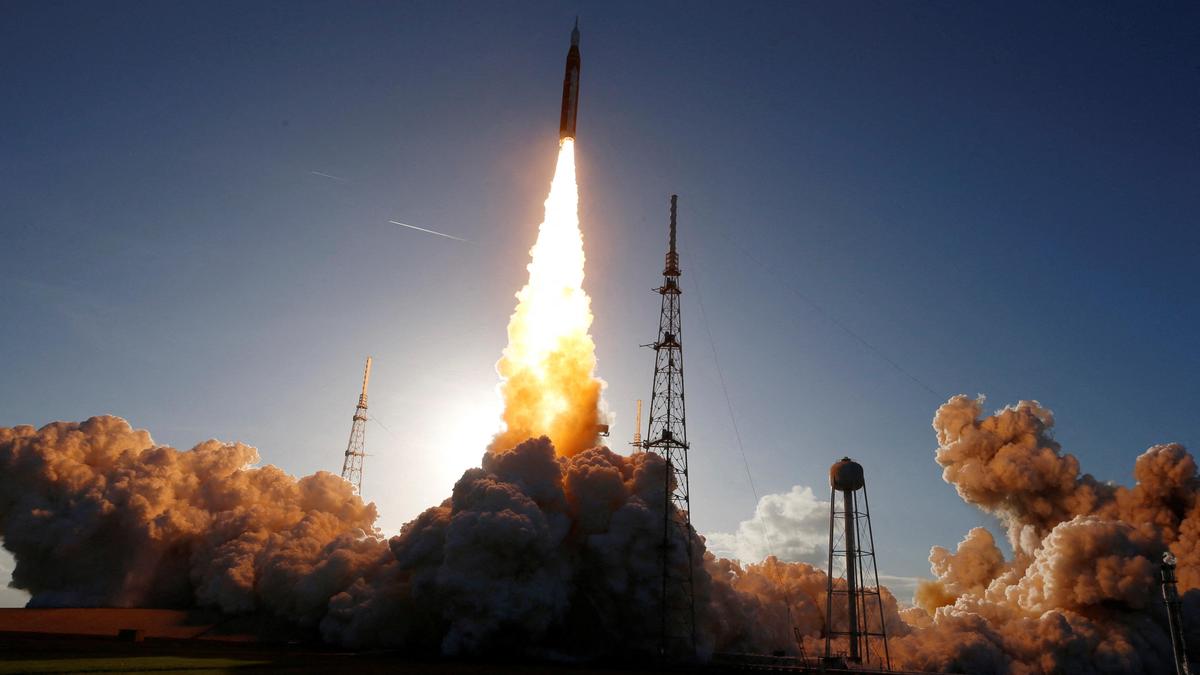
Thu Apr 02 01:56:07 UTC 2026: ### Artemis II Launches, Ushering in a New Era of Lunar Exploration
The Story:
On April 1, 2026, NASA’s Artemis II mission successfully launched from Kennedy Space Center in Cape Canaveral, Florida, marking the first crewed lunar flyby in over 50 years. The mission, utilizing the Space Launch System (SLS) rocket and Orion crew capsule, carries four astronauts—three Americans and one Canadian—on a journey around the Moon. The launch represents a significant step towards NASA’s goal of returning humans to the lunar surface. The mission aims to prove the functionality of the complete system, from ground teams to the rocket itself, before attempting a lunar landing.
Key Points:
- The Artemis II mission launched on April 1, 2026, at approximately 6:35 p.m. EDT.
- The mission utilizes the Space Launch System (SLS) rocket and the Orion crew capsule.
- The crew consists of three American astronauts (Reid Wiseman, Victor Glover, and Christina Koch) and one Canadian astronaut (Jeremy Hansen).
- The mission is a lunar flyby, not a landing, designed to test the system’s capabilities.
- The Orion spacecraft will follow a free-return trajectory around the far side of the moon, coming within 7,500 km of the lunar surface.
- The mission is expected to last less than 10 days, culminating in a splashdown in the Pacific Ocean.
- The launch was met with congratulations from U.S. President Donald Trump.
- The mission marks the first time a woman, person of color, and non-US citizen have been part of a lunar mission crew.
Key Takeaways:
- Artemis II represents a major milestone in renewed lunar exploration efforts.
- The mission serves as a crucial test for future lunar landing attempts.
- International collaboration is a key component of the Artemis program.
- The successful launch boosts investor confidence in the space industry, as evidenced by rising aerospace company shares.
- The mission is a significant achievement for NASA and the participating nations, demonstrating technological capabilities and commitment to space exploration.
Impact Analysis:
The Artemis II mission has far-reaching implications for the future of space exploration. Its success validates the SLS rocket and Orion spacecraft, paving the way for more ambitious lunar missions, including planned landings. The mission also fosters international partnerships in space, as evidenced by the inclusion of a Canadian astronaut and international payloads. Furthermore, the renewed focus on lunar exploration is expected to drive innovation in space technology and inspire future generations of scientists and engineers. The long-term impact includes potential establishment of a sustained lunar presence, resource utilization on the Moon, and further exploration of deep space.
 First Piper