
Wed Apr 01 05:44:13 UTC 2026: # Artemis II Faces High Stakes as US-China Lunar Race Intensifies
The Story:
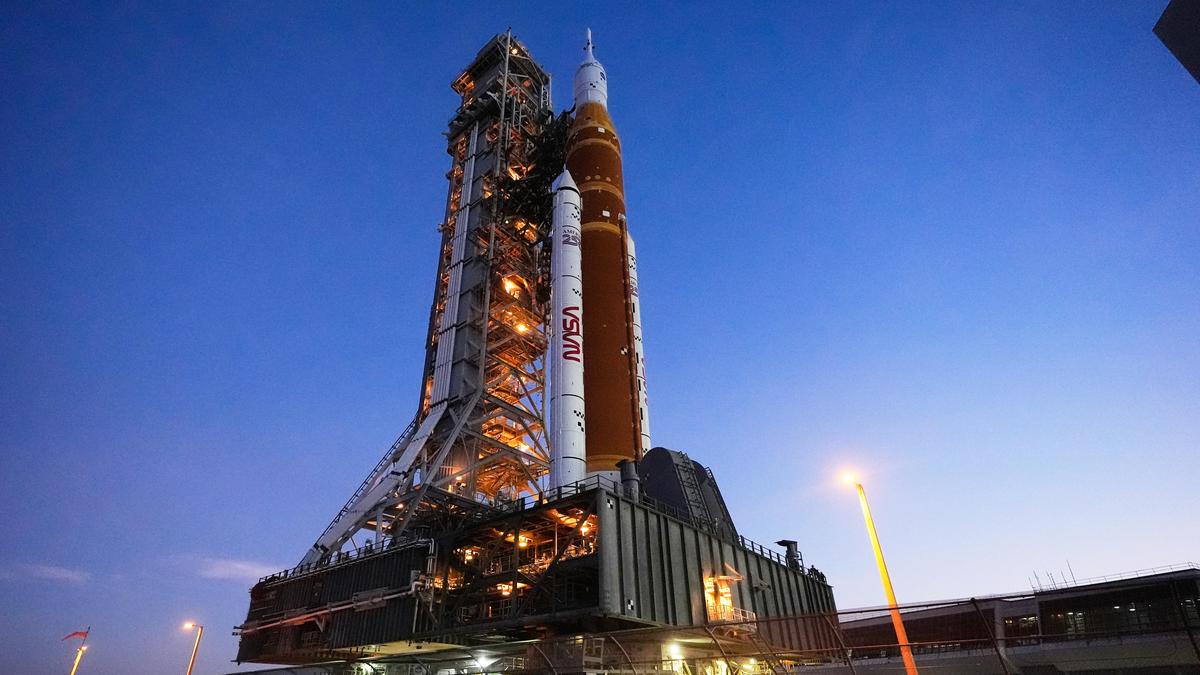
NASA’s Artemis II mission, slated to launch no earlier than April 1, 2026, represents a pivotal moment in the United States’ ambition to return humans to the vicinity of the Moon. This mission, using the Space Launch System (SLS) rocket and Orion crew capsule, aims to send a crew of four astronauts – Reid Wiseman, Victor Glover, Christina Koch, and Jeremy Hansen – on a free-return trajectory around the Moon. Significantly, this mission serves as a crucial test of the entire system’s functionality, from ground operations to the rocket’s performance and the crew’s ability to handle deep-space travel.
The mission’s importance is heightened by the intensifying space race with China, which plans to land humans on the Moon by 2030. NASA’s restructuring of the Artemis program, driven by concerns over workforce attrition and the need to accelerate timelines, underscores the urgency to establish a presence on the lunar surface, particularly in the resource-rich south pole region.
Key Points:
- Artemis II is scheduled to launch no earlier than April 1, 2026, sending humans beyond low-earth orbit for the first time since 1972.
- The crew includes Victor Glover, the first person of color, Christina Koch, the first woman, and Jeremy Hansen, the first non-U.S. citizen to embark on a lunar trajectory.
- The mission will test the SLS rocket, Orion capsule, and crew’s ability to operate in deep space, including life support systems and heat shield performance.
- NASA restructured the Artemis program to accelerate lunar landings, driven by competition with China’s lunar ambitions.
- The Lunar Gateway project was cancelled, and its components reallocated to lunar south pole infrastructure.
- China is developing its own lunar lander (Lanyue) and plans to land humans on the moon by 2030.
- The race for water ice deposits in the Moon’s south pole is a key geopolitical driver.
- The Artemis program has faced delays and high costs, with at least $93 billion spent so far and each launch costing at least $2 billion.
Critical Analysis:
The news article clearly reveals that the Artemis program’s evolution is inextricably linked to the escalating competition with China. NASA’s decision to restructure the program, cancel the Lunar Gateway, and prioritize speed reflects a strategic shift driven by the perceived threat of China achieving a dominant position on the Moon. The focus on the lunar south pole and its potential water ice resources further highlights the geopolitical dimension of the space race, with both countries vying for control over valuable lunar resources.
Key Takeaways:
- The Artemis II mission is a critical test for NASA’s lunar program, with significant implications for the US’s ability to compete with China in space.
- The US-China space race is intensifying, driven by geopolitical considerations and the potential for resource exploitation on the Moon.
- Delays or failures in the Artemis program could have serious consequences for NASA’s credibility, partnerships, and funding.
- The Artemis program has undergone significant changes to accelerate the timeline for landing humans on the Moon.
- The availability of water ice on the Moon’s south pole is a key strategic factor driving the lunar space race.
Impact Analysis:
The success or failure of Artemis II will have long-term ramifications for the future of space exploration and international relations. A successful mission would not only validate NASA’s technology and approach but also galvanize political and public support for the Artemis program, strengthening the US’s position in the space race. Conversely, a failure could
 First Piper