
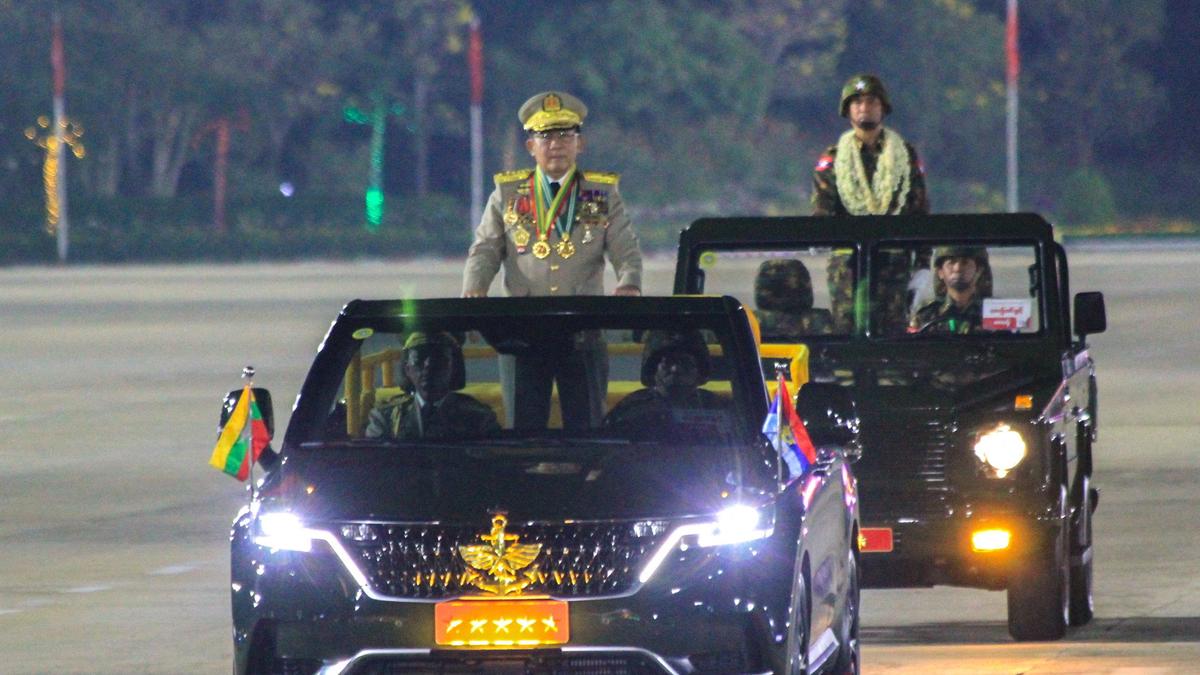
Tue Mar 31 17:46:50 UTC 2026: ### Headline: Myanmar Junta Chief Min Aung Hlaing Elected Vice-President, Edging Closer to Presidency
The Story:
Myanmar’s junta chief, Min Aung Hlaing, was elected as Vice-President by the lower house of parliament on March 31, 2026. This move brings him significantly closer to securing the presidency and transitioning from military ruler to civilian leader. The election follows a heavily restricted general election in January 2026 that saw a landslide victory for the military-backed Union Solidarity and Development Party (USDP). The selection process involves parliament choosing three Vice-Presidents, one of whom will then be selected as president.
Key Points:
- Min Aung Hlaing received 247 out of 260 votes in the lower house election for Vice-President.
- Nan Ni Ni Aye, a regional MP from Karen State with the USDP, was elected as another Vice-President.
- A third Vice-President will be chosen by the military.
- A parliament-wide vote to select the president from among the three Vice-Presidents is expected this week.
- Min Aung Hlaing handed over the reins of the military to Ye Win Oo on March 30, 2026.
- The USDP won 80% of elected seats in the January 2026 elections.
Critical Analysis:
The election of Min Aung Hlaing as Vice-President is the culmination of a carefully orchestrated plan to consolidate military control under the guise of a civilian government. The historical context reveals a series of preceding events designed to facilitate this transition: Min Aung Hlaing’s nomination in the presidential process, his step down as military chief, and earlier signals of leadership changes within the military. The heavily restricted elections in January 2026, which resulted in a sweeping victory for the USDP, further solidified the military’s position and paved the way for this outcome. This strategic maneuvering indicates a calculated effort to maintain power despite international condemnation of the 2021 coup and subsequent hardline rule.
Key Takeaways:
- The election of Min Aung Hlaing as Vice-President represents a significant step towards consolidating military control in Myanmar under a civilian facade.
- The USDP’s dominance in parliament ensures that the new government will likely adhere to the military’s agenda.
- The events highlight the erosion of democratic principles in Myanmar following the 2021 coup.
- The transition is designed to provide a semblance of legitimacy to the military’s continued rule.
- The orchestrated nature of the transition suggests a lack of genuine political reform.
Impact Analysis:
The election of Min Aung Hlaing as Vice-President, and his likely subsequent ascension to the presidency, has several long-term implications. Domestically, it signals a continuation of authoritarian rule, likely suppressing dissent and hindering any progress towards genuine democracy. The ongoing civil war, triggered by the 2021 coup, is likely to persist, further destabilizing the country and exacerbating humanitarian crises. Internationally, Myanmar’s isolation is likely to deepen, with continued sanctions and limited engagement from democratic nations. The event may also influence regional dynamics, potentially straining relations with neighboring countries concerned about stability and human rights. Furthermore, the fencing of the Myanmar border, mentioned in the historical context, could lead to increased tensions and further limit cross-border interactions. The long-term impact will be a more entrenched military regime and a protracted period of instability for Myanmar.
 First Piper