
Mon Mar 30 11:10:00 UTC 2026: ### Bank of India Plummets Amidst Sector-Wide and Market Downturn
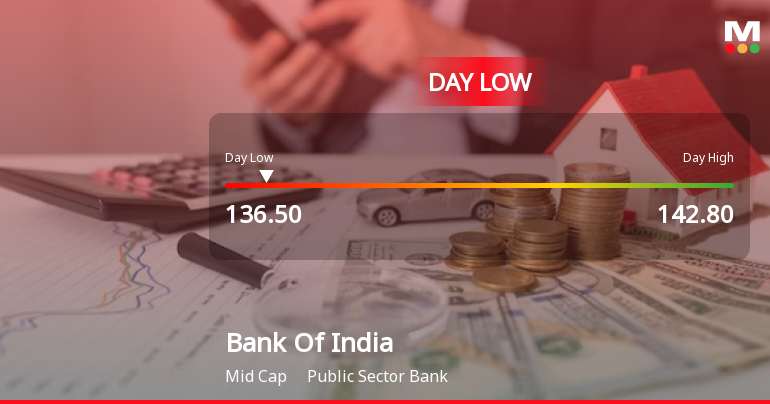
The Story: Bank of India (BOI) experienced a significant intraday decline on March 30, 2026, underperforming both the Public Sector Bank (PSB) sector and the broader Sensex index. Opening with a gap down of -2.07%, the stock continued its descent to an intraday low of Rs 136.65, a -5.73% drop from the previous close. The stock closed down -5.31%, exceeding the PSB sector’s -4.17% fall and the Sensex’s -2.02% decline.
This downturn extends a two-day losing streak, resulting in a cumulative loss of -8.3%. While BOI has shown strong performance over the past year (28.10% return) and three years (78.88% rise), recent market pressures and technical indicators suggest short- to medium-term downward momentum.
Key Points:
- Bank of India’s stock price declined sharply on March 30, 2026, falling -5.31%.
- The decline was more pronounced than the Public Sector Bank sector’s -4.17% decrease and the Sensex’s -2.02% drop.
- The stock is trading below its short-term moving averages, indicating downward momentum.
- Weekly technical indicators like MACD and KST show mild bearishness.
- The Sensex is nearing its 52-week low, reflecting a cautious market sentiment.
- The article mentions a “Mojo Score” of 71.0 and a “Buy” grade that was downgraded from “Strong Buy” on March 9, 2026, indicating a change in investment rating.
Critical Analysis:
The simultaneous decline of Union Bank of India and Bank of India on the same day (March 30, 2026) highlights a potential systemic risk or external factor impacting the Public Sector Banks. The passage of the Insolvency and Bankruptcy Code amendment bill may have a bearing on the banking sector’s health, influencing investor sentiment.
Key Takeaways:
- Bank of India is facing immediate price pressures due to a combination of sectoral weakness, broader market downturn, and technical resistance.
- Market sentiment is cautious, with the Sensex approaching its 52-week low.
- Technical indicators provide mixed signals, with short-term bearishness contrasting with longer-term bullish signals.
- The performance of other Public Sector Banks, such as Union Bank of India, could be indicative of a broader trend affecting the sector.
- Investors should exercise caution and consider both short-term and long-term indicators before making investment decisions related to Bank of India.
Impact Analysis:
The current market volatility and sector-wide pressures could lead to continued downward pressure on Bank of India’s stock in the short term. The extent of this impact will depend on how the bank navigates the challenging market conditions and whether the broader economic sentiment improves. The passage of the Insolvency and Bankruptcy Code amendment bill could have long term implications on the banking sector, and thus, on Bank of India.
 First Piper