
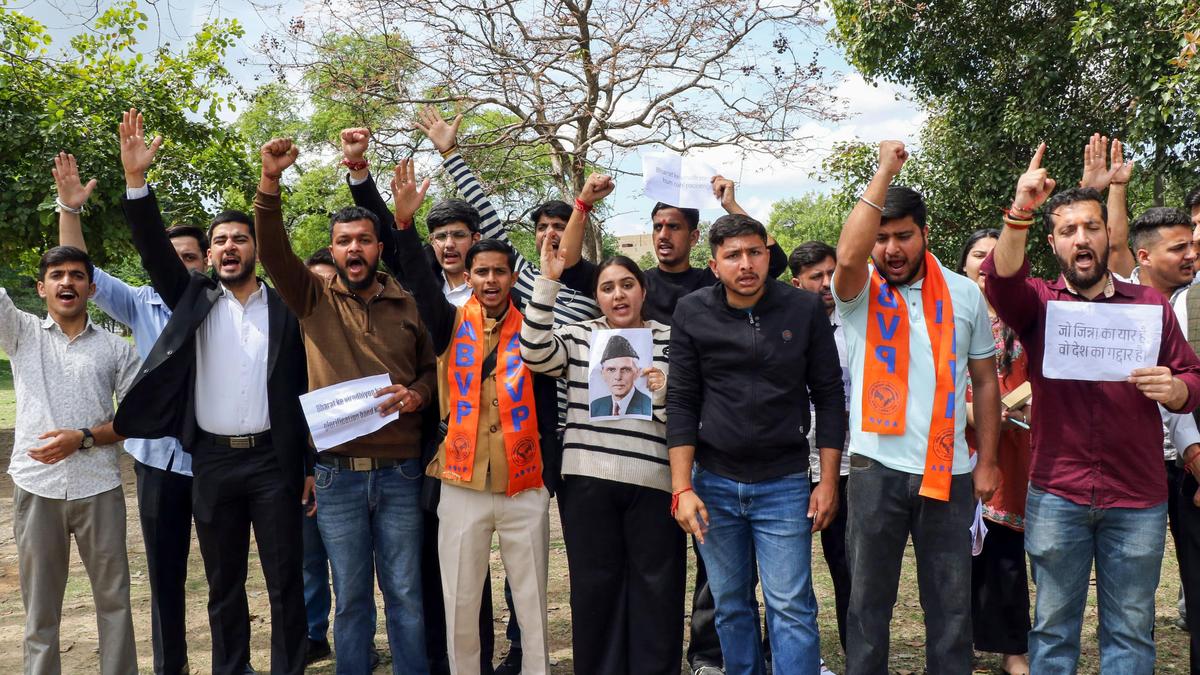
Mon Mar 23 15:37:02 UTC 2026: Headline: Jammu University Considers Dropping Jinnah, Iqbal, and Sir Syed Ahmad Khan from Syllabus Following Protests
The Story:
Jammu University is considering removing chapters on Mohammad Ali Jinnah, Sir Syed Ahmad Khan, and Mohammad Iqbal from its postgraduate Political Science curriculum. This decision follows protests by the Akhil Bharatiya Vidyarthi Parishad (ABVP) on March 20, 2026, who demanded the removal of the chapter on Jinnah. The university’s departmental affairs committee (DAC) convened on March 22, 2026, to address the concerns. The National Conference (NC) and the Peoples Democratic Party (PDP) have criticized the move, viewing it as a capitulation to pressure and a dangerous attempt to curate acceptable history.
Key Points:
- ABVP protested the inclusion of a chapter on Muhammad Ali Jinnah.
- Jammu University’s committee recommended removing topics concerning Jinnah, Khan, and Iqbal.
- The NC and PDP criticized the decision as a capitulation to pressure and a “narrow academic outlook.”
- A fresh meeting of the Board of Studies (BOS) will be held on March 24, 2026, to further deliberate on the matter.
- The decision is being considered under the context of the National Education Policy 2020.
Critical Analysis:
The removal of these figures from the curriculum, especially under the guise of the National Education Policy 2020, suggests a potential shift towards prioritizing a specific nationalist narrative within the education system. The fact that the university is yielding to pressure from a student organization raises concerns about academic freedom and the potential for politically motivated censorship. The related context of strict new rules for college events at Delhi University further reinforces the idea of increased control over academic spaces.
Key Takeaways:
- The incident highlights a growing trend of politicization of academic curricula in India.
- Pressure from student organizations can significantly influence university decisions.
- The removal of historical figures from syllabi raises concerns about academic freedom and intellectual inquiry.
- Political parties are divided on the value of curricula inclusion.
- The National Education Policy 2020 is used to justify curriculum changes.
Impact Analysis:
This event could set a precedent for similar actions in other universities, potentially leading to a homogenized and less diverse academic environment. The long-term impact could be a generation of students with a limited understanding of complex historical figures and events, particularly those related to the formation of Pakistan and the intellectual landscape of the subcontinent. This could further exacerbate existing tensions and hinder efforts towards reconciliation and understanding between India and Pakistan.
 First Piper