
Sat Mar 14 04:49:23 UTC 2026: # Earth’s Magnetic Field Reversals Can Last Significantly Longer Than Previously Thought
The Story:
A new study published in Communications Earth & Environment challenges the long-held belief that Earth’s magnetic field reversals occur relatively quickly, within approximately 10,000 years. By analyzing deep-sea sediment cores from 40 million years ago, researchers from France, Japan, and the U.S. discovered that some reversals can last much longer, potentially leaving the planet with a weakened defense against solar radiation for tens of thousands of years.
The research team examined mud settled on the ocean floor during the Eocene epoch, using X-ray scanning and magnetic measurements to reconstruct the magnetic field’s history. Their findings reveal that one reversal spanned 18,000 years, while another extended for a staggering 70,000 years, significantly longer than previously understood.
Key Points:
- The study analyzed deep-sea sediment cores from the North Atlantic Ocean dating back 40 million years.
- Researchers found evidence of magnetic field reversals lasting 18,000 and 70,000 years.
- The 70,000-year event included a complex precursor phase and multiple “rebounds.”
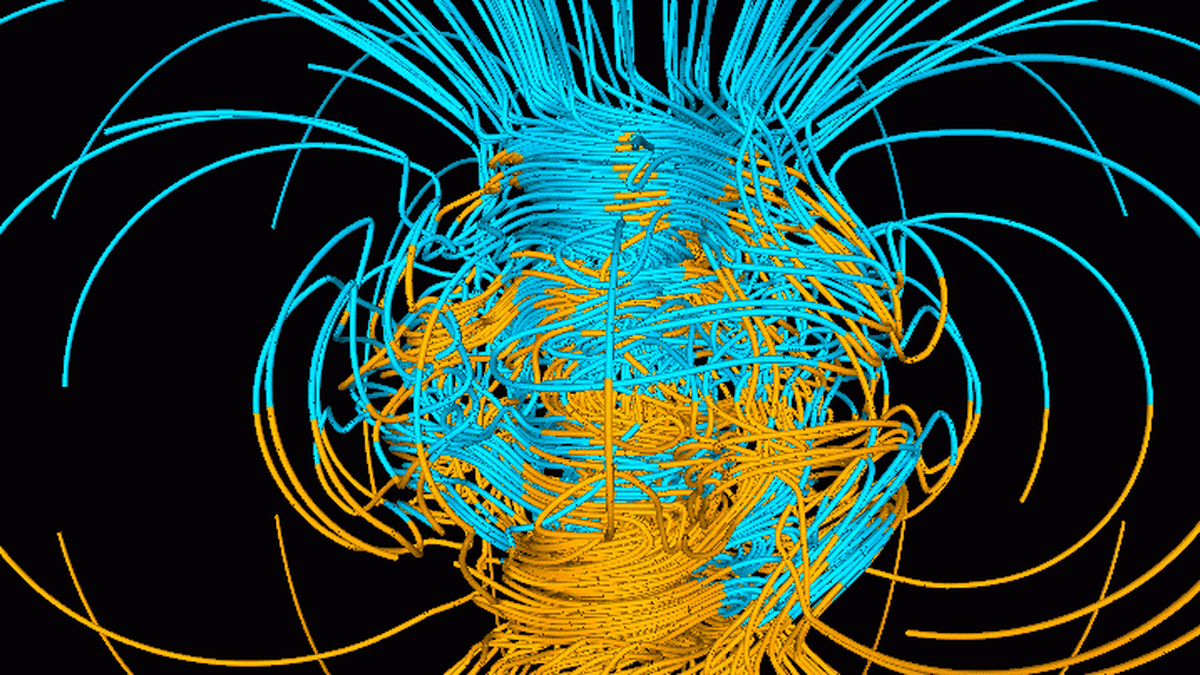
- Numerical simulations of the Earth’s core support the possibility of such prolonged reversals.
- A weak magnetic field for extended periods could expose the atmosphere and surface life to increased solar radiation.
Critical Analysis:
The related news regarding ISRO’s Aditya-L1 decoding how solar storms affect earth’s magnetic field provides a contextual backdrop. The understanding of the magnetic field’s dynamics and its interaction with solar activity is crucial, because prolonged magnetic field reversals could have significant consequences for Earth’s climate and life.
Key Takeaways:
- Earth’s magnetic field reversals are not always rapid events; they can last for tens of thousands of years.
- Prolonged magnetic field weakness can significantly increase exposure to solar radiation.
- This research challenges existing models of the Earth’s geodynamo.
- Understanding the duration and impact of these reversals is crucial for assessing long-term environmental changes.
- The study highlights the importance of researching geological records to understand Earth’s past and predict future events.
Impact Analysis:
This discovery has implications for understanding past climate changes and the evolution of life on Earth. If prolonged periods of weakened magnetic field strength correlate with specific environmental or biological events in the geological record, it could provide new insights into the drivers of those events. It may also influence future research on space weather and its potential impact on our planet.
 First Piper