
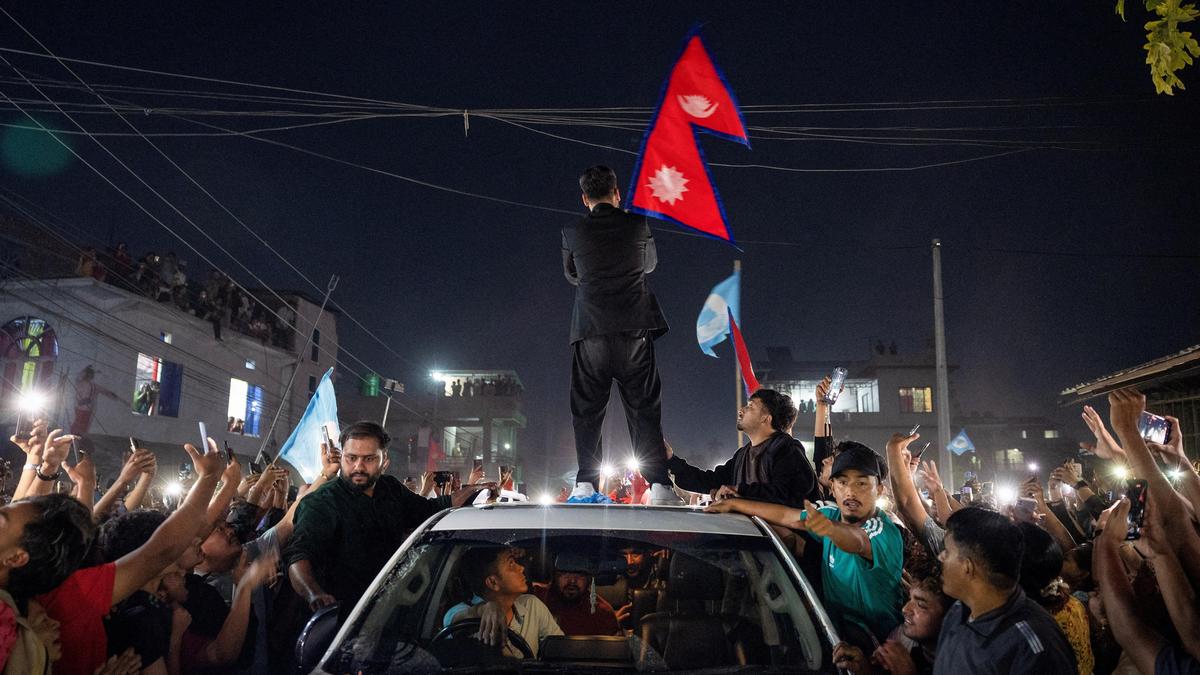
Thu Mar 12 06:46:16 UTC 2026: ### Headline: Nepal’s Rastriya Swatantra Party Secures Landslide Victory, Ushering in Generational Shift
The Story:
Nepal’s general election on March 5, 2026, resulted in a significant victory for the Rastriya Swatantra Party (RSP), marking a potential turning point in Nepali politics. The RSP’s success came at the expense of established political parties like the Nepali Congress (NC) and the Communist Party of Nepal (United Marxist-Leninist), or CPN(UML), with many veteran leaders losing to new faces. This outcome follows the September 2025 Gen Z movement, fueled by widespread discontent over corruption and nepotism, which led to the formation of an interim government under former Chief Justice Sushila Karki and the subsequent dissolution of Parliament.
The RSP, despite its relative newness, capitalized on public sentiment, particularly among young voters, by promising clean governance and addressing issues of corruption and economic development. Balendra “Balen” Shah, a former rapper and Mayor of Kathmandu, is the party’s prime ministerial candidate.
Key Points:
- The Rastriya Swatantra Party (RSP) achieved a landslide victory in the March 5, 2026, general election.
- The election was triggered by the Gen Z movement in September 2025, protesting corruption and nepotism.
- Former Chief Justice Sushila Karki led the interim government and oversaw the election process.
- Balendra “Balen” Shah, a former rapper and Mayor of Kathmandu, is the RSP’s prime ministerial candidate.
- The RSP’s manifesto focused on clean governance, anti-corruption measures, and administrative reforms.
- India has congratulated Nepal on the successful elections and pledged continued support.
- The RSP needs 138 seats to form a government and will likely do so without a coalition.
Key Takeaways:
- The election results reflect a deep dissatisfaction with traditional political parties in Nepal, especially among the youth.
- The RSP’s victory signifies a generational shift in Nepali politics, with younger leaders and new ideas gaining prominence.
- The new government faces the challenge of delivering on its promises of clean governance and socio-economic development to maintain public trust.
- India aims to maintain a consistent and respectful engagement with Nepal, regardless of the political configuration.
- The focus of India’s engagement will be on development partnerships, infrastructure connectivity, and quiet diplomacy.
Impact Analysis:
The RSP’s rise to power has several long-term implications:
- Domestic Stability: The RSP’s ability to form a stable government without inner-party conflicts will be crucial for Nepal’s political stability.
- Socio-Economic Development: Meeting the expectations of young Nepalis by focusing on socio-economic development and job creation will be vital for the government’s success.
- Regional Relations: India’s approach of respectful engagement and development partnerships will be essential for maintaining positive bilateral relations.
- Democratic Evolution: The election outcome demonstrates the evolution of Nepal’s young democracy and its ability to respond to the aspirations of its citizens.
- Political Landscape: The traditional parties will need to re-evaluate their strategies and adapt to the changing political landscape to remain relevant.
 First Piper