
Mon Mar 09 10:21:52 UTC 2026: # First Direct Observation of Coronae on Trees Confirms Century-Old Prediction
The Story:
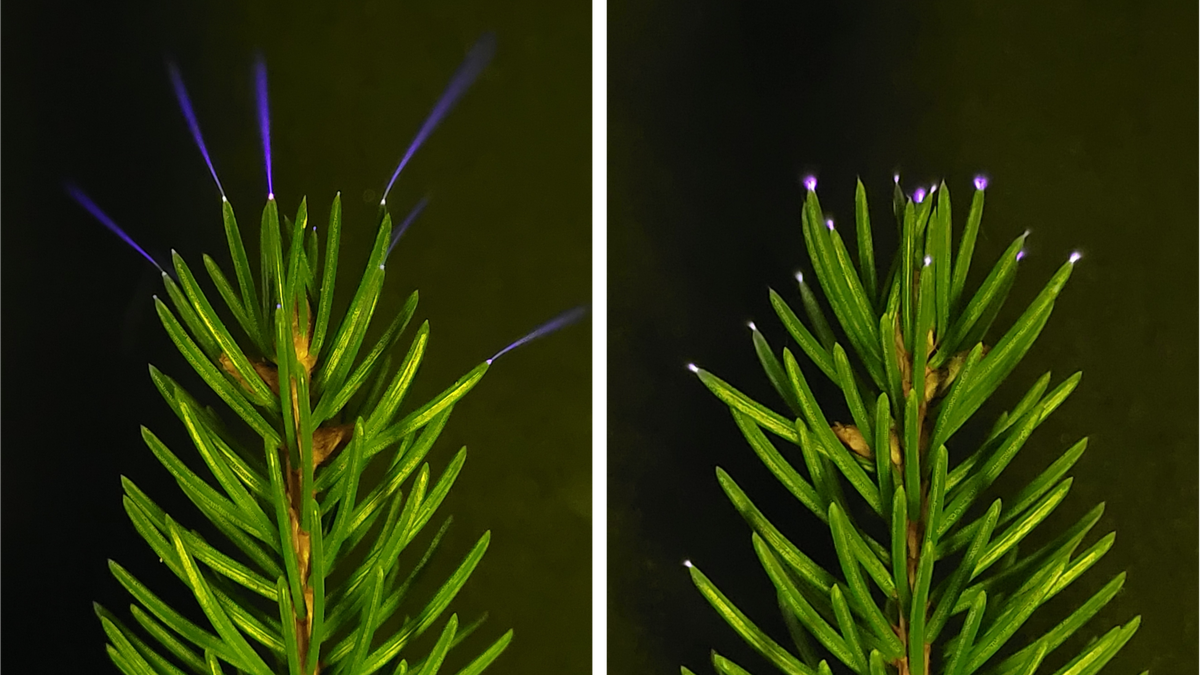
Researchers from Pennsylvania State University have made the first direct observations of coronae, weak electric discharges, on trees during thunderstorms. Using a novel instrument called the Corona Observing Telescope System (COTS), the team detected ultraviolet glows on sweetgum and loblolly pine trees during a thunderstorm in North Carolina. This confirms a nearly century-old prediction about the interaction between forests and thunderstorms. The study, published in Geophysical Research Letters, sheds light on the role of these electrical discharges in atmospheric chemistry and forest ecology.
Key Points:
- Researchers used COTS, a specialized camera sensitive to a narrow range of ultraviolet light, to observe coronae.
- Coronae were observed on sweetgum and loblolly pine trees during a thunderstorm in North Carolina.
- The ultraviolet glow hops sporadically from leaf to leaf and branch to branch.
- A typical corona discharge emits approximately one hundred billion photons, corresponding to an electrical current of about one microampere (1 μA) flowing through an individual tree branch.
- Coronae produce large amounts of the hydroxyl radical (OH–), acting as a detergent for the air.
- The electrical charge released by millions of glowing trees could influence the electrification of the clouds above them.
- Observations were expanded to four other storms from Florida to Pennsylvania.
Key Takeaways:
- The existence of coronae on trees during thunderstorms has been confirmed through direct observation.
- These discharges play a role in atmospheric chemistry by producing hydroxyl radicals, which clean the air.
- The widespread nature of this phenomenon, observed across multiple states, suggests its significance in forest ecosystems.
- The study provides a foundation for further research into the interaction between forests, thunderstorms, and the atmosphere.
- The voltage surges associated with these glows can cause small but permanent damage to trees by burning the fine tips of leaves.
Impact Analysis:
The confirmation of coronae on trees has several potential long-term implications.
- Atmospheric Science: Understanding the role of these discharges in producing hydroxyl radicals can refine atmospheric models and our understanding of air quality.
- Ecology: The subtle damage caused by these electrical discharges to trees could have cumulative effects on forest health. Further research is needed to determine the extent of this impact.
- Climate Modeling: The influence of tree electrification on cloud formation could be a previously overlooked factor in climate models.
- Technology: The innovative technology developed for this research, COTS, could be adapted for other environmental monitoring applications.
 First Piper