
Sat Feb 21 17:35:25 UTC 2026: # Trump’s Trade Policies in Disarray After Supreme Court Ruling; India Deal Remains Intact Amidst New Global Tariffs
The Story:
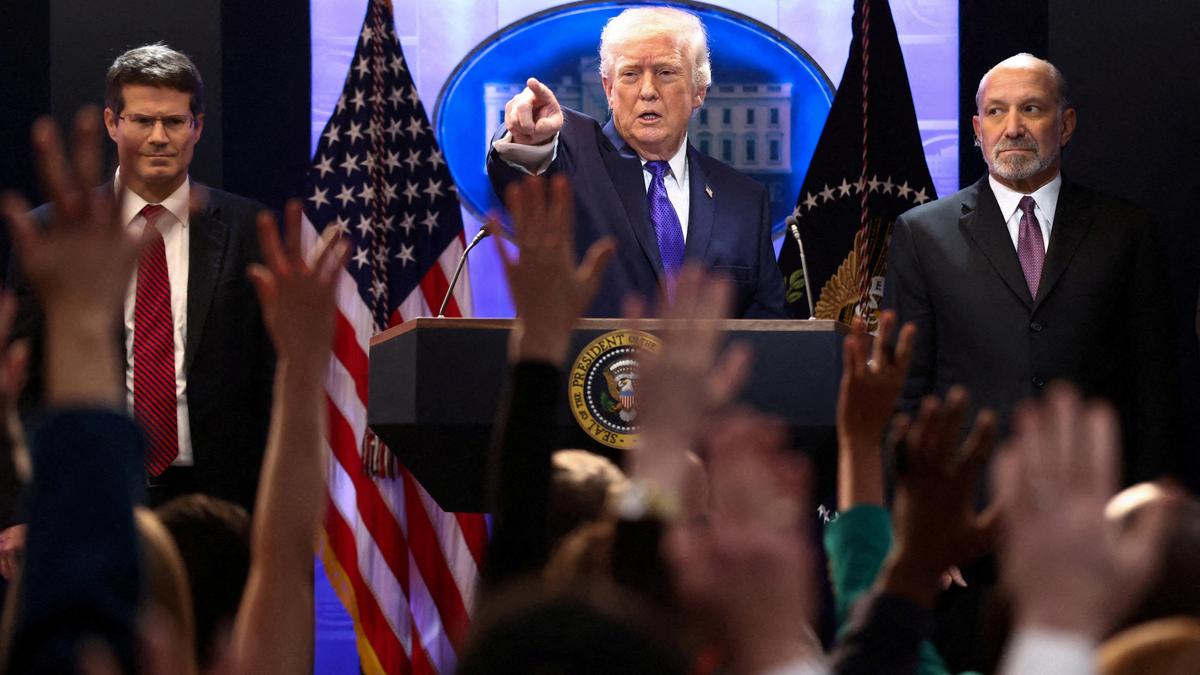
U.S. President Donald Trump confirmed the U.S.-India trade deal announced on February 2, 2026, remains unchanged despite the Supreme Court’s February 20, 2026, ruling against his ‘reciprocal tariffs.’ The Court found that Trump exceeded his authority under the International Emergency Economic Powers Act (IEEPA). Undeterred, Trump announced a broad 10% global tariff, raised to 15% on February 21, 2026, using Section 122 of the U.S. Trade Act (1974), valid for 150 days, while also maintaining existing Section 232 and 301 tariffs and initiating new 301 investigations. This comes as a surprise to many, who are still trying to understand the legal basis for the 18% tariff rate on India.
Key Points:
- The U.S. Supreme Court ruled against President Trump’s ‘reciprocal tariffs’ on February 20, 2026.
- The U.S.-India trade deal, reducing tariffs on Indian goods from 50% to 18%, remains in effect.
- Trump announced a 10% (later raised to 15%) “global tariff” under Section 122 of the U.S. Trade Act, effective February 24, 2026, lasting for 150 days.
- Exemptions to the global tariff include critical minerals, certain fertilizers, pharmaceuticals, some agricultural products, certain electronics, vehicles, aerospace products, and informational materials.
- Trump claimed credit for stopping a war between India and Pakistan and for India reducing its Russian oil purchases.
Critical Analysis:
The events reveal a pattern of Trump’s aggressive trade policies facing legal challenges and subsequent attempts to circumvent those challenges through alternative legal mechanisms. His continued emphasis on tariffs, despite legal setbacks, suggests a deep-seated belief in their effectiveness for reshaping trade relationships and reshoring domestic production. The exemptions to the global tariff appear strategically designed to minimize disruption to key U.S. industries and supply chains.
Key Takeaways:
- The U.S. Supreme Court is willing to check Presidential power regarding tariffs, setting a precedent for future trade policy disputes.
- The U.S.-India trade deal survives despite the broader disruption to Trump’s trade agenda.
- Trump’s administration is determined to use tariffs as a primary tool for trade policy, even if it requires finding alternative legal justifications.
- Trump’s claims regarding India’s actions on Russian oil and the India-Pakistan conflict appear exaggerated and politically motivated.
- The short-term nature of the global tariff (150 days) introduces uncertainty into international trade relationships.
Impact Analysis:
The Supreme Court ruling and subsequent global tariff announcement have several significant implications:
- Legal Ramifications: The ruling could embolden other countries to challenge U.S. tariffs.
- Economic Uncertainty: The global tariff creates uncertainty for businesses and consumers, potentially impacting global supply chains.
- Geopolitical Implications: The situation could strain relationships with countries affected by the global tariff. The exemptions offered suggest a strategic prioritizing of certain relationships (USMCA, Dominican Republic-Central America Free Trade Agreement trade partners).
- U.S.-India Relations: While the existing deal is maintained, the new global tariff could still create
 First Piper