
Sun Feb 15 10:08:43 UTC 2026: ### Headline: “Inside-Out” Planetary System Challenges Planet Formation Theories
The Story:
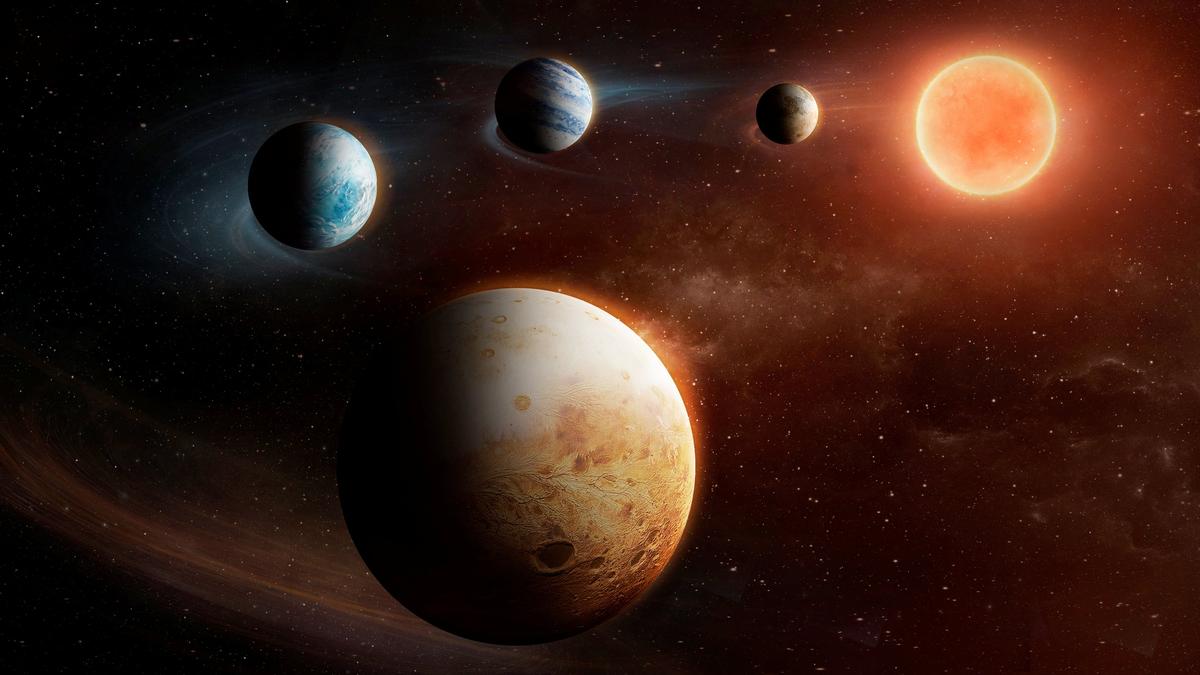
Astronomers have discovered an exoplanetary system that defies conventional planet formation models. Observed by the European Space Agency’s Cheops space telescope, the system, located 117 light-years away in the Lynx constellation, features four planets orbiting the red dwarf star LHS 1903. The planets consist of two rocky and two gaseous, but the order of the planets is unexpected. The outermost planet that should have been gaseous based on its location is rocky, challenging existing theories about planetary formation in different areas around a star.
Key Points:
- The exoplanetary system is located 117 light-years from Earth.
- The central star, LHS 1903, is a red dwarf, approximately 50% as massive and 5% as luminous as our Sun.
- The system comprises four planets: two rocky and two gaseous.
- The unexpected configuration is that the fourth planet, furthest from the star, is rocky instead of gaseous as expected, according to planet formation theories.
- Lead astronomer Thomas Wilson describes the system as “built inside-out.”
- About 6,100 exoplanets have been detected since the 1990s.
Key Takeaways:
- The discovery highlights the diversity and complexity of planetary systems beyond our own.
- Existing planet formation models may need to be revised to account for such “inside-out” systems.
- The finding underscores the importance of continued exoplanet research to better understand the processes that govern planet formation.
- The Cheops space telescope is proving to be a valuable tool for characterizing exoplanetary systems.
- Further observations and theoretical modeling are necessary to fully understand the formation history of LHS 1903’s planetary system.
 First Piper