
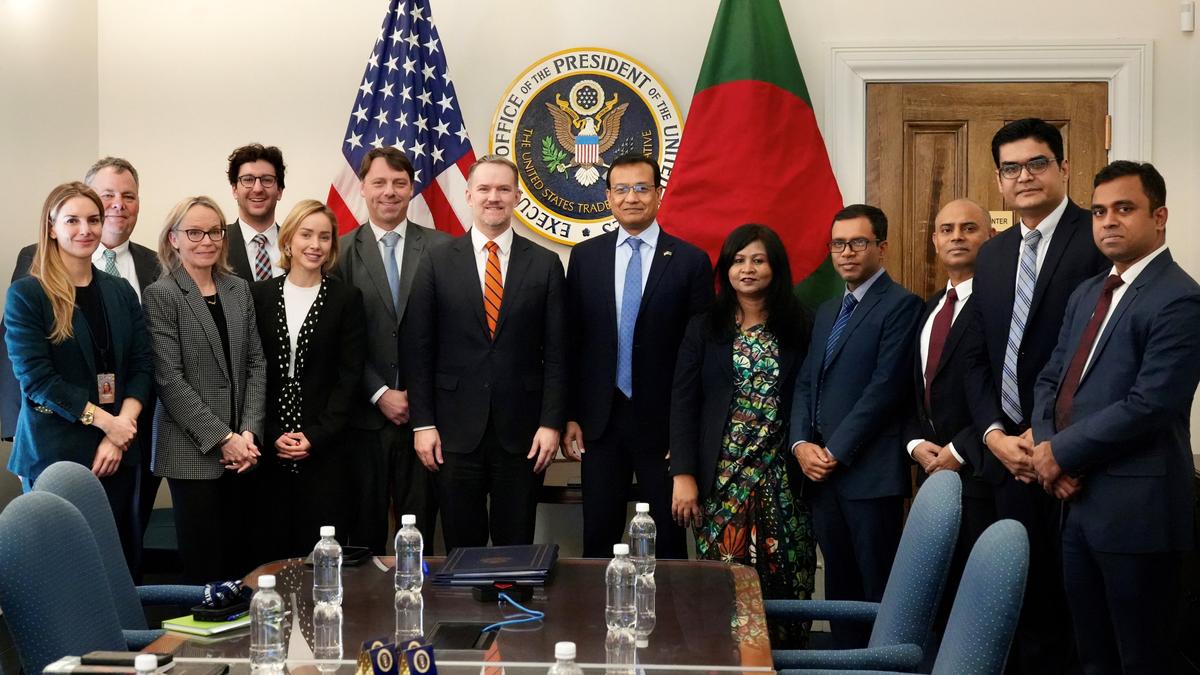
Tue Feb 10 05:28:31 UTC 2026: # U.S. and Bangladesh Sign Landmark Trade Agreement Amidst Geopolitical Shifts
The Story: On February 9, 2026, the U.S. and Bangladesh signed the U.S.–Bangladesh Agreement on Reciprocal Trade, marking a significant step in their economic partnership. The agreement, finalized after nine months of negotiations, grants Bangladesh a reduced 19% tariff on select textiles and garments manufactured using U.S. materials. This deal aims to boost Bangladesh’s ready-made garment (RMG) sector, a crucial component of its economy, while also opening new markets for U.S. exports, including wheat, soybean, and LNG.
Key Points:
- Bangladesh secured a reduced 19% tariff on specific textile and garment exports to the U.S. made with U.S.-produced cotton and man-made fiber.
- The agreement includes provisions for importing U.S. wheat, soybean, and LNG, and commits Bangladesh to refrain from imposing tariffs on e-commerce and to comply with U.S.-mandated intellectual property rights standards.
- Bangladesh recently agreed to purchase 25 aircraft from Boeing to ease U.S. tariffs.
- The U.S. remains Bangladesh’s largest export market.
- Bangladesh’s closest competitor, Vietnam, has been given a 20% reciprocal tariff, while Pakistan, Cambodia and Indonesia have also been subjected to a 19% tariff.
- The agreement comes shortly before Bangladesh’s general election on February 12, 2026.
- The U.S. earlier this month announced lowering tariffs to 18% from 50% for India, seeking New Delhi to halt Russian oil purchases and lower trade barriers.
Critical Analysis:
The timing of the U.S.-Bangladesh trade deal, coinciding with a similar agreement with India and just ahead of Bangladesh’s general election, suggests a deliberate U.S. strategy to strengthen ties in South Asia. The Commerce Secretary of Bangladesh hinted that recently concluded U.S.-India trade deal might have influenced Washington’s decision to cut the tariff “possibly due to geopolitical considerations.” The historical context also included that the US House voted to end Trumps tariffs on Canada. This could be connected to the United States re-engaging in trade negotiations.
Key Takeaways:
- The agreement provides much-needed relief to Bangladesh’s RMG sector, which heavily relies on exports.
- Geopolitical considerations, including balancing relations with India and potentially countering Chinese influence, appear to be a significant factor in the U.S.’s decision-making.
- The deal reflects a broader U.S. strategy to secure access to markets and promote its exports in South Asia.
- This trade agreement could potentially stabilize the political landscape in Bangladesh ahead of the upcoming elections.
Impact Analysis:
This agreement has the potential to significantly boost Bangladesh’s economy by enhancing its export capabilities and attracting further investment. It could lead to job creation, particularly for women in the RMG sector, and contribute to GDP growth. Simultaneously, it strengthens the U.S.’s economic and political influence in the region, creating a strategic advantage amidst evolving global trade dynamics. The agreement serves as a model for potential future trade deals in the region, contingent on countries aligning with U.S. trade and foreign policy objectives.
 First Piper