
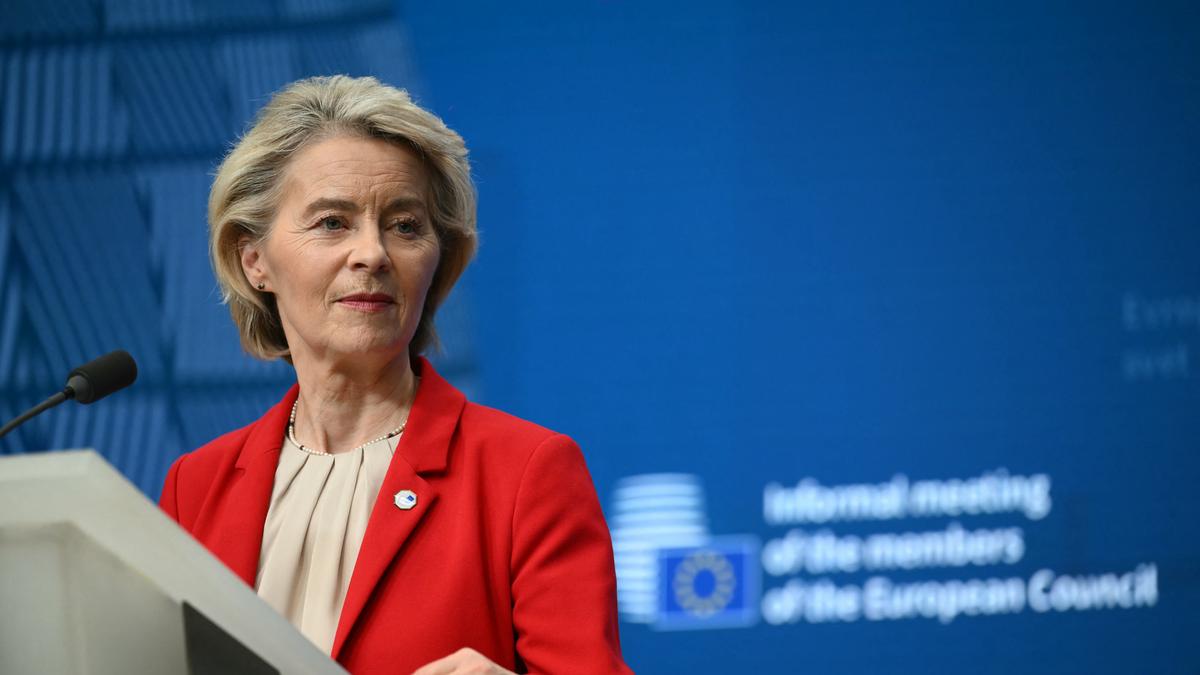
Thu Feb 12 06:02:44 UTC 2026: ### EU Faces Internal Divisions Amidst External Pressures
The Story:
European Union leaders convened on February 12, 2026, in Belgium to address growing challenges from the U.S., China, and Russia. The meeting, held at the Alden Biesen castle, highlighted deep divisions within the bloc regarding economic strategy, trade policy, and defense spending. While there’s consensus on the need for change, disagreements persist on the best path forward, particularly concerning deregulation, trade relationships, and the implementation of “European preference” to protect domestic industries.
Key Points:
* European Commission chief Ursula Von Der Leyen called for the EU to “tear down” economic barriers.
* The meeting aimed to shape proposals for a summit in late March 2026.
* German Chancellor Friedrich Merz and Italian Prime Minister Giorgia Meloni advocate for deregulation and stronger trade deals with nations like Mercosur.
* French President Emmanuel Macron pushes for “European preference” in key sectors and the issuance of “Eurobonds for the future” to challenge the dominance of the U.S. dollar.
* Germany and Italy are pushing for reduced EU red tape and an ambitious trade policy.
* An EU poll shows citizens desire a stronger, more unified EU leadership.
Critical Analysis
The situation reflects long-standing tensions between economic liberalism (favored by Germany and Italy) and protectionist tendencies (advocated by France). The pressure from external actors like the U.S. (President Donald Trump‘s tariffs) and China (critical mineral restrictions) are acting as catalysts, forcing the EU to confront its internal divisions and consider more unified economic and trade policies. Macron’s push for Eurobonds represents a bold attempt to create greater fiscal unity and challenge U.S. economic hegemony, but faces resistance due to concerns about shared debt.
Key Takeaways:
* The EU is at a critical juncture, needing to balance internal economic philosophies to effectively address external pressures.
* Trade policy and defense spending are key battlegrounds in the debate over Europe’s future direction.
* The future of the Euro and the EU’s economic sovereignty are central to the discussions.
* The need for a stronger, unified EU leadership is evident amid global instability.
* The tensions between Germany, France, and Italy are at the heart of the EU’s policy dilemmas.
Impact Analysis:
The outcome of these debates will significantly shape the EU’s economic competitiveness, its geopolitical influence, and its relationship with major global powers. If the EU fails to bridge its internal divisions, it risks being weakened and sidelined in an increasingly multipolar world. A more unified and strategic approach, particularly regarding trade and technology, could enable the EU to better compete with the U.S. and China, while also mitigating risks from Russia. The decision on Eurobonds will have far reaching impacts on the Euro and the EU’s ability to act with economic efficiency on the world stage.
 First Piper