
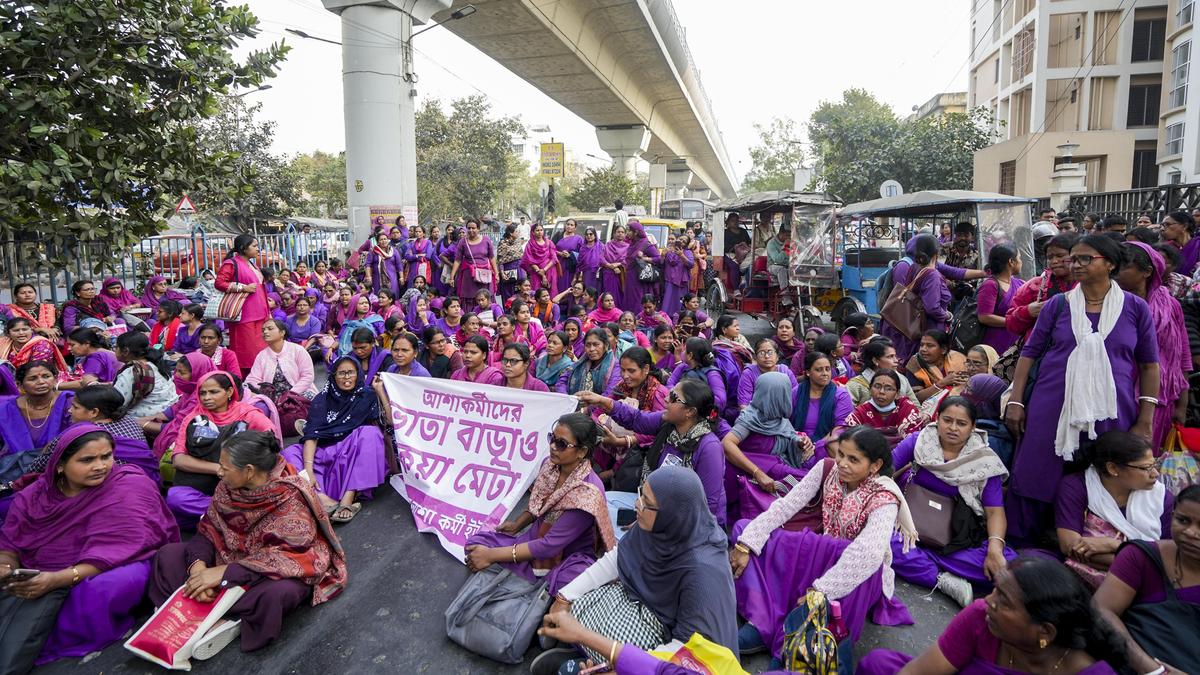
Fri Feb 06 09:39:33 UTC 2026: ### ASHA Workers Protest “Paltry” Honorarium Hike in Kolkata
The Story:
Hundreds of Accredited Social Health Activist (ASHA) volunteers in Kolkata staged a protest on Friday, February 6, 2026, expressing their dissatisfaction with a recent ₹1,000 hike in their monthly honorarium, announced in the West Bengal interim budget. The ASHA workers, who gathered outside the Swasthya Bhavan, the state’s health department headquarters, are demanding a minimum monthly remuneration of ₹15,000. This demonstration follows previous protests earlier in the month, highlighting the ongoing tension between the ASHA workers and the state government regarding fair compensation for their services.
Key Points:
- ASHA workers protested a ₹1,000 honorarium hike, demanding ₹15,000 per month.
- The protest took place outside Swasthya Bhavan in Salt Lake, Kolkata, on February 6, 2026.
- Protesters cite the current pay as a “paltry sum.”
- A 17-member delegation is scheduled to meet with the State’s health secretary.
- The West Bengal government claims the hike brings their honorarium to ₹6,250 per month, with additional benefits such as a ₹5 lakh death benefit and maternity leave.
- Previous protests occurred on January 8 and January 12, and included blocking key roads in Kolkata.
Critical Analysis:
The ASHA workers’ protests are happening in the context of other recent government actions:
- February 5, 2026: The TMC government hiked monthly aid for women, suggesting a focus on women’s welfare, but the ASHA workers clearly feel left out.
- February 4, 2026: The AIADMK in Tamil Nadu promised a hike in old-age pensions, indicating that other states are also addressing social welfare issues, possibly raising expectations in West Bengal.
This suggests the West Bengal government is attempting to address social welfare concerns, but the offered increase for ASHA workers is perceived as insufficient, especially when compared to other initiatives. The timing of the protest following the announcement indicates a direct reaction to perceived inadequacy.
Key Takeaways:
- The ASHA workers’ dissatisfaction underscores a significant gap between the government’s perception of fair compensation and the workers’ actual needs.
- The timing of the protest highlights the ASHA workers’ strategic use of public pressure to amplify their demands.
- The repeated protests indicate a breakdown in communication and negotiation between the ASHA workers and the state government.
- Social welfare initiatives, while positive overall, can create disparities and spark further demands if not implemented equitably.
Impact Analysis:
The continued protests by ASHA workers, if unresolved, could have significant long-term impacts:
- Decreased Morale and Effectiveness: Dissatisfaction among ASHA workers could lead to decreased motivation and effectiveness in their roles, impacting rural healthcare delivery.
- Political Fallout: The ongoing protests could damage the reputation of the Mamata Banerjee government, especially if they are perceived as being insensitive to the needs of frontline healthcare workers.
- Increased Unionization: The protests may encourage further unionization and collective action among ASHA workers and other public health employees.
- Policy Re-evaluation: The protests may force the West Bengal government to re-evaluate its compensation policies for ASHA workers and potentially other community health workers. The efficacy of performance-based allowances versus fixed monthly salaries will likely be debated.
 First Piper