
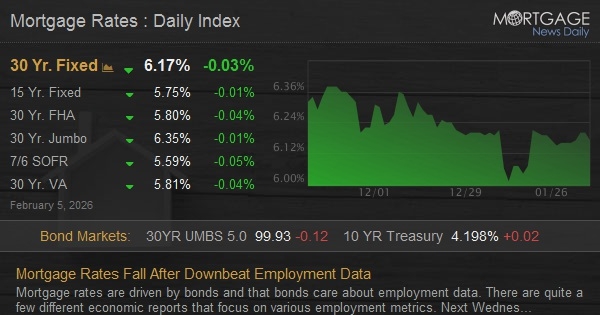
Fri Feb 06 12:10:00 UTC 2026: Headline: Job Market Data Drives Mortgage Rate Volatility, Briefly Pushing Rates Down
The Story:
Mortgage rates experienced a brief dip after the release of weaker-than-expected employment data. Several economic reports, including data on planned layoffs, weekly jobless claims, and job openings, all contributed to the shift. The most impactful was the Job Openings data for December, which showed the lowest levels since September 2020. The bond market reacted favorably to the news, leading lenders to briefly reduce rates, although the overall range remains narrow.
Key Points:
- Mortgage rates are sensitive to bond market fluctuations, which are in turn influenced by employment data.
- December’s Job Openings data showed the lowest levels since September 2020, significantly below forecasts.
- Planned layoffs at large firms were the third highest since 2020.
- Weekly jobless claims ticked up after several weeks of lower-than-average numbers.
- The bond market reacted positively to the data, leading to a brief decrease in mortgage rates.
- The fluctuation in mortgage rates was within a narrow range of 6.15-6.20%.
Key Takeaways:
- The job market remains a crucial driver of mortgage rate volatility.
- Weaker-than-expected employment data can lead to temporary decreases in mortgage rates.
- Even seemingly minor economic reports can influence market sentiment.
- The Federal Reserve’s rate cut expectations can be impacted by employment data, though this impact on mortgages is indirect.
- Mortgage rates remain range-bound despite intraday volatility.
 First Piper