
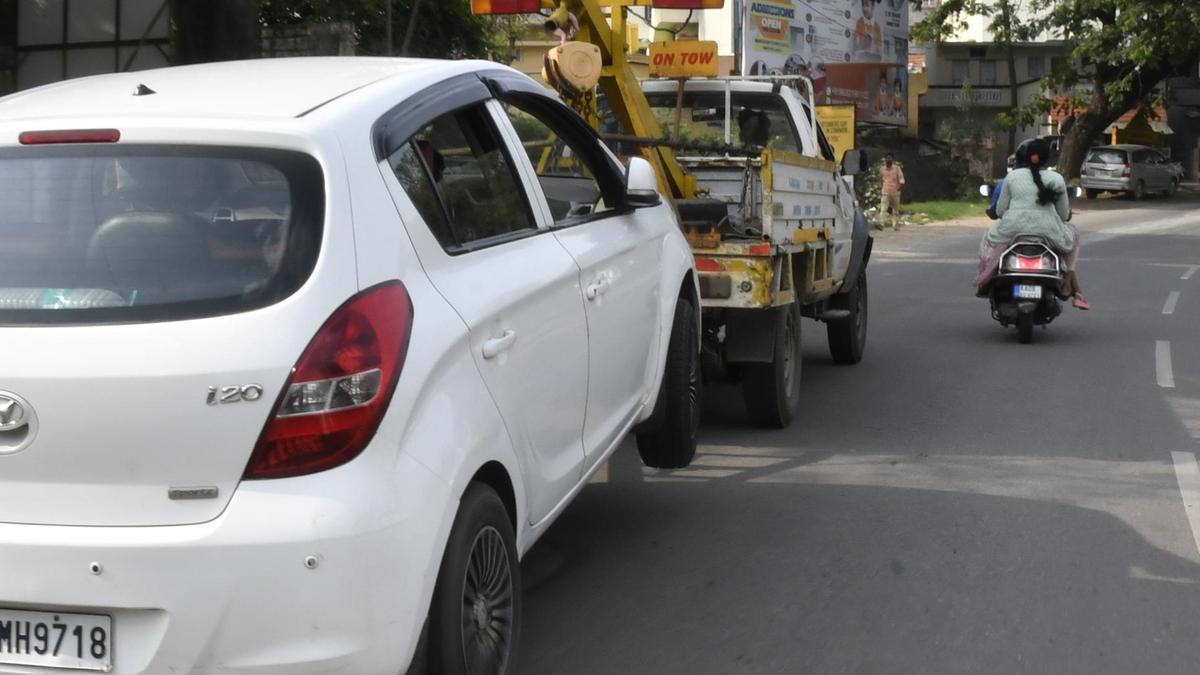
Fri Feb 06 05:29:24 UTC 2026: ### Bengaluru Traffic Police Face Parking Crisis Amid Towing Resumption
The Story:
The Bengaluru Traffic Police (BTP) are grappling with a significant logistical challenge: where to store towed vehicles. Despite receiving towing vehicles from corporations, the BTP lacks designated parking spaces, exacerbating the problem of already overcrowded police station premises. This issue has resurfaced after the BTP was instructed to clear vehicles dumped at Jakkarayanakere, a location that has drawn complaints from residents due to safety and environmental concerns. The current plan of storing seized vehicles at police stations threatens to further congest these facilities and potentially spill onto public footpaths, directly contravening court orders.
The BTP has appealed to the Bengaluru Urban district administration for land allocation, requesting three parcels of at least three acres each. However, the underlying issue remains the infrequent auctioning of unclaimed vehicles, leading to a constant accumulation. The situation is rapidly approaching a critical point, jeopardizing the BTP’s ability to enforce parking regulations effectively.
Key Points:
- Three out of four Bengaluru traffic divisions have received towing vehicles.
- The BTP lacks designated parking spaces for towed vehicles.
- Vehicles are currently being stored at police stations, causing overcrowding.
- The BTP has requested land from the Bengaluru Urban district administration.
- Infrequent auctioning of unclaimed vehicles contributes to the problem.
- The Jakkarayanakere facility, previously used for storage, was shut down due to resident complaints and a fire in 2025.
- A 2021 High Court observation mandates clear footpaths around police stations.
Critical Analysis:
The situation reflects a systemic failure in urban planning and law enforcement coordination. The rollout of towing vehicles without corresponding infrastructure is a clear oversight. The reluctance to auction seized vehicles, despite legal provisions, indicates bureaucratic inertia or potential administrative bottlenecks. The closure of the Jakkarayanakere facility highlights the importance of considering environmental and social impact when establishing such facilities. This is further compounded by the constant increase in vehicles coupled with already strained civic resources.
Key Takeaways:
- Lack of infrastructure planning is undermining law enforcement efforts in Bengaluru.
- Inefficient disposal processes for unclaimed vehicles are exacerbating the parking crisis.
- Community concerns and environmental factors play a crucial role in the sustainability of vehicle storage solutions.
- The Bengaluru civic bodies are planning off-street parking projects as mentioned in the context, suggesting the council is aware of the problem and looking into a solution.
- Without a multi-pronged approach involving land allocation, streamlined auction processes, and proactive urban planning, the traffic and parking situation in Bengaluru is set to worsen.
Impact Analysis:
The unresolved parking crisis has the potential to significantly impact Bengaluru’s liveability and traffic management. Continued obstruction of footpaths will endanger pedestrians and undermine accessibility for vulnerable populations. Overcrowded police stations will hinder operational efficiency and potentially compromise security. The failure to address these issues will further erode public trust in law enforcement and civic administration. Long-term, this could contribute to increased traffic congestion, reduced urban mobility, and a decline in the quality of life for Bengaluru residents. The need to identify and secure appropriate land parcels for vehicle storage is crucial to solving this problem and will likely remain a long term focus of the city council.
 First Piper