
Wed Feb 04 16:22:05 UTC 2026: # Tamil Nadu Farmers Protest, Demanding MSP Guarantee and Repeal of Key Legislation
The Story
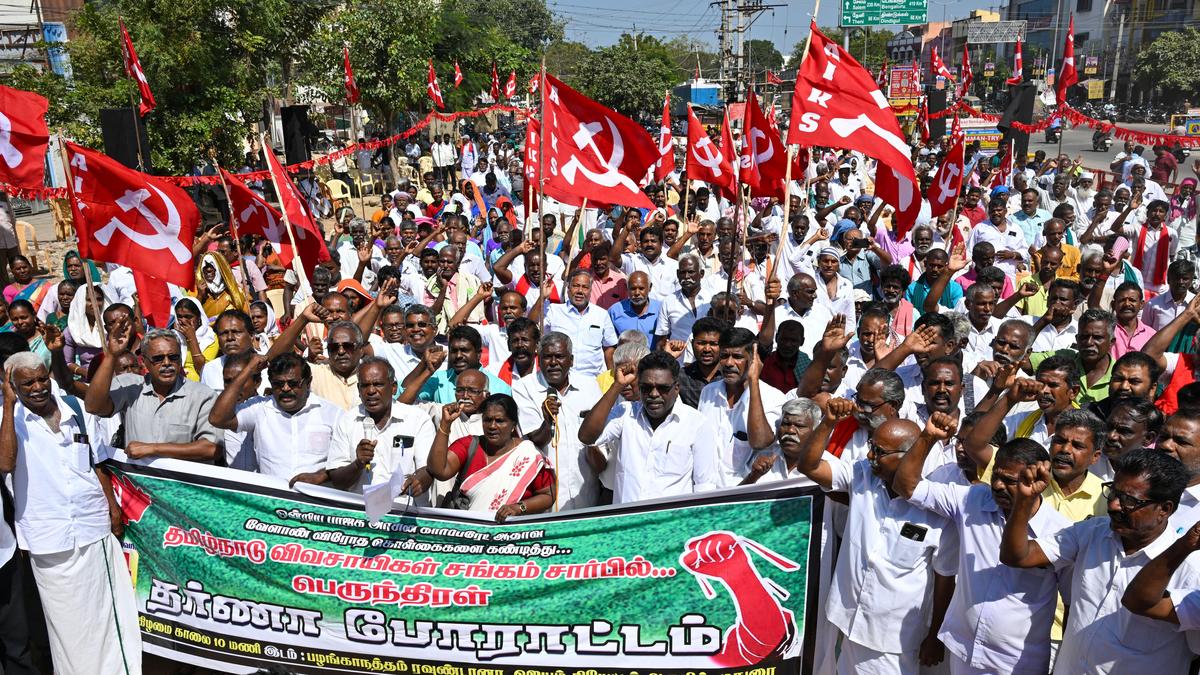
On Wednesday, February 4, 2026, members of the Tamil Nadu Farmers’ Association staged a significant dharna in Madurai, demanding a law guaranteeing Minimum Support Price (MSP) for their crops. The protest highlighted several grievances, including the perceived corporate capture of the agricultural sector and the erosion of farmer welfare programs. The farmers are calling for policy changes that prioritize their livelihoods and protect them from market fluctuations and corporate influence.
Key Points
- Farmers are demanding a central law guaranteeing Minimum Support Price (MSP) for crops.
- They are seeking crop prices fixed based on the Swaminathan Committee recommendation.
- Protesters call for the complete waiver of loans obtained from nationalized banks.
- They demand the withdrawal of the Electricity Amendment Bill 2025, citing threats to free electricity for farmers and subsidized power for small businesses.
- The farmers are urging the repeal of the Seed Act 2025, fearing corporate monopolization of seed production.
- They want the government to directly implement crop insurance schemes, cutting out corporate intermediaries.
- Protesters condemned the replacement of Mahatma Gandhi National Rural Employment Guarantee Act (MGNREGA).
- They object to the acquisition of agricultural land for industrial growth.
- The association seeks the resumption of operations at the National Cooperative Sugar Mill in Alanganallur.
Critical Analysis
The timing of the Tamil Nadu farmers’ protest, coinciding with similar demonstrations across the country (as evidenced by the “Farmers stage dharna protest demanding MSP for crops” entry in the related historical context), suggests a coordinated effort to pressure the Union government on agricultural policies. The reference to Karnataka Legislature demanding reinstatement of MGNREGA reinforces a nationwide discontent with the current state of rural employment and welfare programs. This suggests the farmers are leveraging a moment of perceived weakness to push for long-desired reforms. The reference to the Electricity Amendment Bill 2025, Seed Act 2025 as well as a new scheme meant to replace MGNREGA means the farmers are acting in response to multiple recently introduced legislative measures.
Key Takeaways
- Farmers across India are becoming increasingly vocal about their demands for MSP guarantees and protection from corporate influence.
- The Electricity Amendment Bill 2025 and Seed Act 2025 are significant points of contention between farmers and the government.
- The perceived erosion of welfare schemes like MGNREGA is fueling farmer discontent.
- There seems to be a growing distrust of corporate involvement in agriculture, with farmers advocating for direct government intervention.
- The Swaminathan Committee recommendations continue to be a rallying cry for farmer movements.
Impact Analysis
The coordinated nature of these protests, if sustained, could put significant pressure on the Union government to reconsider its agricultural policies. The outcome of these protests could reshape the landscape of Indian agriculture, impacting everything from pricing mechanisms to seed production and rural employment. A failure to address these concerns could lead to increased social unrest and political instability in rural areas. The push for MSP guarantees has long-term implications for the national economy, potentially affecting food prices and government subsidies.
 First Piper