
Sun Feb 01 07:43:34 UTC 2026: ### Sitharaman Presents Union Budget 2026-27, Focuses on Growth and Infrastructure
The Story:
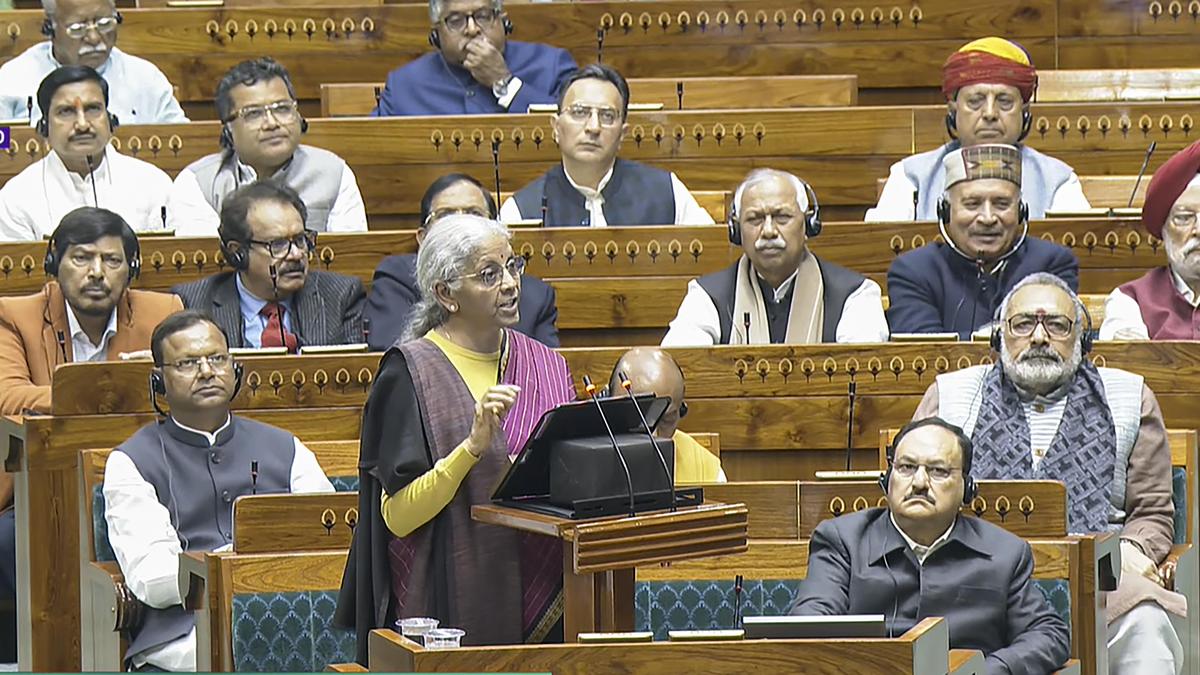
Finance Minister Nirmala Sitharaman presented the Union Budget 2026-27 in the Lok Sabha on February 1, 2026, marking her ninth consecutive budget presentation and the first ever presented on a Sunday in independent India. The budget retains the states’ share in the common pool of taxes at 41% for the 2026-31 period, as recommended by the 16th Finance Commission. The Economic Survey 2025-26, authored by Chief Economic Advisor V. Anantha Nageswaran, projects a medium-term growth outlook of 7%, up from the previous estimate of 6.5%.
Key Points:
- Nirmala Sitharaman presented the Union Budget 2026-27 on February 1, 2026.
- States’ share in the common pool of taxes remains at 41% for 2026-31.
- The Economic Survey 2025-26 projects a medium-term growth outlook of 7%.
- The Survey estimates 7.4% growth for the financial year 2025-26 and a growth rate range of 6.8-7.2% for 2026-27.
- The budget emphasizes tourism, infrastructure, MSMEs, and the small-scale sector.
- Congress criticized the budget as “lacklustre” and lacking transparency in program allocations.
- Government plans tax holiday for foreign firms using Indian data centers for Cloud Services.
- Three of seven high-speed rail corridors to connect Hyderabad.
- India set to host first ever Global Big Cat summit.
Key Takeaways:
- The Union Budget 2026-27 aims to build on the economic progress of the past decade, focusing on key sectors for growth.
- Maintaining the states’ share of taxes at 41% signals fiscal stability and cooperative federalism.
- The budget includes forward-looking initiatives like tax holidays for foreign cloud service providers using Indian data centers.
- There is political divide regarding the merit of the budget, with the ruling party praising it and the opposition criticizing it.
- Initiatives such as high-speed rail and hosting the Global Big Cat Summit show a focus on infrastructure development and global leadership respectively.
 First Piper