
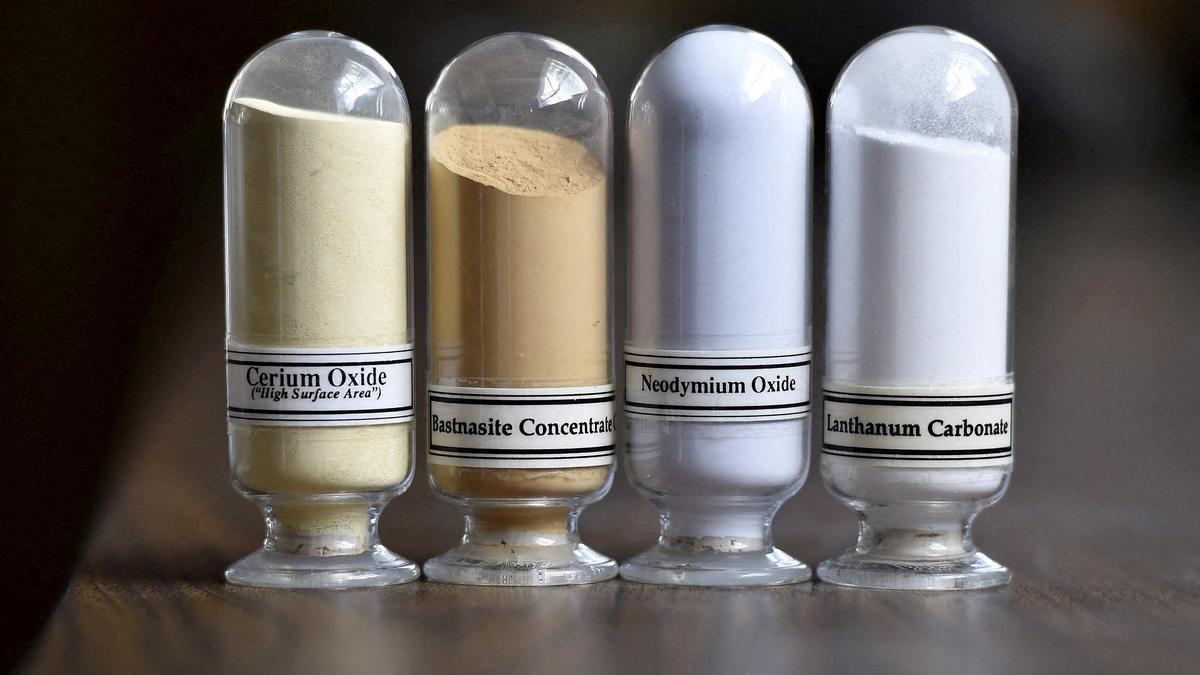
Sun Feb 01 06:25:58 UTC 2026: ### India Aims for Rare Earth Independence with New Corridors
The Story:
Union Finance Minister Nirmala Sitharaman, while presenting the Union Budget for April 2026 to March 2027 on February 1, 2026, proposed the establishment of dedicated rare-earth corridors in the mineral-rich states of Odisha, Kerala, Andhra Pradesh, and Tamil Nadu. This initiative is a strategic move to reduce India’s reliance on China for rare-earth minerals, crucial components in various high-tech industries. The announcement follows the approval of a ₹7,280 crore scheme in November 2025 to promote the manufacturing of Rare Earth Permanent Magnets (REPM) in India.
Key Points:
- Nirmala Sitharaman proposed rare earth corridors in Odisha, Kerala, Andhra Pradesh, and Tamil Nadu during the Union Budget 2026 presentation.
- The initiative aims to secure India’s supplies of rare earth magnets and reduce dependence on China.
- Two of the four states (Tamil Nadu and Kerala) are scheduled for Assembly elections in 2026.
- The corridors will promote mining, processing, research, and manufacturing of rare earth minerals.
- In November 2025, a ₹7,280 crore scheme to manufacture REPM in India was approved, targeting 6,000 metric tonnes per annum (MTPA) of integrated REPM manufacturing.
- The ₹7,280 crore outlay includes ₹6,450 crore in sales-linked incentives over five years and ₹750 crore in capital subsidies.
Critical Analysis:
The timing of this announcement, coinciding with upcoming Assembly elections in Tamil Nadu and Kerala, suggests a potential political dimension. However, the underlying strategic imperative of reducing reliance on China for critical minerals appears to be the primary driver. The previously launched REPM manufacturing scheme in November 2025 underscores a consistent and proactive government policy in this area.
Key Takeaways:
- India is actively pursuing strategies to become self-sufficient in rare earth minerals.
- The government is using financial incentives and infrastructure development to encourage domestic REPM manufacturing.
- The initiative is aligned with a broader geopolitical strategy to diversify supply chains and reduce dependence on China.
- The focus on mineral-rich states indicates a resource-driven economic development approach.
- The timing suggests possible coordination of the economic and political agenda in the country.
Impact Analysis:
The establishment of rare earth corridors has the potential to significantly impact India’s manufacturing sector and its position in the global technology supply chain. Success in this endeavor could lead to:
- Reduced Dependence on China: Decreased vulnerability to supply disruptions and price fluctuations in the rare earth market.
- Boost to Domestic Manufacturing: Increased investment and job creation in the mining, processing, and manufacturing sectors.
- Enhanced Technological Competitiveness: Improved access to critical materials for industries like electronics, renewable energy, and defense.
- Regional Economic Development: Economic growth and development in the selected mineral-rich states.
 First Piper