
Fri Jan 30 06:51:05 UTC 2026: ### EU and India Forge Strategic Alliance Amid Global Uncertainty
The Story:
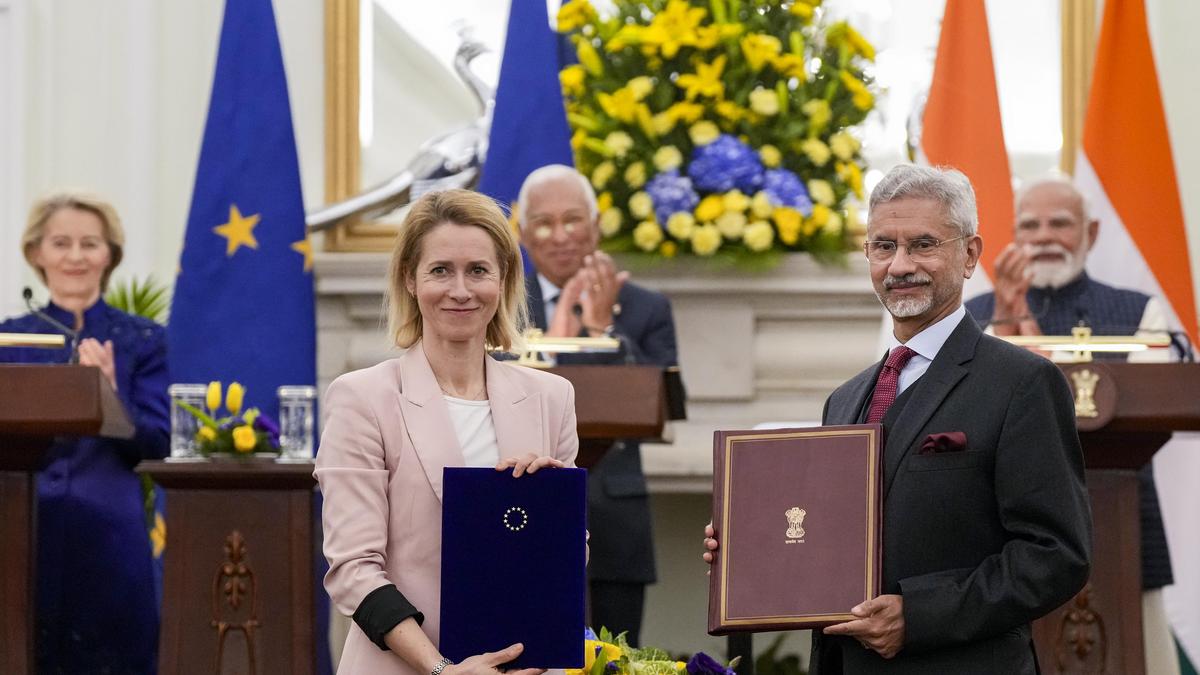
On January 27, 2026, the European Union and India announced a Free Trade Agreement (FTA) and a Strategic and Defence Partnership (SDP) during the EU-India Summit in New Delhi. EU High Representative for Foreign Affairs, Kaja Kallas, emphasized the need for a “predictable” partnership between Europe and India, contrasting it with the perceived unpredictability of the U.S., Russia, and China. Kallas urged India to pressure Russia to end the war in Ukraine and highlighted the need for collaboration on the Indo-Pacific region to counter China’s “economic coercion.”
Key Points:
- The EU-India Summit took place on January 27, 2026, featuring Prime Minister Narendra Modi, European Commission President Ursula von der Leyen, and European Council President Antonio Costa.
- The EU and India announced a Free Trade Agreement (FTA) and a Strategic and Defence Partnership (SDP).
- Kaja Kallas criticized the U.S.’s “tariff threats,” China’s “economic coercion,” and the “existential threat” from Russia as common challenges.
- The EU has asked India to “put pressure” on Russia to end the war in Ukraine.
- Kallas called for cooperation on defense hardware, maritime exercises, cybersecurity, and hybrid threats.
Critical Analysis:
The EU is actively courting India as a stable and reliable partner, explicitly contrasting its approach with the policies of the U.S. under a (potentially future or current) administration mirroring Donald Trump‘s protectionist trade policies. Given Kallas’ past criticism of India’s engagement with Russia, this signals a significant shift towards prioritizing strategic alignment with India to counter broader geopolitical challenges posed by Russia and China.
Key Takeaways:
- The EU views India as a crucial partner in maintaining a multilateral world order.
- The Russia-Ukraine war continues to be a major point of contention and a catalyst for geopolitical realignments.
- The EU is actively seeking to diversify its defense partnerships amidst perceived threats from Russia.
- China’s economic influence and practices are a shared concern for both the EU and India.
- The “predictability” of the EU is presented as a key asset in building partnerships.
Impact Analysis:
The FTA and SDP between the EU and India have the potential to reshape global trade and security dynamics. The partnership could bolster both economies against external pressures, particularly from China. Furthermore, increased cooperation on defense could have long-term implications for regional stability, particularly in the Indo-Pacific, and potentially influence the trajectory of the Russia-Ukraine conflict if India exerts diplomatic pressure on Russia. The success of this partnership will depend on the ability of both sides to navigate their differing perspectives on Russia and to effectively counter China’s economic influence.
 First Piper