
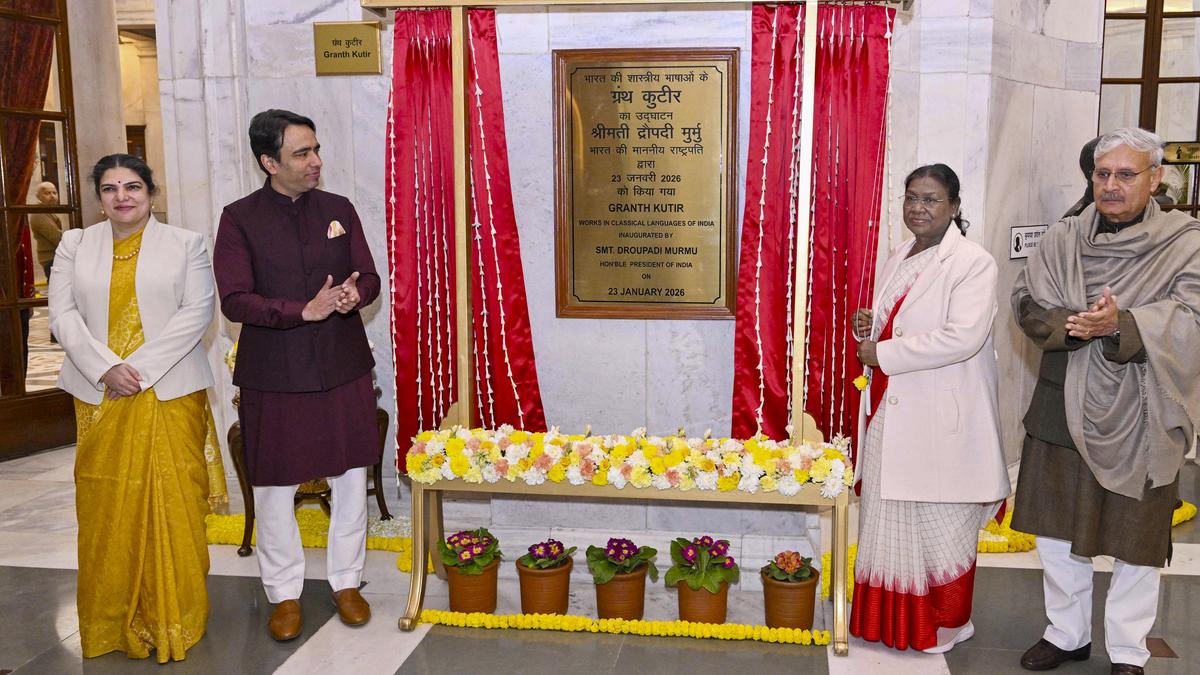
Mon Jan 26 05:00:00 UTC 2026: ### Headline: President Murmu Inaugurates ‘Granth Kutir’, Showcasing India’s Literary Heritage
The Story:
On Friday, January 23, 2026, President Droupadi Murmu inaugurated ‘Granth Kutir’ (book house) at Rashtrapati Bhavan in New Delhi. The Granth Kutir houses a collection of approximately 2,300 books and 50 manuscripts in 11 classical Indian languages, including Tamil, Sanskrit, Kannada, Malayalam, Odia, Marathi, Pali, Prakrit, Assamese, and Bengali. The initiative aims to enhance awareness of India’s rich cultural, philosophical, literary, and intellectual heritage.
Key Points:
- ‘Granth Kutir’ was inaugurated by President Droupadi Murmu on January 23, 2026.
- The collection includes approximately 2,300 books in 11 classical Indian languages.
- The collection also contains around 50 manuscripts, many handwritten on traditional materials.
- Subjects covered include epics, philosophy, linguistics, history, governance, science, devotional literature, and the Constitution of India.
- The development of Granth Kutir involved collaboration with the Union government, State governments, universities, research institutions, cultural organizations, and individual donors.
- The Ministry of Education and Ministry of Culture supported the initiative, with the Indira Gandhi National Centre for the Arts (IGNCA) providing expertise in manuscript management and conservation.
Key Takeaways:
- The inauguration of ‘Granth Kutir’ highlights the Indian government’s commitment to preserving and promoting India’s classical languages and literary heritage.
- The collaborative effort involved in establishing the Granth Kutir demonstrates a nationwide interest in supporting and showcasing Indian culture.
- The inclusion of diverse subjects within the collection suggests a comprehensive approach to representing India’s intellectual contributions across various fields.
- This initiative may lead to increased public engagement with and appreciation for India’s classical literature and cultural history.
Impact Analysis:
The ‘Granth Kutir’ initiative is likely to have a long-term impact on the preservation and promotion of Indian culture. By providing a centralized location for accessing and studying these classical texts, the government is investing in the future of India’s intellectual heritage. The involvement of educational institutions and cultural organizations ensures the sustainability and accessibility of the collection for future generations of scholars and citizens. The impact of this initiative can be seen as increased cultural awareness, enhanced research opportunities, and a stronger sense of national identity rooted in its rich literary past. The focus on digitization and conservation will guarantee the preservation of these invaluable resources for posterity.
 First Piper