
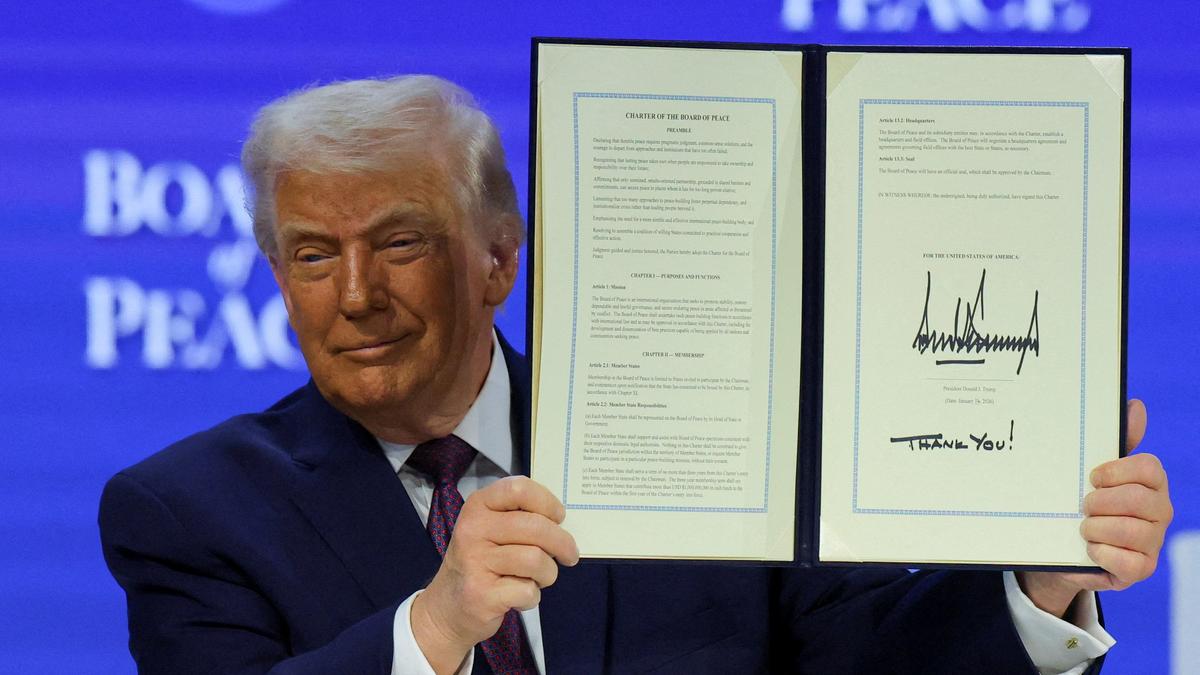
Sat Jan 24 19:54:00 UTC 2026: ### Headline: Trump Launches “Board of Peace” in Davos Amidst International Skepticism
The Story:
On January 22, 2026, former U.S. President Donald Trump formally launched the “Board of Peace” at a ceremony in Davos, Switzerland, coinciding with the World Economic Forum. The initiative, endorsed by the UN Security Council in November 2025, is ostensibly aimed at resolving global conflicts, with an initial focus on rebuilding war-torn Gaza. However, the charter’s lack of specific mention of a Palestinian state, combined with Trump’s past criticisms of the UN and his intention to potentially expand the Board’s mandate beyond Gaza, has drawn significant international concern and skepticism. Key nations like France, Sweden, Norway, and Slovenia have declined invitations to join.
Key Points:
- The Board of Peace was proposed by Donald Trump and endorsed by the UN Security Council in November 2025.
- The initial focus is on the “demilitarization, technocratic governance, and reconstruction” of Gaza.
- The charter does not expressly mention Gaza and allows for a potential expansion of its mandate.
- Donald Trump will be the inaugural chairman, with members including Tony Blair, Marco Rubio, Jared Kushner, and Ajay Banga.
- Countries donating $1 billion within the first year can become permanent members.
- Several nations, including France, Sweden, and Norway, have declined invitations, citing concerns about overshadowing the UN.
- The charter makes no reference to a path to a Palestinian state.
- The plan includes a “New Gaza” with coastal tourism, industrial zones, and high-rise buildings.
Critical Analysis:
The timing of the announcement is notable, occurring alongside other board-related news, such as a “Big Resignation In Bangladesh Cricket Board Amid ICC’s T20 World Cup Verdict” and a report on a “Legislation filed to dissolve Board of Visitors at VMI, transfer authority to Virginia State University”. While these events appear unrelated, they highlight a broader trend of scrutiny and change affecting various boards and administrative bodies globally. Trump’s initiative, in this context, appears to be an attempt to establish a new, potentially more autonomous power structure for international diplomacy, rather than a traditional multilateral approach.
Key Takeaways:
- The Board of Peace reflects Donald Trump’s continued desire to reshape international relations, possibly outside of existing UN frameworks.
- The lack of specific commitments to a Palestinian state raises concerns about the initiative’s true objectives and potential bias.
- The mixed international reaction suggests a divided global community regarding Trump’s leadership and vision for global peace.
- The financial incentives for permanent membership may lead to concerns about the board’s accountability and potential influence peddling.
- The focus on redevelopment plans for Gaza, led by figures like Jared Kushner, indicates a significant economic dimension to the peace initiative.
Impact Analysis:
The Board of Peace has the potential for significant long-term impact, regardless of its ultimate success. If it gains traction and effectively addresses conflicts, it could establish a new model for international diplomacy, potentially diminishing the role of the UN. Conversely, if it fails to gain broad support or is perceived as biased, it could further polarize international relations and undermine existing diplomatic institutions. The success of the initiative hinges on its ability to secure widespread international buy-in, particularly from nations traditionally involved in peace-building efforts. Furthermore, its impact on the ground in Gaza will be a critical factor in determining its legitimacy and long-term viability.
 First Piper