
Tue Jan 20 00:00:00 UTC 2026: ### Graviton Hunt Begins: Skepticism and Excitement Surround New Experiment
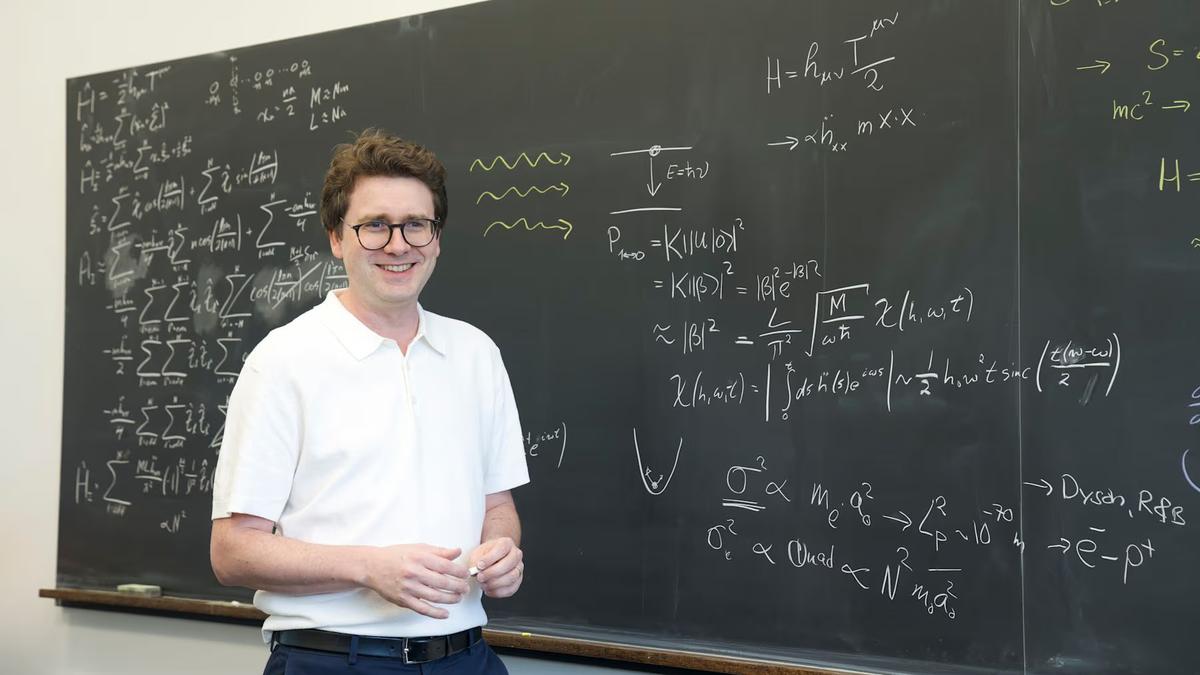
The Story: A team of scientists at the Stevens Institute of Technology and Yale University is embarking on an ambitious project to detect individual gravitons, the hypothetical particles that mediate gravity. Backed by a $1.3 million grant from the W.M. Keck Foundation, the experiment aims to use an ultra-sensitive superfluid helium resonator, cooled to near absolute zero, to detect the minute vibrations caused by a single graviton interacting with the fluid. While the announcement has been met with skepticism from some physicists, who argue that any detected signal could be explained through classical gravity, the team is optimistic about creating a blueprint for future graviton detectors within the next three years.
Key Points:
- The project aims to detect gravitons using a cylindrical resonator made of superfluid helium cooled to its quantum ground state.
- A strong gravitational wave could transfer a single graviton into the cylinder, creating a detectable mechanical vibration.
- Igor Pikovski, assistant professor at Stevens Institute, acknowledges the experiment is unlikely to detect single gravitons initially but will serve as a blueprint.
- Physicists believe finding the graviton would bridge the gap between general relativity and quantum mechanics, leading to a “theory of everything.”
- Daniel Carney, a theoretical physicist at Berkeley National Lab, argues that any signal detected could be explained by classical gravity, rendering the experiment inconclusive regarding the existence of gravitons.
Key Takeaways:
- The experiment represents a significant attempt to directly detect gravitons, a challenge considered by some to be physically impossible.
- The debate surrounding the experiment highlights the fundamental challenge of reconciling general relativity and quantum mechanics.
- Even if successful in detecting a signal, differentiating between a graviton interaction and a classical gravitational wave effect remains a major hurdle.
- The experiment could pave the way for future research, regardless of its immediate success, by refining detection techniques and theoretical understanding.
 First Piper