
Mon Jan 19 06:41:23 UTC 2026: ### Groundbreaking Discovery: Solid-Liquid Hybrid Nanoparticles Could Revolutionize Catalysis
The Story:
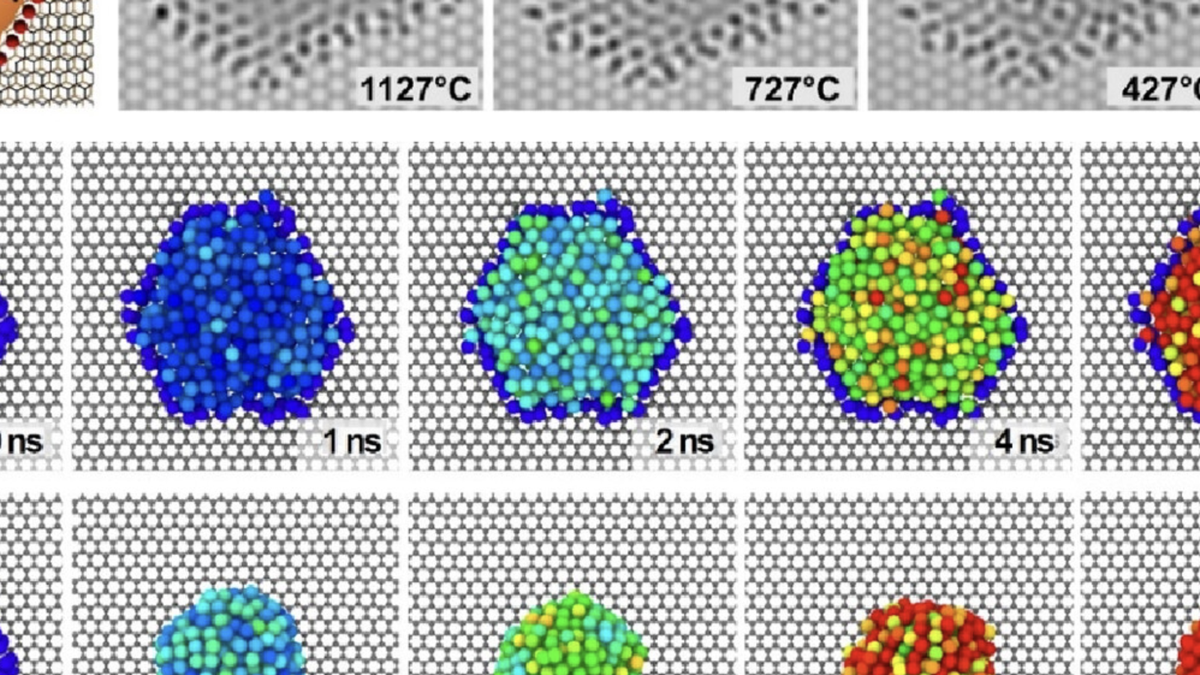
Scientists from Ulm University in Germany and the University of Nottingham in the UK have announced the discovery of a new state of matter, a solid-liquid hybrid nanoparticle, as reported in the journal ACS Nano. This groundbreaking material exhibits properties of both solids and liquids simultaneously, leading to unique behaviors not seen in either pure state. The discovery has potential implications for catalysis, particularly in applications like fuel cells and the production of pharmaceuticals and petrochemicals.
Key Points:
* The new material is a nanoparticle with different parts existing in solid and liquid states concurrently.
* Researchers used high-resolution transmission electron (HRTE) microscopy to observe nanoparticles of platinum, palladium, and gold on graphene.
* Stationary metal atoms confined to gaps in graphene act as a “corral” for the liquid core of the nanoparticle.
* The nanoparticles remain liquid at temperatures significantly lower (200-300º C) than normal crystallization points.
* When frozen, the supercooled liquid forms a disordered solid, structurally distinct from its natural crystal form.
* The discovery could improve the effectiveness and longevity of catalysts, preventing clumping and maintaining active states.
Key Takeaways:
* The distinction between solid and liquid phases at the nanoscale is more nuanced than previously understood.
* The “corralling effect” allows nanoparticles to remain liquid at lower temperatures and form disordered solids upon freezing.
* This discovery has potential applications in improving the design and performance of heterogeneous catalysts, particularly in fuel cells and chemical production.
Impact Analysis:
This discovery has the potential to significantly impact the field of catalysis. Current catalysts, particularly those used in proton exchange membrane fuel cells and direct methanol fuel cells, often suffer from clumping and poisoning over time, reducing their effectiveness. By utilizing the “corralling effect” of stationary atoms on graphene, future catalysts could be designed to prevent clumping and maintain active liquid or amorphous states. This could lead to more efficient and durable catalysts, with significant implications for hydrogen electric vehicles, stationary power generators, pharmaceutical production, and the breakdown of organic pollutants. The long-term effects could include cleaner energy technologies and more sustainable chemical processes.
 First Piper