
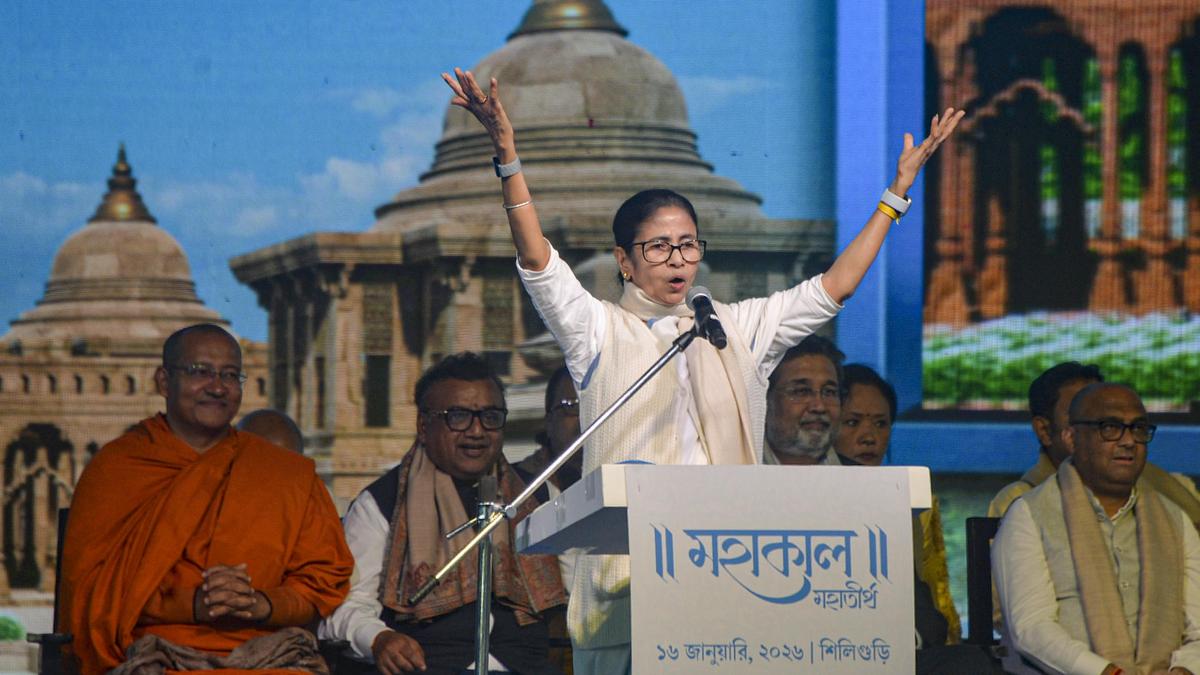
Fri Jan 16 22:10:00 UTC 2026: # Banerjee Announces Mahakal Temple in Siliguri, Sparks Political Controversy
The Story:
West Bengal Chief Minister Mamata Banerjee laid the foundation stone for the Mahakal Mahatirtha Temple in Siliguri on January 16, 2026. This marks the third temple project initiated by her government, following the Jagannath Temple in Digha (April 2025) and Durga Angan at Rajarhat (December 2025). Banerjee envisions the new temple as a major international tourism destination.
The temple, to be built on 17.41 acres of land, is expected to take 2 to 2.5 years to complete. A key feature will be a 108-foot tall bronze Mahakal idol, placed on a 108-foot high foundation. Opposition Leader Suvendu Adhikari criticized the move, accusing Banerjee of attempting to woo Hindu voters.
Key Points:
- Mamata Banerjee laid the foundation stone for the Mahakal Mahatirtha Temple in Siliguri on January 16, 2026.
- The temple will be built on 17.41 acres and is expected to take 2 to 2.5 years to complete.
- The temple will feature a 108-foot tall Mahakal idol.
- Banerjee aims to develop Siliguri as a global tourism hub.
- Suvendu Adhikari accused Banerjee of attempting to win over Hindu voters.
Critical Analysis:
The rapid succession of temple announcements by Mamata Banerjee‘s government, culminating in the Mahakal Mahatirtha Temple, suggests a strategic shift toward appealing to Hindu voters. This is further highlighted by Suvendu Adhikari‘s direct accusation. Coupled with the other news items from the same day, specifically the defamation suit filed by Suvendu Adhikari against Mamata Banerjee and the claims by Mamata regarding the treatment of Bengali speakers in BJP-ruled states, points to a tense and highly polarized political environment in West Bengal, where identity and religious politics are playing a crucial role.
Key Takeaways:
- Banerjee’s government is actively investing in religious infrastructure.
- The construction of the Mahakal Mahatirtha Temple is framed as a tourism initiative, but also carries political undertones.
- The opposition views these projects as an attempt to consolidate Hindu votes.
- The political climate in West Bengal is highly charged, with accusations of anti-Hindu sentiment being levied against the Chief Minister.
- Identity politics, specifically religion and language, are significant factors in West Bengal’s political landscape.
Impact Analysis:
The construction of the Mahakal Mahatirtha Temple and similar projects could have several long-term impacts:
- Shift in voter alignment: If successful, Banerjee‘s strategy could lead to increased support from Hindu voters, potentially altering the state’s political dynamics.
- Economic boost for Siliguri: The development of Siliguri as a tourism hub could bring significant economic benefits to the region, creating employment opportunities and stimulating local businesses.
- Increased communal polarization: The politicization of religious projects could exacerbate existing tensions between different religious communities, leading to further polarization.
- Re-election implications: These initiatives will undoubtedly be a key feature in the next election cycle. Success for these large projects can cement the Chief Minister’s position, any failure will severely damage her chances.
- Nationwide Implications: Regardless of outcome, these events show a continued trend towards the use of religion for political power in India, a dangerous trend that can have long term ramifications.
 First Piper