
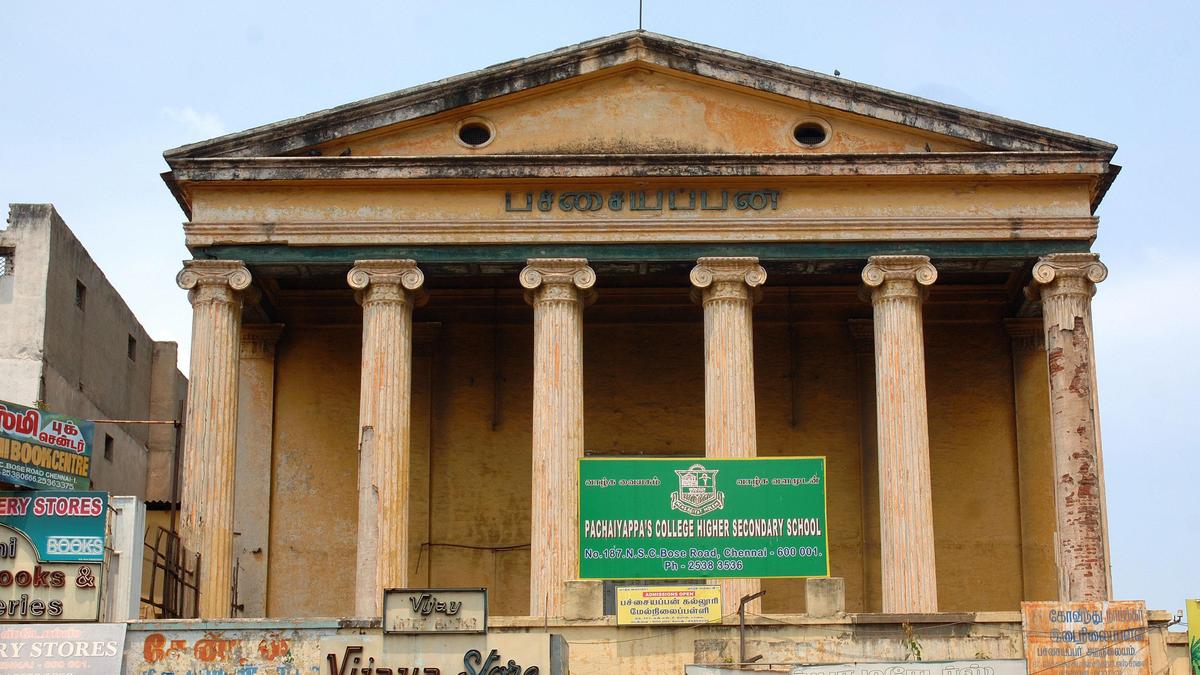
Wed Jan 14 01:30:00 UTC 2026: ### Chennai’s Historic Pachaiyappa’s Hall Faces Uncertain Future Amidst Legal Battles
The Story:
A recent article in The Hindu, published on January 14, 2026, highlights the deteriorating condition of Pachaiyappa’s Hall in Chennai and calls for its restoration. The article emphasizes the historical significance of the building, which dates back to 1850, and its role as a major public venue in the city’s past. Despite the restoration of other historical buildings in Chennai, Pachaiyappa’s Hall remains neglected due to ongoing legal disputes involving the trust that owns it. The author urges the State government to intervene and provide financial support to the trust to facilitate the restoration of this landmark.
Key Points:
- Pachaiyappa’s Hall was completed on March 20, 1850, and opened by Governor Sir Henry Pottinger.
- The Hall was the first project of the Pachaiyappa’s Trust, formed in 1832 to administer the estate of Pachaiyappa Mudaliar.
- The building was designed by Captain Ludlow, a junior military engineer, and is based on the temple of Theseus in Athens.
- Pachaiyappa’s Hall hosted Madras’ protest against income tax in 1860.
- The building now suffers from fallen plaster, deteriorated windows, and a generally dingy interior.
- The author calls for State government intervention, suggesting funds be used to restore the building, and proposes that the hall be let out for events to generate income for its maintenance.
Key Takeaways:
- Chennai’s historical landmarks are at risk due to neglect and legal battles.
- Government intervention may be necessary to preserve privately-owned historical buildings of public importance.
- Restoration can be coupled with strategies for sustainable maintenance through venue rentals.
Impact Analysis:
The potential restoration of Pachaiyappa’s Hall would have a significant positive impact on Chennai. Preservation of cultural heritage enhances the city’s identity and attractiveness to tourists. Furthermore, restoring the hall and making it available for events could stimulate the local economy and provide a valuable public space. Failure to restore it, however, risks the loss of an important piece of Chennai’s history and a potentially valuable community asset. The success of this potential project could set a precedent for the restoration and preservation of other privately-owned historical sites in India.
 First Piper