
Fri Jan 09 08:58:49 UTC 2026: ### India and EU Aim to Finalize Free Trade Agreement Amidst Ongoing Negotiations
The Story:
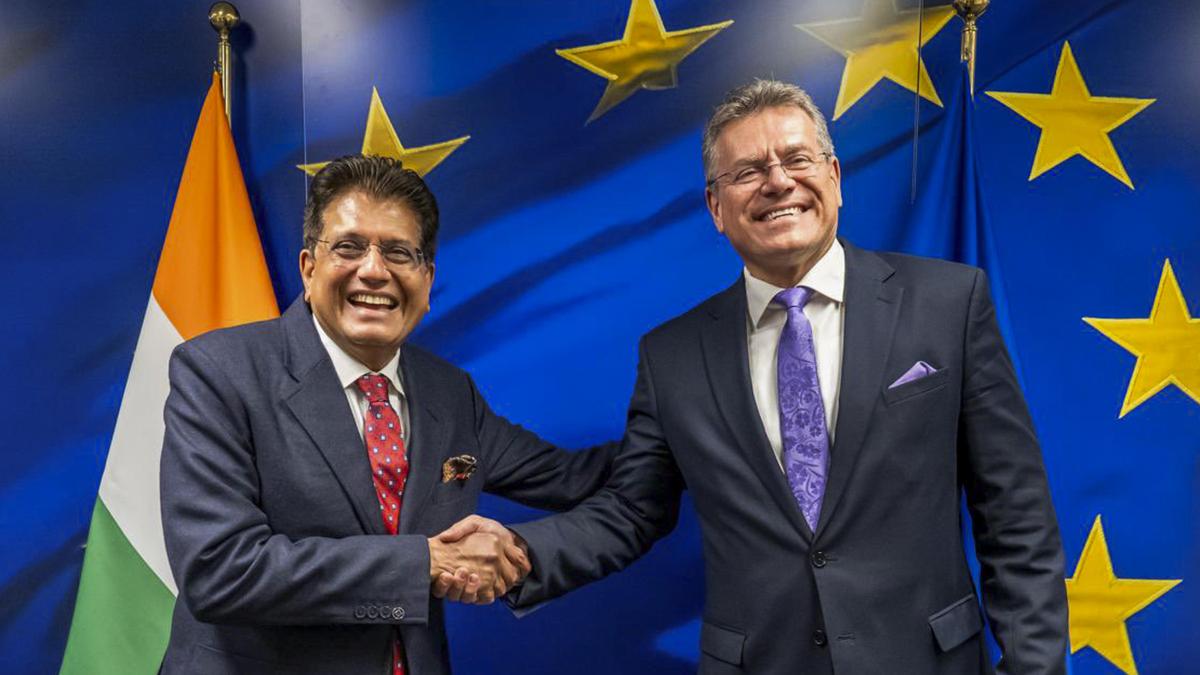
India and the European Union (EU) held high-level talks in Brussels on January 9, 2026, focusing on the proposed Free Trade Agreement (FTA). Union Minister of Commerce and Industry Piyush Goyal met with EU Trade and Economic Security Commissioner Maros Sefcovic to discuss the agreement, reaffirming their commitment to a rules-based trading framework and a modern economic partnership that safeguards the interests of farmers and MSMEs. The talks, building upon earlier discussions between India’s Commerce Secretary Rajesh Agrawal and Director General for Trade of the European Commission Sabine Weyand, are aimed at concluding negotiations as quickly as possible.
Despite the progress, negotiations have entered a difficult stage, with both sides working to bridge remaining differences. The India-EU Summit is expected on January 27, with EU leadership attending India’s Republic Day parade on January 26.
Key Points:
- Talks held in Brussels on January 9, 2026, between Piyush Goyal and Maros Sefcovic regarding the proposed FTA.
- Both sides reaffirmed commitment to a rules-based trading framework and a modern economic partnership.
- Negotiations resumed in June 2022 after being stalled in 2013.
- India is seeking zero-duty access for labor-intensive sectors, while the EU wants duty cuts on automobiles, medical devices, wine, spirits, meat, poultry, and stronger intellectual property protection.
- India-EU bilateral trade in goods reached $136.53 billion in 2024-25.
- The India-EU trade pact negotiations cover 23 policy areas.
Key Takeaways:
- India and the EU are actively working to finalize the FTA, recognizing the mutual benefits of enhanced trade relations.
- Significant hurdles remain, particularly concerning market access for specific sectors and intellectual property rights.
- The upcoming India-EU Summit and EU leadership’s presence at the Republic Day parade underscore the political importance of this partnership.
- India’s strategic focus on integrating industries into global supply chains is a key driver of the FTA negotiations.
- The FTA’s success could significantly boost India’s exports to the EU, especially for ready-made garments, pharmaceuticals, and other key sectors.
Impact Analysis:
The successful conclusion of the India-EU FTA would have far-reaching economic implications. It would likely lead to increased trade and investment flows between the two regions, benefiting businesses, consumers, and workers. India’s labor-intensive sectors could gain a significant competitive advantage, while EU industries would gain greater access to the growing Indian market. The agreement would also strengthen the strategic partnership between India and the EU, promoting cooperation on various global issues. Failure to reach an agreement, however, would represent a missed opportunity and could hinder future trade and economic cooperation between the two entities.
 First Piper